
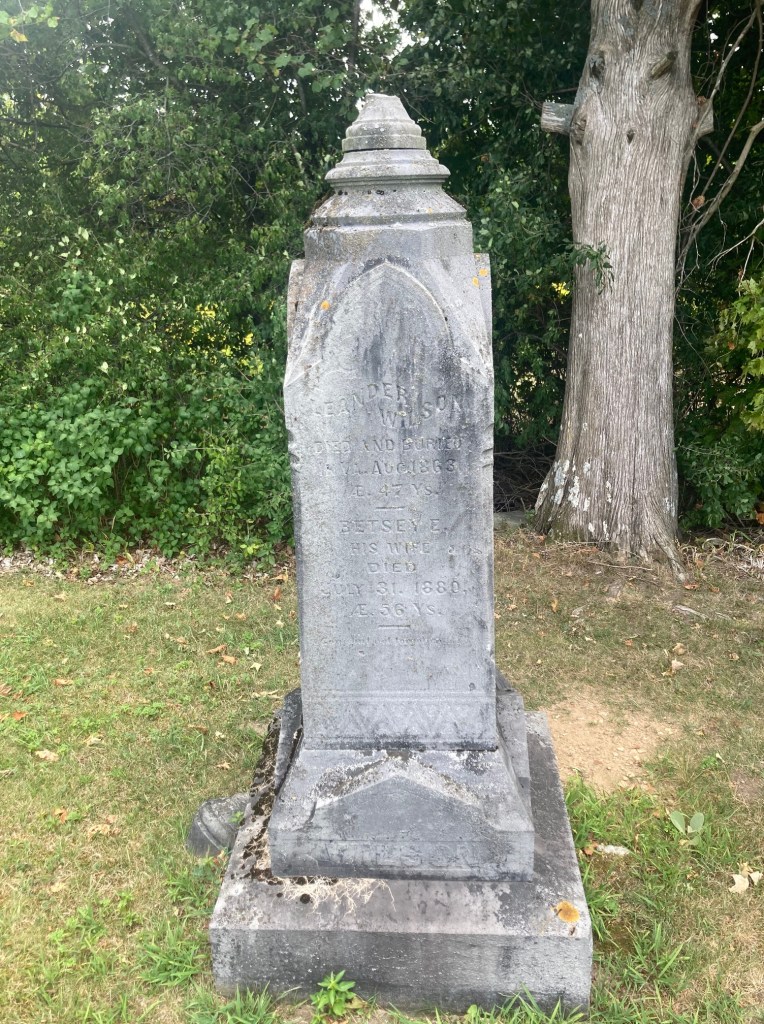
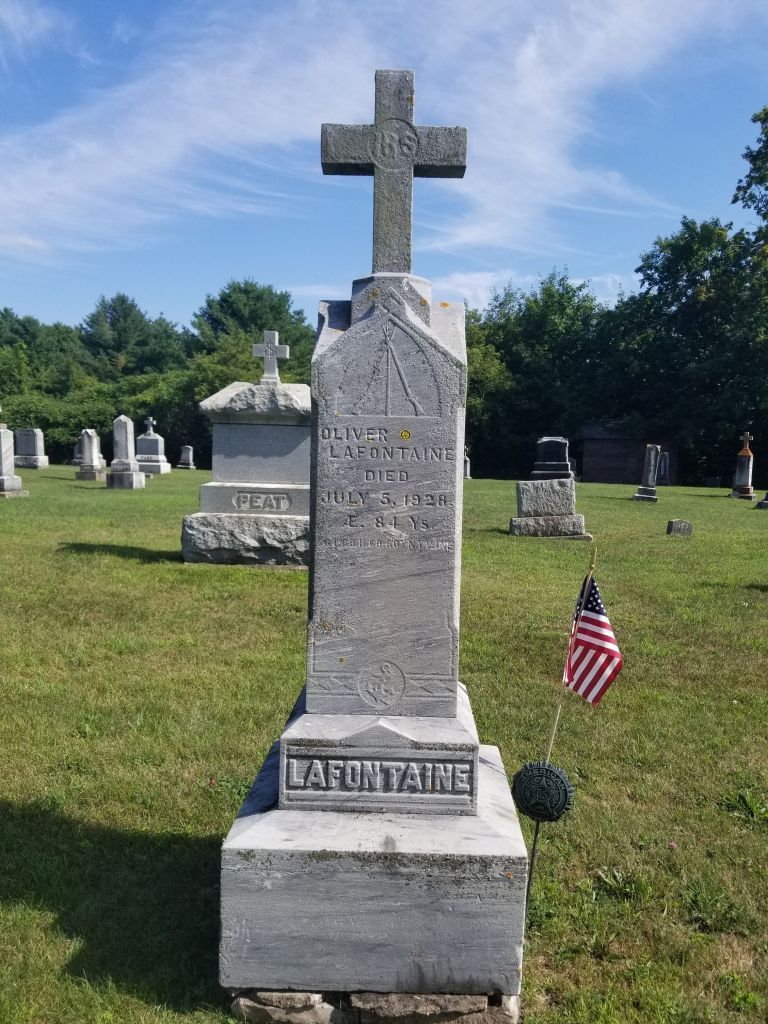
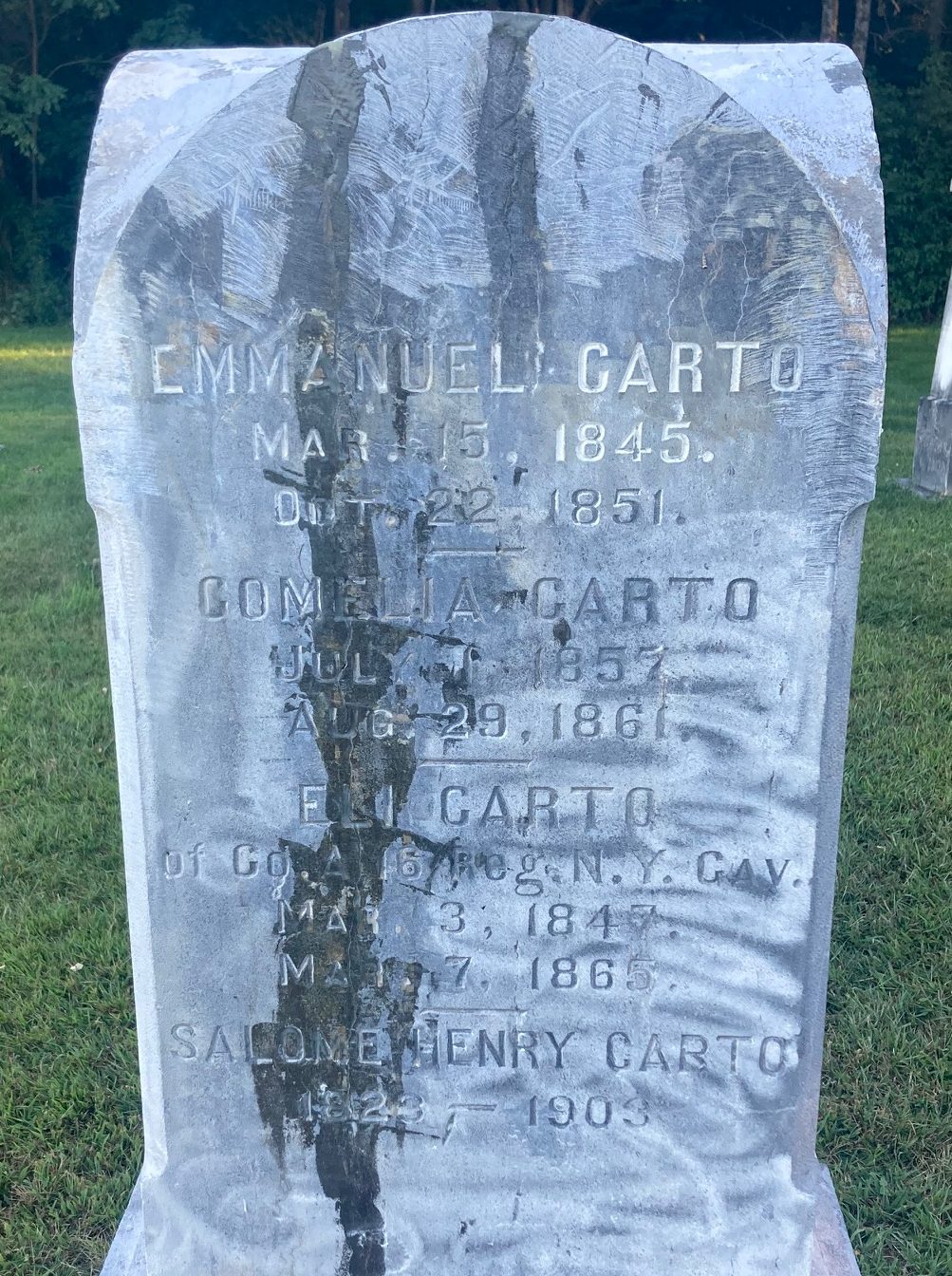
The Wilson grave in Waters Cemetery
Source: author’s personal collection
A large gravestone rises above the southeast corner of Waters Cemetery, tall enough to command attention even from nearby Ridge Road. Time has not been kind to it. The monument’s urn—once crowning the top of the stone—has long since fallen and now rests broken beside the base, its fragments half-settled into the grass. The damage is not recent. Seasons have passed over the fallen stone unnoticed, suggesting that few visitors now come to tend the place.
The monument marks the outline of the Wilson family: Betsey, her husband Leander, and four sons—Alonzo, George, Johnny, and Oscar.1 Gathered together on a single stone, they appear as a unified family memorial. Yet their lives were separated by decades of upheaval in the mid-nineteenth century. The inscriptions themselves offer clues. Weathered and in places imprecise, they suggest that the monument was raised long after the events it commemorates—likely by one of the surviving children who returned to gather the family’s losses into a single memorial.
The story behind the monument began several miles away and decades earlier. Betsey Copp was born in 1824 in the town of Chazy along the western shore of Lake Champlain. She was the daughter of Polly Bugbee and John Copps, a young couple raising their family on the edge of an agricultural world still being carved from the forests along the Adirondack borderlands. While her father was a newcomer from New Hampshire, her mother’s family were among the earliest settlers of northern New York; Polly herself had been born in the region in 1800. Betsey was the eldest child of the Copps family and already had three younger sisters and a brother by the time she was fourteen. That year—an age that feels startlingly young to modern readers but was not uncommon in rural New York in the 1830s—she married Leander Wilson, a Vermont-born farmer, in 1838. The marriage began a life that would be shaped, more than anything else, by the land.
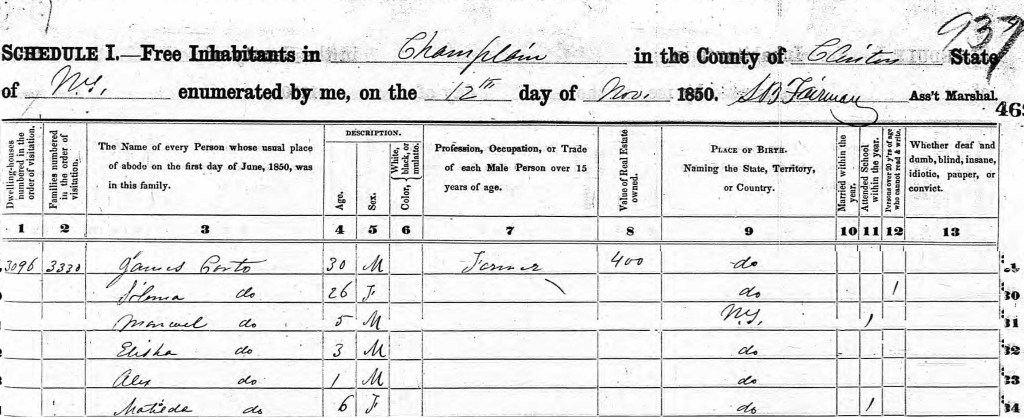
By 1840, Betsey and Leander had settled in the town of Champlain with their infant son Alonzo, where they would spend most of the next three decades farming a small property along Ridge Road. For Betsey, the decade that followed was defined as much by childbirth as by farm work. Between 1840 and 1849 she gave birth to six more children—Mariah in 1840, Martha Jane in 1841, Louisa in 1843, George in 1844, Oscar in 1845, and Wilbur in 1849. In the span of a single decade she moved repeatedly between pregnancy, childbirth, and the daily labor of caring for a growing household. By the end of the 1840s the Wilson home contained nine people, ranging from eleven-year-old Alonzo to infant Wilbur, along with Leander’s sixty-eight-year-old mother Rachel.2
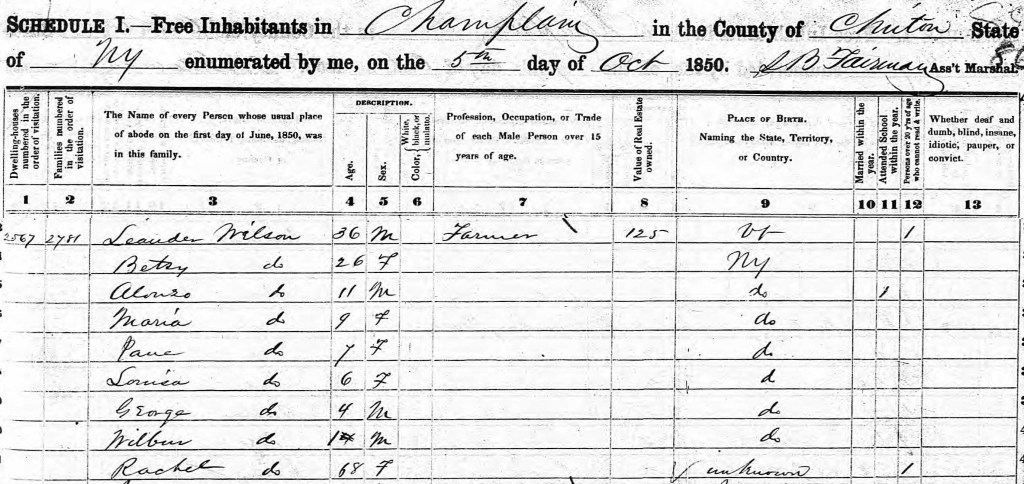
The Wilson family as they appeared in the 1850 census
Source: 1850 US census, Clinton County, New York, population schedule, Champlain Township.
The grave on Ridge Road suggests the family might once have been larger still. In June 1849 Betsey and Leander lost a son, four-year-old Oscar, to croup, a respiratory illness that haunted nineteenth-century childhood. At the time of his death Betsey was eight months pregnant with another child. The following month she gave birth to Wilbur. In an age before antibiotics or effective treatment, such infections could turn fatal with frightening speed. Oscar did not live long enough to appear in the federal census; a single line in the 1850 mortality schedule and the weathered inscription on the family stone are the only surviving traces that he ever lived.3 Nor can we assume that Oscar was the only child the family lost in those years. In an era when many infants died before they could be formally recorded, the long interval between Oscar’s birth in 1845 and Wilbur’s arrival in 1849 may conceal other pregnancies that left no surviving documentary trace.
Oscar’s death was not the only reminder of how fragile life could be in the Wilson household. The same forces that made childhood perilous also shaped the family’s economic survival. Like many small farmers in northern New York, Betsey and Leander lived close to the margins, where illness, crop failure, or the loss of a single animal could threaten the stability of an entire household.
The 1850 agricultural census captures the Wilson farm with clinical precision: six acres of improved land, nineteen acres unimproved, a farm valued at $125, and implements worth only $35. The household kept two horses, one milk cow, two other cattle, five sheep, and a single swine. They harvested fifty bushels of Indian corn and fifty bushels of potatoes, modest quantities that placed the farm among the smallest in Champlain.4 Yet the census also reveals something of Betsey’s labor within this fragile rural economy. The household reported seventy-five pounds of butter, small quantities of wool, and five dollars’ worth of produce from market gardens—products typically associated with women’s work on nineteenth-century farms. Most striking was the thirteen dollars recorded for “home manufacture,” a category that included textiles and other household goods produced within the home. That figure alone equaled the reported value of the family’s slaughtered livestock that year.5 On a small farm where every dollar mattered, Betsey’s work in the dairy, garden, and household workshop formed an essential part of the family’s survival.
The 1850s were once again a decade of childbearing for Betsey. Between 1851 and 1858 she gave birth to six more children—Emily in 1851, Johnny in 1853, Daniel in 1854, Willard in 1855, Henrietta in 1857, and Myrtie in 1858. The rhythm of pregnancy, childbirth, and infant care continued almost without interruption, even as the daily labor of the farm demanded attention. Loss returned as well. Johnny, born in June 1853, lived less than two months before dying on August 4.6 The surviving records offer no cause of death, but in a rural summer household a dozen illnesses could have been responsible. Infants were perilously vulnerable in this era; heat, spoiled milk, contaminated water, and diarrheal diseases made summer particularly deadly. Before germ theory or reliable clean water, families endured a world of persistent childhood mortality and the Wilson family’s position near the bottom of the wealth distribution placed their children at measurably elevated risk.7 For Betsey, these were not statistics but the quiet, constant companions of daily life.
As Betsey’s household expanded, the economic world surrounding the Wilson farm was beginning to change. The growing season in northern New York was short, winters were severe, and the soils of the Champlain Valley—while fertile in places—could be frustratingly uneven. For generations many farm families survived through diversified subsistence agriculture, producing a mix of crops and livestock largely for household use. By the mid-nineteenth century, however, that world was beginning to change as rural communities across the Northeast became increasingly tied to distant markets.8
The arrival of the Ogdensburg and Lake Champlain Railroad in 1850 accelerated this transformation in Clinton County. When the line reached Champlain that September, it connected local farms to commercial networks stretching toward Montreal, Boston, and New York City.9 For farmers like the Wilsons, the railroad brought both opportunity and risk. It opened new outlets for agricultural products but also pulled small farms into increasingly competitive regional markets where success depended on access to labor, land, and capital. Many farmers therefore continued to rely on diversified subsistence strategies rather than committing fully to a single cash crop.
The Wilson farm reflects the cautious adjustments many small households made in response to these changes. The 1850 agricultural census records a modest subsistence operation—corn, potatoes, butter, and small livestock. By 1860, however, the family had begun to adapt their production. The farm was valued at $350—nearly triple its recorded worth a decade earlier—and listed sixteen acres of improved land, up from six in 1850. Their livestock had shifted as well: Leander now kept two working oxen, and the sheep had disappeared. Most telling was the change in crops. Where the earlier census recorded little more than household production, the 1860 schedule listed 150 bushels of potatoes alongside buckwheat, oats, and butter.10 Yet despite these gains, the Wilson property remained small and resources limited. Like many rural families in northern New York, Betsey and Leander were attempting to balance subsistence and market production while still living close to the margins, where a poor harvest, a sick animal, or illness in the household could quickly threaten the stability of the farm.
Yet the gains remained fragile. By 1860 Betsey was in her mid-thirties and had been pregnant or nursing for most of her adult life. The household she managed had children ranging in age from twenty-year-old Mariah to infant daughter Mary, born only five months before the census taker visited. Also present was one-year-old Phoebe, Maria’s daughter, suggesting that the Wilson home—modest as it was—served as a refuge for family members with few other options. Material resources remained thin: the family’s personal estate was valued at only $150.11 The Wilsons were managing, but only barely.
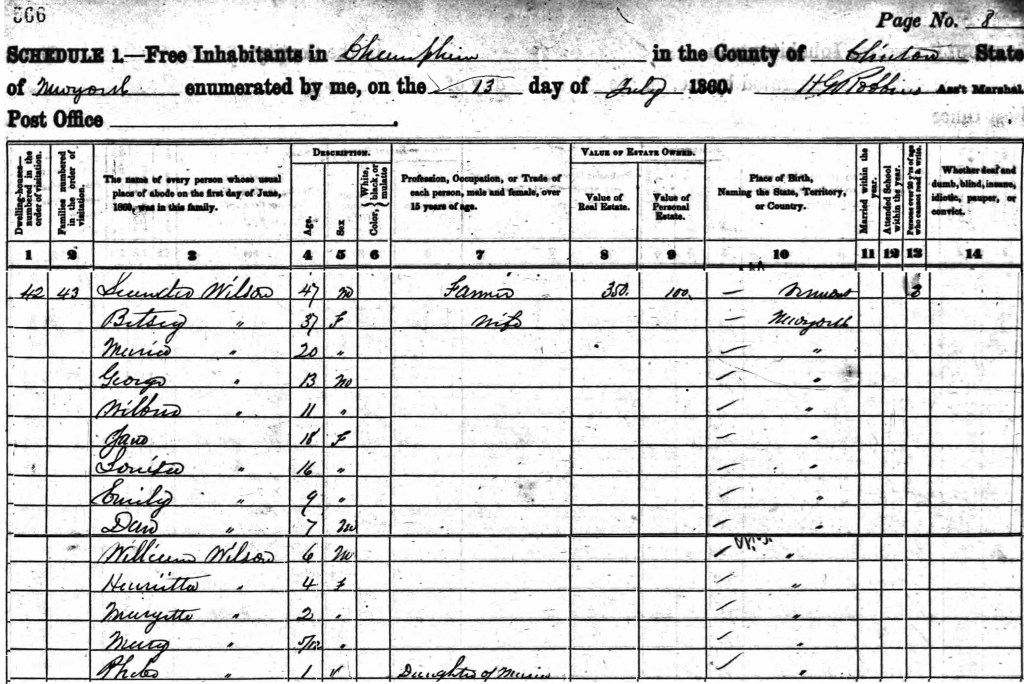
The Wilson family in 1860 just before the start of the Civil War
Source: 1860 US census, Clinton County, New York, population schedule, Champlain Township.
Alonzo, the eldest Wilson child and the only one recorded in the household in the 1840 census, illustrates both the family’s connection to the local economy and the fragility of their circumstances. By 1860 he was living in nearby Chazy in the household of Russell North, a merchant whose real estate was valued at $10,000 and whose personal estate totaled $4,000. Alonzo’s occupation was listed simply as “farm laborer,” a reminder that farm families like Betsey and Leander’s were tied to a wider rural economy in which sons frequently hired themselves out to neighboring farms or local employers.12 Such arrangements provided much-needed income and strengthened local networks of exchange that linked households across the countryside. For the Wilsons, Alonzo’s wages probably represented both economic support and the promise of future labor on the family farm. That hope proved short-lived. Later that year, Alonzo died, his life cut short by a cause the surviving records do not reveal.13 Whatever struck him—illness or accident—removed a son on whom much of the farm’s labor and future stability depended.
The loss carried consequences beyond the emotional toll of grief. Studies of nineteenth-century families suggest that wealth and resources often shaped a child’s chances of survival; households with greater means could sometimes secure better nutrition, shelter, or medical attention.14 The Wilsons possessed few such buffers. Their farm had been valued at only $125 in 1850, and even by 1860 the family’s personal estate totaled just $150. In a household already stretched thin, the death of a grown son altered the delicate balance of labor and survival that sustained the farm.15 And while Betsey was adjusting to life without Alonzo, she was once again pregnant. In August 1861 she gave birth to her final child, a son named Wesley.16
On the heels of Alonzo’s death and Wesley’s birth, the Civil War arrived in the Wilson household. The conflict reached Clinton County in the summer of 1861, but it touched the family directly the following year when Leander enlisted in the 118th New York on August 11, 1862, at the age of forty-one. His reasons are unknown, though like many men who volunteered that year he may have been motivated by a mixture of patriotism, community pressure, and the promise of steady pay. Family connections may also have played a role: his brother-in-law, Eri Tenant, who had married Betsey’s sister Hannah, had enlisted in the same regiment only weeks earlier in late July.17 Mustered into Company I as a private and assigned as a regimental musician, Leander soon left home when the regiment departed New York on September 3 for service in Washington, D.C., and along the Virginia coast.18
For Betsey, his enlistment came at a moment when the household was already stretched thin. Within the span of a year she had buried a grown son and given birth to another child, and now the labor of the farm rested largely in the hands of those who remained. Seventeen-year-old George was still at home and could assist with the daily work, but the absence of an adult man inevitably strained the fragile balance that sustained the Wilson farm as Betsey juggled farm oversight with seven children under the age of ten.
The Wilson household faced another upheaval in February 1863 when nineteen-year-old George enlisted in the 56th Massachusetts Regiment.19 His decision came while his father was already serving in the Union Army, leaving Betsey responsible for a farm and a household filled with young children. The precise circumstances of George’s enlistment are unclear, though like many young men he may have been drawn by a mixture of youthful patriotism, community pressure, and the economic incentives offered to volunteers. For Betsey, the war was not fought in distant fields but in the steady disappearance of the men who sustained the farm.
Military service quickly exposed him to dangers very different from those faced on the Ridge Road farm. Crowded and unsanitary army camps were breeding grounds for disease, and George soon contracted typhoid fever—a scourge that claimed thousands of soldiers during the war. He was sent home on furlough to Champlain, where Betsey almost certainly attempted to nurse him back to health in the familiar surroundings of the family farm.20 Little could be done beyond basic care, however, and like many soldiers of the Civil War, George was claimed not by musket fire but by illness. He died on May 18, 1863, at just nineteen years old.21
Betsey buried him on the Ridge Road farm alongside three brothers who had died before him. His death left fourteen-year-old Wilbur as the oldest male remaining in the household. With her husband still in uniform and most of the children too young to shoulder heavy labor, the burden of sustaining the farm likely fell largely upon Betsey herself.
Yet the losses did not end with George. Less than three weeks later, on June 4, 1863, Betsey’s maternal grandfather John Bugbee died in Champlain at an advanced age.22 Bugbee had been among the town’s earliest settlers, appearing in the federal census as early as 1800, and his passing marked the fading of an older generation whose lives had shaped the community Betsey had always known. Only days after his death, tragedy struck again when Betsey’s brother-in-law, Eri Tenant—who had enlisted in the same regiment as Leander the previous summer—died of typhoid fever on June 9 at the regimental hospital in Suffolk, Virginia.23 Within the span of a few weeks the family lost a son, a patriarch, and a close relative serving in the same regiment as Betsey’s husband.
By the summer of 1864, Leander and the 118th New York had moved into the swampy, mosquito-filled terrain along the James River as Ulysses S. Grant pushed the Union armies deeper into Virginia. For northern soldiers like Leander, the humid heat, standing water, and swarming insects created constant hardship. Camps flooded with rain, latrines overflowed, and drinking water was often contaminated—conditions that made dysentery, typhoid, and other diseases persistent threats. It was in this environment that Leander fell seriously ill and was admitted to the 3rd Division General Hospital at Fortress Monroe on August 4, 1864.24

The letter Betsey received informing her of Leander’s death
Source: Letter from Chaplain Charles A. Raymond to Betsey Wilson, August 17, 1864
News of his death reached Betsey through a letter written by the hospital chaplain:
“Your husband was brought here August 4th. His disease was the diarrhea. His death took place last evening at 9 o’clock and he was buried today in the Hampton Hospital burying ground with the usual military and religious ceremonies. I trust my dear madam that this event so distressing to you and which has left such a void in your family circle, will be borne with christian resignation, remembering that he dies nobly who dies in the path of duty, and that the graves of a nation’s defenders are among her most priceless treasures.”25
The language was formal and familiar, repeated in hundreds of similar letters sent to grieving families during the war. Such words reflected the era’s effort to give meaning to loss: soldiers were said to die nobly, their deaths framed as sacrifices for the nation. For Betsey, however, the consolation could not soften the practical consequences. In just four years she had lost the adult men on whom the farm’s labor depended. With Leander gone, fifteen-year-old Wilbur became the eldest male in the household, assuming responsibilities far beyond his years. Betsey herself—forty years old and newly widowed—now faced the task of maintaining the farm while raising children as young as three-year-old Wesley. The chaplain’s words offered moral reassurance, but the realities they left behind were immediate and unrelenting.
Betsey was granted a widow’s pension on October 10, 1864, less than two months after Leander’s death.26 The federal pension system, extended to the widows of soldiers who died in Union service, provided a modest but vital source of income. By the late nineteenth century, roughly 360,000 Union widows would receive such pensions—evidence of how deeply the conflict had reshaped American households. For Betsey, however, the pension could only soften the blow. It was something, but it was not a farmhand, and it was not a husband.
The Ridge Road farm still needed tending, and the work now fell squarely on Betsey and the children who remained at home. She would have cared for livestock, planted and harvested crops, gathered wood, and made decisions that only a few years earlier would have been the province of men. It was exhausting work, driven not by choice but necessity, and carried the constant pressure of financial uncertainty. The pension offered some relief, but it could not replace the strength and experience of the adult men who had once operated the farm.
During these same years the extended family network that might once have supported Betsey was gradually shifting away from Champlain. By the early 1860s her sister Minerva had already moved to Fitchburg, Massachusetts, part of the growing migration of northern New York families toward the factory towns of central New England.27 Their father, John Copps, died there on January 13, 1865, leaving the region where his children had grown up.28 Other siblings soon followed the same path. By the spring of 1865 Betsey’s sister Martha and her husband Charles Byam—a veteran of the 36th Massachusetts Infantry—were living in Winchendon, Massachusetts, along with the youngest sister, Delia.29 Delia married Washington Irving Powers there the following year, and by 1866 Betsey’s widowed sister Hannah, whose husband Eri Tenant had died in Union service, had also relocated to Winchendon and remarried.30 Even as Betsey struggled to sustain the Ridge Road farm in the difficult years after the war, much of the family network that had once surrounded her was re-forming more than two hundred miles away in the mill towns of central Massachusetts.
The historical record offers little insight into how Betsey managed the years immediately following the war, but by 1870 her life had clearly changed. She had given up the Ridge Road farm and relocated to the village of Ingraham in nearby Chazy. When the census taker arrived that year, Betsey was living with six of her children. She still reported $500 in real estate—possibly the farm property she had once occupied—and a personal estate of $130.31 The figures suggest a household in transition, holding onto the remnants of a farm while gradually adapting to village life.
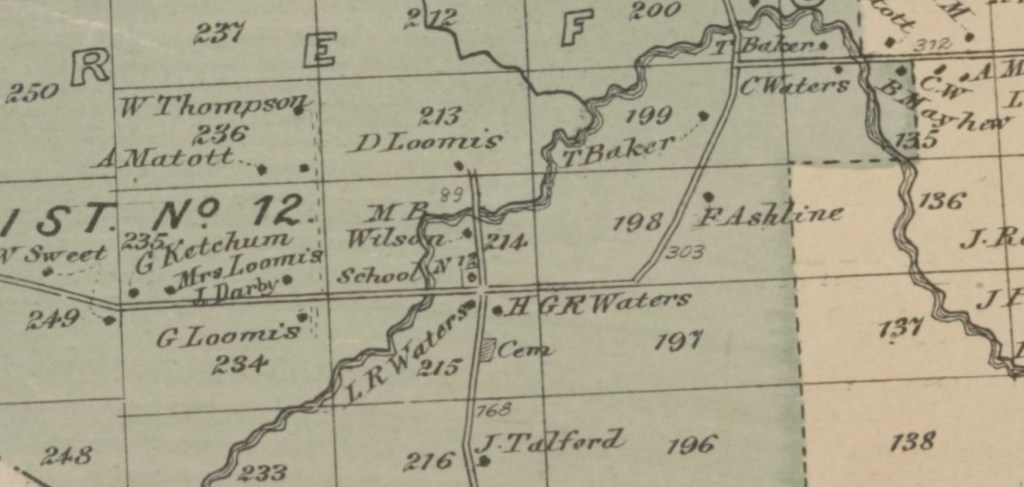
The location of the Wilson family farm as shown in 1869
Source: Lionel Pincus and Princess Firyal Map Division, The New York Public Library. “Champlain [Township]”
The move reflected the difficult economics facing small rural families in the postwar years. With Leander and George gone, the Wilson farm had lost the adult male labor on which it had depended. The household’s strategy shifted accordingly. Wilbur, now married, worked as a farm laborer and remained on the Ridge Road property, suggesting that the family farm continued to operate in some form even as Betsey and the younger children relocated to the village.32 An 1869 map of the town of Chazy labeled the property “M. B. Wilson,” indicating that the land still remained associated with the family even after Betsey’s move.33 Meanwhile, younger sons Daniel and Willard had entered wage employment at the Sciota Manufacturing Company, a local bedstead factory.34 The family that had once depended on the rhythms of agriculture was increasingly tied to the wages of industrial work, a transformation unfolding in rural households across the North as farm families adjusted to the economic realities of the postwar era.
By 1874 the Wilson family’s world had shifted once more in the post-Civil War period. Similar to many widowed farm women of the period, Betsey followed the path opened by her children’s wages, relocating to Nashua, New Hampshire, a growing textile center whose mills drew workers from rural communities across northern New England and upstate New York. The Nashua city directory recorded Betsey, identified as the widow of Leander, living at “5 Jackson Corporation”—not a street address but one of the boardinghouses owned by the Jackson Manufacturing Company for its mill workers. Residing with her was her son Daniel, listed simply as an “operative,” the common term for the men and women who tended the spinning frames and looms of the city’s textile mills.35
Other members of the family settled nearby. Daughter Martha and her husband, Luther Stark, lived at 16 South Pine Street in the same household as her sister Louisa and her husband, Chester Barnhart; both Luther and Chester were likewise employed as mill operatives.36 Although daughters Henrietta and Myrtie do not appear in the 1874 directory, later census records suggest that they too eventually made their way to Nashua, joining the extended family clustered around the Jackson mill housing. Only a few years earlier the Wilson family had lived together on a small farm along Ridge Road in Champlain, New York. By the mid-1870s they had reassembled instead in Nashua’s mill districts, their livelihoods tied to the rhythms of factory labor along the Nashua River—a path followed by thousands of rural families who left struggling farms for the opportunities and uncertainties of the industrial city.
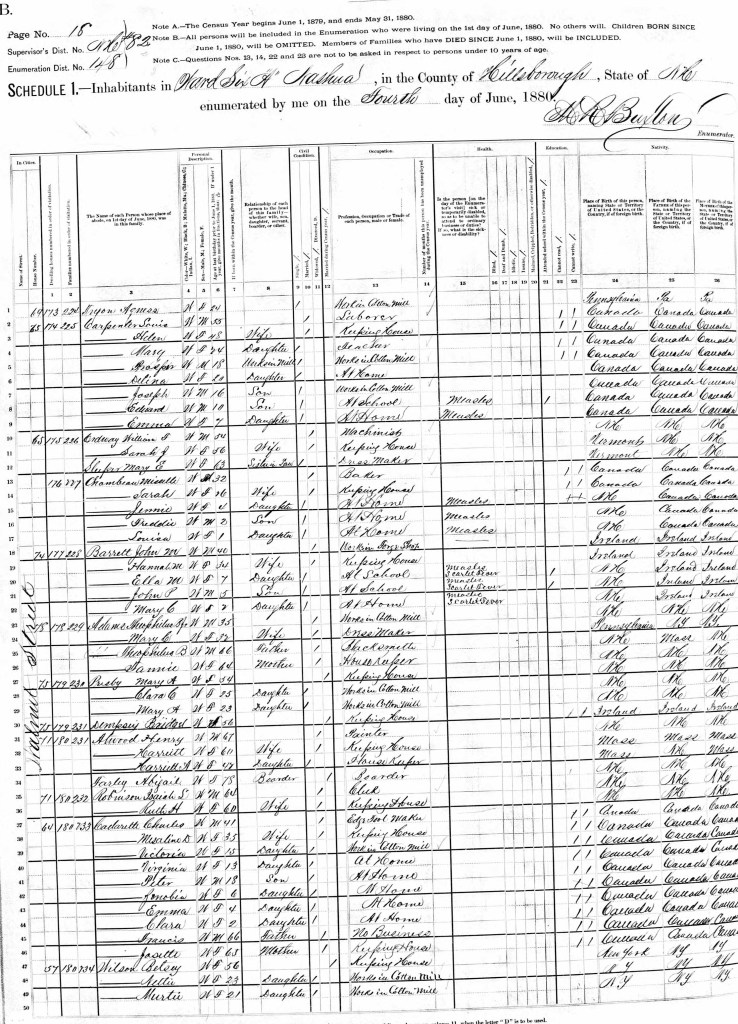
Betsey and her two daughters living on Walnut Street in Nashua–just a few doors away from both measles and scarlet fever
Source: 1880 US census, Hillsborough County, New Hampshire, population schedule, Nashua Township.
The 1880 census offers the clearest surviving picture of the household Betsey had established in Nashua. She and her daughters Henrietta and Myrtie were living at 57 Walnut Street, both daughters employed in a cotton mill while Betsey was recorded simply as “keeping house.”37 In Nashua’s densely packed mill neighborhoods, such arrangements were common. Women made up a substantial share of the textile workforce, and their wages often sustained entire households. For Betsey, the transformation was profound. A generation earlier she had managed a farm household along Ridge Road in Champlain; by 1880 she presided instead over a modest urban home supported by her daughters’ factory wages—one of many rural families whose lives were reshaped by the pull of New England’s textile industry in the decades after the Civil War.
By this time the Wilson family was beginning to spread beyond Nashua as well. Some children followed the same industrial path that had brought them to New Hampshire, while others joined the westward migration reshaping the nation after the war. Son Willard and daughter Mariah eventually settled in Georgetown, Michigan.38 Daughter Emily moved to Massachusetts, where her husband found work in another cotton mill outside Worcester.39 Youngest son Wesley, who was barely a year old when his father marched off to war, remained closer to Nashua, and provided another reminder that the burdens of the Civil War fell heavily on the families left behind: in the 1880 census he appears as a cotton mill worker but also as a “prisoner” in the state reform school in nearby Manchester.40 The scattered locations of her children hint at the final stage of Betsey’s long journey—from a tightly bound farm household in northern New York to a family dispersed across the industrial towns and western frontiers of postwar America.
Yet even as some of her children moved farther afield, much of the Wilson family remained close to Betsey in Nashua. Daughter Louisa lived nearby on Milden Street with her husband and two children, while Martha remained on South Pine Street with her husband Luther and their growing family.41 By the time Betsey reached her fifties, at least six of her grandchildren were living within a short walk of her door—children whose presence likely brought both comfort and renewed purpose to her later years.
Those grandchildren may also have revived familiar anxieties. When the federal census taker visited Walnut Street on June 4, 1880, families in the neighborhood were in the midst of an outbreak: fifteen—nearly half—of the children under ten living on the street were recorded as suffering from measles.42 In Nashua’s crowded mill districts, the close quarters of tenement housing and the constant movement of workers between home and factory allowed such diseases to spread quickly. Measles, far more dangerous in the nineteenth century than today, could prove fatal for children encountering it for the first time. For Betsey, who had buried four children and a husband decades earlier, the presence of such illness in the neighborhood must have carried a painfully familiar shadow.
Betsey died less than two months later, on July 31, 1880.43 Her cause of death was not recorded. Yet the measles outbreak that swept through Walnut Street that summer illustrates the kinds of dangers that surrounded her final days. She had begun adulthood confronting the diseases that claimed Oscar and Johnny, endured the war years and the illnesses that took George and Leander, and now spent her final weeks in a crowded mill neighborhood where contagion again moved easily through the community.
After her death, Betsey’s body was returned to Champlain and buried beside the children she had already lost. Though much of the family had dispersed across the country, one son remained tied to the land. Wilbur, who had worked as a farm laborer in 1870, eventually took over the Ridge Road property where Betsey and Leander had raised their family and farmed it for the rest of his life. He likely erected the monument in Waters Cemetery commemorating his parents and the brothers who had died decades earlier. When Wilbur himself died in 1931, he was buried only a short distance away.
It is difficult not to consider what might have been. By 1860 the Wilson farm was modest but improving: its value had nearly tripled in a decade, the acreage under cultivation had expanded, and new market opportunities were emerging with the growth of the potato starch industry. Had the war and disease not intervened, the Wilson farm may well have continued along the path of modest improvement suggested by the 1860 census. Instead, the deaths of George and Leander left Betsey to manage alone. Without adult male labor the farm could not be sustained, and the children she had raised as farmhands ultimately became factory workers in Nashua and other industrial towns.
Perhaps the chaplain’s assurance in 1864 that Leander had “died nobly” offered some comfort to Betsey. Or perhaps the greater nobility lay in something quieter: the endurance required to carry a family through decades marked by illness, loss, and upheaval. The stone in Waters Cemetery offers no answer, but it does gather together the fragments of a family’s story—sons lost too young, a husband taken by war, and a mother who outlived them all. Weathered and slightly broken—its urn long since fallen from the top—the monument still stands at the edge of the cemetery, a reminder of the lives once lived along Ridge Road and of the quiet absences that shaped them. In the end, the story of Betsey Copp Wilson survives not only in scattered records but in that weathered stone above the fields where her life once unfolded.
Endnotes
- Find a Grave, “Betsey E Copp Wilson (1824-1880),” Memorial 29480492, citing Waters Cemetery, Champlain, Clinton County, New York, accessed March 12, 2026, https://www.findagrave.com/memorial/29480492/betsey-e-wilson.
- 1850 US census, Clinton County, New York, population schedule, Champlain Township, Leander Wilson household, dwelling 2567 family 2781, digital image, Ancestry (http://www.ancestry.com: accessed March 12, 2026); citing National Archives Microfilm Publication, Roll M432, Page: 13.
- U.S. Census Mortality Schedules, New York, 1850-1880; New York State Education Department, Office of Cultural Education; Albany, New York; Year: 1850; Roll: M1; Line Number: 11. Ancestry (http://www.ancestry.com: accessed March 12, 2026).
- The Wilson family farm ranked 211th out of 228 farms in the town of Champlain based on the acres of improved land.
- 1850 U.S. Census, Agricultural Schedule, Champlain, Clinton County, New York, p. 6, line 14, Leander Wilson farm; U.S. Census Non-population Schedules, New York, 1850–1880, Record Group 29, Records of the Bureau of the Census, National Archives, Washington, DC (NAID 2791276).
- Find a Grave, “Johnny Wilson (1853-1853),” Memorial 29480642, citing Waters Cemetery, Champlain, Clinton County, New York, accessed March 12, 2026, https://www.findagrave.com/memorial/29480642/johnny-wilson.
- For more information on the connection between wealth and higher child mortality, see J. David Hacker, Martin Dribe, and Jonas Helgertz. “Wealth and Child Mortality in the Nineteenth-Century United States: Evidence from Three Panels of American Couples, 1850–1880.” Social Science History 47, no. 3 (Fall 2023): 333–366. https://doi.org/10.1017/ssh.2023.12.
- See Christopher Clark, The Roots of Rural Capitalism: Western Massachusetts, 1780–1860 (Ithaca: Cornell University Press, 1990) for an overview of the broader social, economical, and ideological changes seen in a rural community from 1790-1860.
- Doherty, Lawrence. “General History of the O. & L. C. Railroad.” The Railway and Locomotive Historical Society Bulletin, no. 58A (1942): 91–98. http://www.jstor.org/stable/43504337.
- 1860 U.S. Census, Agricultural Schedule, Champlain, Clinton County, New York, p. 1, line 31, Leander Wilson farm; Copies of Nonpopulation Census Schedules, Record Group 29, Records of the Bureau of the Census, National Archives, Washington, DC (NAID 2791276).
- 1860 US census, Clinton County, New York, population schedule, Champlain Township, Leander Wilson household, dwelling 42 family 43, digital image, Ancestry (http://www.ancestry.com: accessed March 12, 2026); citing National Archives Microfilm Publication, Roll M653_736, Page: 565.
- 1860 US census, Clinton County, New York, population schedule, Chazy Township, Russell North household, dwelling 106 family 108, digital image, Ancestry (http://www.ancestry.com: accessed March 12, 2026); citing National Archives Microfilm Publication, Roll M653_735, Page: 195.
- Find a Grave, “Alonzo Wilson (1841-1860),” Memorial 29480541, citing Waters Cemetery, Champlain, Clinton County, New York, accessed March 12, 2026, https://www.findagrave.com/memorial/29480541/alonzo-wilson.
- Hacker, “Wealth and Child Mortality,” 130–138.
- 1860 US census, Clinton County, New York, population schedule, Champlain Township, Leander Wilson household, dwelling 42 family 43, digital image, Ancestry (http://www.ancestry.com: accessed March 12, 2026); citing National Archives Microfilm Publication, Roll M653_736, Page: 565.
- 1900 US census, Middlesex County, Massachusetts, population schedule, Lowell Ward 7, Enumeration District (ED) 812, sheet 8A, dwelling 126, family 155, Wesley Wilson household; digital image, Ancestry (http://www.ancestry.com: accessed March 12, 2026); citing National Archives Microfilm Publication, Roll 661, Page: 8.
- John Lovell Cunningham, Three Years with the Adirondack Regiment (Norwood, MA: Plimpton Press, 1920), 276.
- Leander Wilson, service entry, Town Clerks’ Registers of Men Who Served in the Civil War, ca. 1865–1867, Collection (N-Ar)13774, box 12, roll 8, New York State Archives, Albany; microfilm publication, 37 rolls; digital image, Ancestry (http://www.ancestry.com: accessed March 12, 2026).
- George Wilson, entry in Registers of Officers and Enlisted Men Mustered into Federal Military or Naval Service during the Civil War, 1861–1865, Series A0389, vol. 6, New York (State) Bureau of Military Statistics, New York State Archives, Albany, New York; digital image, Ancestry (http://www.ancestry.com: accessed March 12, 2026).
- Ibid.
- Find a Grave, “George Wilson (1844-1863),” Memorial 29480581, citing Waters Cemetery, Champlain, Clinton County, New York, accessed March 12, 2026, https://www.findagrave.com/memorial/29480581/george-wilson.
- Find a Grave, “John Bugbee (1778-1863),” Memorial 54368318, citing Riverview Cemetery, Chazy, Clinton County, New York, accessed March 14, 2026, https://www.findagrave.com/memorial/54368318/john-bugbee.
- Cunningham, Three Years with the Adirondack Regiment, 276.
- Leander Wilson, service entry, Town Clerks’ Registers of Men Who Served in the Civil War, ca. 1865–1867, Collection (N-Ar)13774, box 12, roll 8, New York State Archives, Albany; microfilm publication, 37 rolls; digital image, Ancestry (http://www.ancestry.com: accessed March 12, 2026).
- Chaplain Charles A. Raymond to Betsey Wilson, August 17, 1864, 3rd Division U.S. General Hospital, Fortress Monroe, Virginia. Private family document, original custodian unknown; digital image uploaded to Ancestry.com by a family contributor, accessed March 13, 2026.
- Wilson, Betsy. Widow’s Pension Application No. 68,212, Certificate No. 47,002. Filed October 10, 1864. Case of Leander Wilson, Company I, 118th New York Infantry. General Index to Pension Files, 1861–1934. T288, 546 rolls. Record Group 15. National Archives and Records Administration, Washington, DC.
- Find a Grave, “Walter Davis (1862-1933),” Memorial 44405216, citing Evergreen Cemetery, Leominster, Worcester County, Massachusetts, accessed March 14, 2026, https://www.findagrave.com/memorial/44405216/walter-ellsworth-davis.
- Find a Grave, “John Copps (1794-1865),” Memorial 101223562, citing Laurel Hill Cemetery, Fitchburg, Worcester County, Massachusetts, accessed March 14, 2026, https://www.findagrave.com/memorial/101223562/john-abrams-copps.
- 1865 Massachusetts State Census, Worcester County, Massachusetts, population schedule, Winchendon township, dwelling 239, family 277, Charles Byam household; digital image, Ancestry (http://www.ancestry.com: accessed March 12, 2026); citing 1855–1865 Massachusetts State Census, New England Historic Genealogical Society, Boston, Massachusetts, Reel 37, Vol. 41, p. 16.
- Marriage of Washington Irving Powers and Delia Copps,” March 3, 1866, Winchendon, Worcester County, Massachusetts; Massachusetts Vital and Town Records, Town and City Clerks of Massachusetts (Provo, UT: Holbrook Research Institute); digital image, Ancestry (http://www.ancestry.com: accessed March 12, 2026). Marriage of Haskell Austin and Hannah Tennant,” October 27, 1866, Winchendon, Worcester County, Massachusetts; Massachusetts Vital and Town Records, Town and City Clerks of Massachusetts (Provo, UT: Holbrook Research Institute); digital image, Ancestry (http://www.ancestry.com: accessed March 12, 2026).
- 1870 US census, Clinton County, New York, population schedule, Chazy Township, Betsey Wilson household, dwelling 363 family 335, digital image, Ancestry (http://www.ancestry.com: accessed March 12, 2026); citing National Archives Microfilm Publication, Roll M953_918, Page: 239B.
- 1870 US census, Clinton County, New York, population schedule, Champlain Township, Wilbur Wilson household, dwelling 313 family 318, digital image, Ancestry (http://www.ancestry.com: accessed March 12, 2026); citing National Archives Microfilm Publication, Roll M953_918, Page: 173A.
- Lionel Pincus and Princess Firyal Map Division, The New York Public Library. “Champlain [Township]” The New York Public Library Digital Collections. 1869. https://digitalcollections.nypl.org/items/4e4cd030-c5f7-012f-1524-58d385a7bc34.
- 1870 US census, Clinton County, New York, population schedule, Chazy Township, Betsey Wilson household, dwelling 363 family 335, digital image, Ancestry (http://www.ancestry.com: accessed March 12, 2026); citing National Archives Microfilm Publication, Roll M953_918, Page: 239B.
- Greenough, Jones & Co. Greenough, Jones & Co.’s Directory of the Inhabitants, Institutions, Manufacturing Establishments, Societies, Business Firms, Etc. Etc., in the City of Nashua, N.H., for 1874–75. Boston: Greenough, Jones & Company, 1874. Entry for Betsey Wilson, 5 Jackson Corporation. Accessed via U.S., City Directories, 1822–1995, digital image, Ancestry (http://www.ancestry.com: accessed March 12, 2026).
- Greenough, Jones & Co. Greenough, Jones & Co.’s Directory of the Inhabitants, Institutions, Manufacturing Establishments, Societies, Business Firms, Etc. Etc., in the City of Nashua, N.H., for 1874–75. Boston: Greenough, Jones & Company, 1874. Entries for Luther Stark and Charles Barnhart, 16 South Pine Street. Accessed via U.S., City Directories, 1822–1995, digital image, Ancestry (http://www.ancestry.com: accessed March 12, 2026).
- 880 US census, Hillsborough County, New Hampshire, population schedule, Nashua township, Enumeration District (ED) 148, dwelling 180, family 234, Betsey Wilson household; digital image, Ancestry (http://www.ancestry.com: accessed March 12, 2026); citing National Archives Microfilm Publication, Roll 764, Page: 487B.
- 1880 US census, Ottawa County, Michigan, population schedule, Georgetown township, Enumeration District (ED) 241, dwelling 365, family 370, Willard Wilson household; digital image, Ancestry (http://www.ancestry.com: accessed March 12, 2026); citing National Archives Microfilm Publication, Roll 601, Page: 438A. 1880 US census, Ottawa County, Michigan, population schedule, Georgetown township, Enumeration District (ED) 241, dwelling 51, family 52, Joseph Goosebury household; digital image, Ancestry (http://www.ancestry.com: accessed March 12, 2026); citing National Archives Microfilm Publication, Roll 601, Page: 421B.
- 1880 US census, Worcester County, Massachusetts, population schedule, West Boylston township, Enumeration District (ED) 835, dwelling 432, family 617, Sidney Garland household; digital image, Ancestry (http://www.ancestry.com: accessed March 12, 2026); citing National Archives Microfilm Publication, Roll 564, Page: 149D.
- 1880 US census, Hillsborough County, New Hampshire, population schedule, Manchester township, Enumeration District (ED) 124, dwelling 33, family 37, State Reform School; digital image, Ancestry (http://www.ancestry.com: accessed March 12, 2026); citing National Archives Microfilm Publication, Roll 763, Page:51C.
- 1880 US census, Hillsborough County, New Hampshire, population schedule, Nashua township, Enumeration District (ED) 149, dwelling 110, family 257, Chester Barnhart household; digital image, Ancestry (http://www.ancestry.com: accessed March 12, 2026); citing National Archives Microfilm Publication, Roll 764, Page: 514A. 1880 US census, Hillsborough County, New Hampshire, population schedule, Nashua township, Enumeration District (ED) 149, dwelling 35, family 41, Luther Starks household; digital image, Ancestry (http://www.ancestry.com: accessed March 12, 2026); citing National Archives Microfilm Publication, Roll 764, Page: 501D.
- 1880 US Census, Hillsborough County, New Hampshire, population schedule, Nashua township, Enumeration District (ED) 148, dwellings 152–194, families 198–250; digital images, Ancestry (http://www.ancestry.com: accessed March 12, 2026); citing National Archives Microfilm Publication, Roll 764. Analysis by the author of all children under age ten residing on Walnut Street as enumerated on June 4, 1880.
- Find a Grave, “Betsey E Copp Wilson (1824-1880),” Memorial 29480492, citing Waters Cemetery, Champlain, Clinton County, New York, accessed March 12, 2026, https://www.findagrave.com/memorial/29480492/betsey-e-wilson.




 Cemetery Tales