
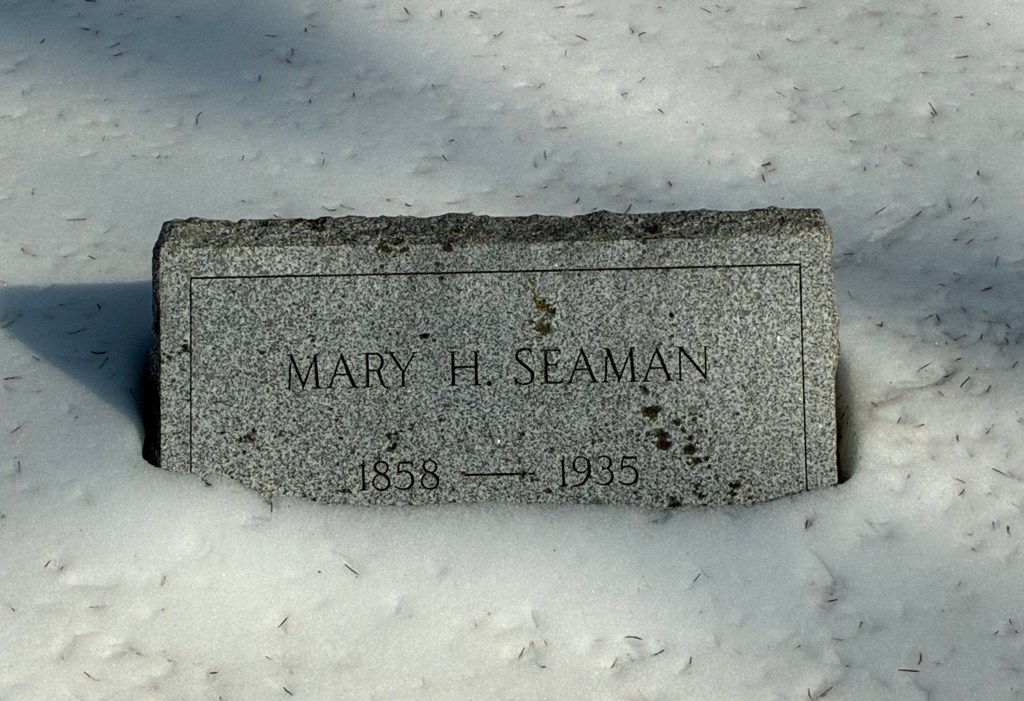
Mary Haggerty Seaman’s grave in Saint James Episcopal Church Graveyard, Smithtown, NY
Source: author’s personal collection
In winter, Mary Seaman’s grave often disappears. It lies nearly flat in the churchyard of Saint James Episcopal Church in Saint James, Suffolk County, New York, and after a heavy snowfall it is easily passed over—an unbroken stretch of white where a life is meant to be marked. When the ground is bare, a simple stone emerges, reading only “Mary Seaman” and the dates “1858-1935.”1 The marker is spare, almost austere. It offers no indication of the decades she spent shaping the moral and social life of Smithtown, nor of how closely her life tracked the transformations that reshaped Long Island during the late nineteenth and early twentieth centuries.
Like many women of her generation, Mary left few monumental traces. Her public memory was flattened, even as her daily labor sustained institutions created to respond to a world widely perceived as slipping beyond control. She lived through the transition of Smithtown from a small farming community into a more urban suburb, and through the anxieties that accompanied that change—crime, alcohol, gambling, and the fear that traditional forms of order were dissolving. Her story is not one of prominence or formal authority, but of persistence: an ordinary woman who devoted her life to civic work rooted in temperance, faith, and community, and who labored—largely unseen—to impose moral order on an age of disruption.
Mary Haggerty was born in May 1856 into a Smithtown that remained firmly rural, structured by long-standing patterns of family, church, and land.2 Her parents’ household reflected the layered immigrant world of mid-nineteenth-century New York. Her father, John Haggerty, was an Irish immigrant; her mother, Rosanna, was New York–born to parents who had also emigrated from Ireland. From childhood through early adulthood, Mary lived continuously within this small Long Island community, her life bounded by the routines and expectations of a farming town still organized around household labor and local institutions.
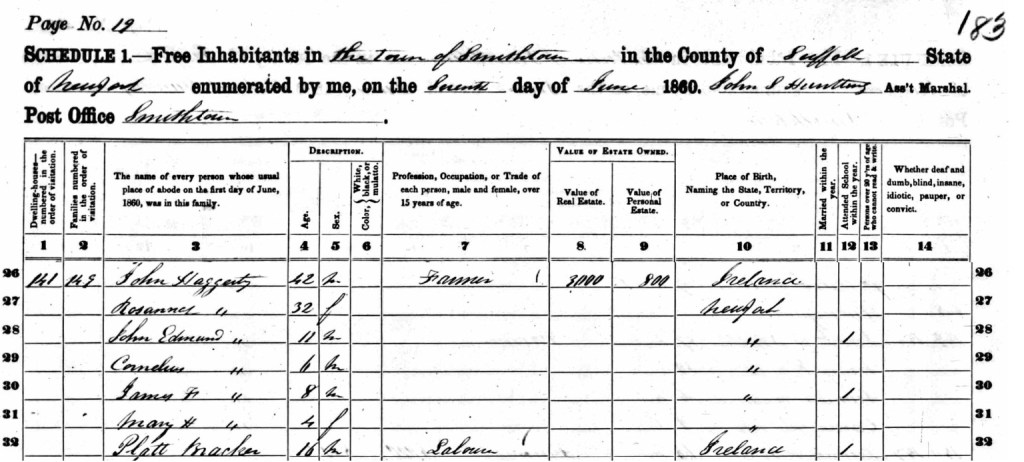
Four-year-old Mary and her family in 1860
Source: 1860 US census, Suffolk County, New York, population schedule, Smithtown Township.
In 1860, Mary resided in a crowded household that was typical of agrarian and semi-agrarian communities where family labor and shared space were economic necessities. Such households functioned not only as domestic spaces but as sites of production and discipline, where work, morality, and survival were tightly interwoven. The Haggerty farm itself was substantial by local standards, encompassing roughly 150 acres, of which one hundred were improved and actively cultivated. Its fields yielded a diversified mix of staple crops—one hundred bushels of wheat, four hundred bushels of Indian corn, one hundred forty bushels of oats, and thirty tons of hay—while its orchard and dairy operations produced fruit and one hundred pounds of butter.3 Livestock filled the barn and pasture: a horse for transportation and heavy work, two mules for field labor, two milk cows, eleven additional cattle, and eight swine. This was not subsistence farming at its most marginal but a working family enterprise tied to local markets and seasonal rhythms that demanded constant attention.
Within such a household, labor was distributed across age and gender from an early stage. Mary, only four years old in 1860, would have grown up surrounded by activity that blurred the line between home and workplace. Her older brothers—John, Cornelius, and James—were already entering the cycle of farm labor that structured boys’ lives, assisting with feeding animals, gathering fuel, and tending fields under their father’s direction. Indoors, Mary’s mother oversaw dairying, food preservation, and textile work, tasks in which daughters were gradually trained through observation and participation. Even at a young age, Mary would have absorbed the rhythms of milking, churning, planting, harvesting, and slaughtering that defined the agricultural year. The presence of a sixteen-year-old Irish farm laborer reinforced the household’s role as an economic unit where space, food, and labor were carefully apportioned.4 In this environment, structure and cooperation were not abstract virtues but practical necessities. Order within the household ensured the farm’s productivity; productivity ensured its survival.
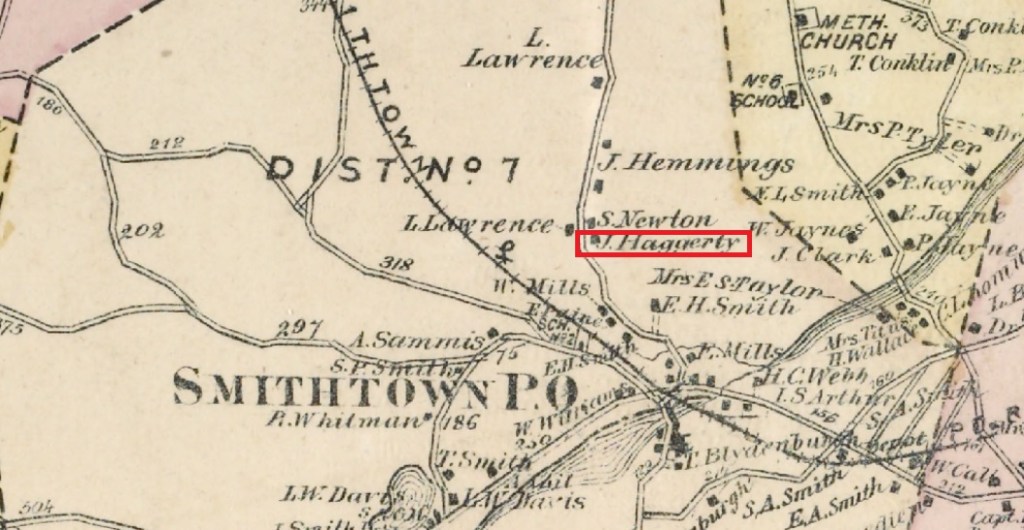
Smithtown in 1873 showing the location of the Haggerty home alongside what is today’s Route 25A (Main Street/Fort Salonga Road)
Source: F. W. Beers, “Town of Smithtown, Suffolk Co. L.I.,” map, in Atlas of Long Island, New York (New York: Beers, Comstock & Cline, 1873).
By 1870, Mary was listed simply as “at home,” a designation that obscured the productive labor performed by girls and women within households that blended domestic work and informal economic activity.5 Yet the decade preceding that census had altered the structure of the Haggerty household in ways that such a brief notation cannot capture. By the end of the Civil War, the family that had once filled the 150-acre farm in 1860 was already contracting. Mary’s older brothers began to move outward in search of wages and opportunity. By 1865, only Cornelius and Mary remained at home with their parents, while her eldest brother John hired himself out as a farm laborer on the property of Edwin Smith in Smithtown.6 Within a few years he had moved again, working by 1870 as a hostler on a horse-training farm in nearby Huntington, a position that reflected the growing importance of specialized wage labor within the region’s changing economy.7
For families like the Haggertys, these shifts altered daily life in ways both practical and psychological. The rhythms of work began to move away from the predictable cycles of planting and harvest toward the uncertainties of wages and market prices. Young men sought employment beyond the farm; households adjusted to shrinking labor pools and changing incomes; and the boundaries between rural self-sufficiency and market dependence grew increasingly porous. For Mary, the 1860s were likely experienced as a period of quiet contraction and adaptation—a household slowly diminishing in size while also relinquishing the autonomy associated with landownership and farm management. Change came gradually enough to be absorbed into everyday routine, yet steadily enough to reshape how residents understood security, risk, and respectability. Within these altered circumstances, young women like Mary learned habits of order, thrift, and responsibility shaped as much by economic uncertainty as by inherited rural regulation. By the time she reached adulthood, Smithtown remained recognizably rural in appearance, but its social and economic foundations were already being drawn into the orbit of a rapidly expanding metropolitan world.
Smithtown during Mary’s youth remained small—fewer than 2,500 residents through much of her childhood—and still defined by farms, churches, and kinship networks that stretched back generations. Yet the changes reshaping the Haggerty household were not occurring in isolation. They unfolded within a town that, while outwardly stable, was itself undergoing gradual but consequential transformation. Between 1850 and 1880 Smithtown’s population grew slowly but steadily, and with that growth came new economic and social pressures.8 Improved roads and transportation linked the town more closely to the markets and demands of nearby New York City, drawing it into regional systems of exchange and labor. Farm families continued to work the land, but agriculture increasingly existed alongside wage labor, small trades, and the first signs of regular commuting beyond the town’s boundaries. Goods that had once circulated locally now moved outward to regional markets, while cash and manufactured products flowed back in, subtly reshaping expectations about work, consumption, and stability.
Mary reached adulthood just as these local transformations began to press more insistently upon daily life. In 1880 she remained in her parents’ household, unmarried at twenty-three, in a family of four that still included both parents and her brother Cornelius. The census listed her aging immigrant father, John, as a laborer afflicted with rheumatism—an indication of both his continued need to work and the physical toll such labor exacted. Cornelius, meanwhile, had begun the transition away from the farm economy that had shaped his parents’ lives, finding employment as a coachman and thus tying the household more directly to a wage-based, service-oriented world.9 Together these details suggest a family adjusting, if cautiously, to new economic realities. As Smithtown’s economy slowly diversified and cash wages became more central to household survival, unmarried daughters like Mary often provided essential labor and stability within multigenerational homes, their contributions blurring the boundaries between domestic duty and economic necessity while helping families navigate the uncertain ground between agrarian self-sufficiency and market dependence.
The death of John Haggerty in March 1881 marked a turning point in Mary’s life. With the passing of the family patriarch, the household lost not only a father but the anchor of an older, more predictable order rooted in land, kinship, and inherited patterns of authority.10 For women like Mary, such losses often extended rather than concluded familial responsibility. Her prolonged unmarried status suggests both economic caution and enduring obligation to her widowed mother. It also unfolded in the shadow of a broader demographic disruption. In the two decades before Mary reached adulthood, the Civil War had removed or permanently altered the lives of thousands of northern men, reshaping local marriage patterns and leaving many communities with fewer eligible partners. Even in towns like Smithtown, where losses were measured in dozens rather than hundreds, the effects lingered in delayed marriages and extended family households.
At the same time, the community around Mary was changing with increasing speed. Between 1880 and 1890 Smithtown’s population rose from 2,249 to 3,357 residents, and by 1900 it approached 6,000.11 This steady influx reshaped what had long been a sparsely settled agricultural settlement. Roads improved, rail connections tightened links to Brooklyn and New York City, and small trades and services multiplied to meet the needs of a growing population. Increased density and mobility brought opportunity but also unease. Saloons, taverns, and other leisure spaces associated with drinking became more visible even in communities that continued to imagine themselves as rural. Across the United States, reformers increasingly linked alcohol to crime, domestic violence, gambling, prostitution, and political corruption—urban vices they feared were seeping into once-stable towns. For residents of Smithtown, the closing years of the nineteenth century carried the sense that older forms of social discipline rooted in kinship and church were being tested by the pressures of growth and proximity to the metropolis. It was within this shifting landscape—one defined by both personal loss and communal expansion—that new opportunities drew skilled tradesmen into the town.
Paul Seaman’s arrival in Smithtown in the late 1880s reflected the pull of opportunity in a community reshaped by the expanding market economy of late nineteenth-century Long Island. A German immigrant who had come to the United States in the 1870s, Paul first established himself in New York City, where he developed his trade as a barber. As Smithtown’s population grew and its residents became increasingly accustomed to the services associated with a more connected and prosperous society, local demand for skilled tradesmen intensified. In 1889 a local newspaper reported that townspeople, eager to secure reliable services, sought to persuade Paul—described as an “A No. 1” barber from New York—to settle permanently among them, even proposing to erect a dedicated shop if he would return.12 The episode reveals a community in transition: no longer sustained solely by agriculture, Smithtown required barbers, carpenters, and other service workers whose livelihoods depended on population growth and consumer demand. Within this evolving landscape Paul established himself, and in March 1893 his marriage to Mary united two immigrant-rooted households shaped by the same forces of mobility, work, and community formation.
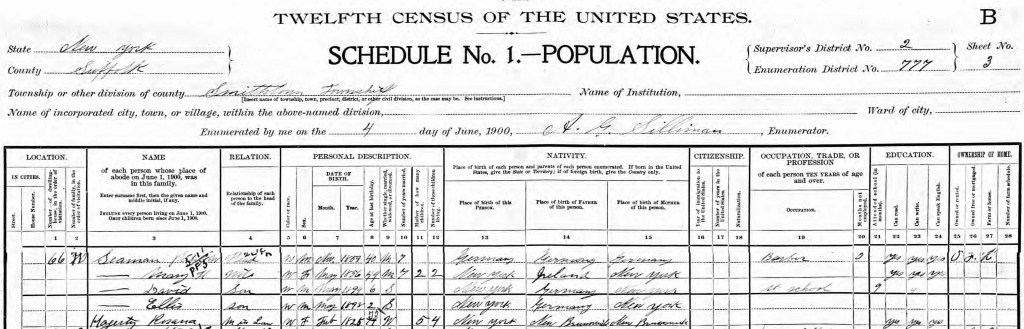
Mary and Paul’s household at the turn of the century in 1900
Source: 1900 US census, Suffolk County, New York, population schedule, Smithtown Township.
The 1890s unfolded as a decade of profound transition in Mary’s personal life, marked by late motherhood, physical vulnerability, and the establishment of a permanent home. Married in March 1893, she entered motherhood at an age when many women were already raising adolescents. On 24 May 1894, at thirty-eight, she gave birth to her first son, David Seaman, an event that coincided with a period of physical hardship rather than domestic repose.13 In December 1893, only months before David’s birth, a local newspaper reported that “Mrs. Mary Seaman of this place fell and fractured her hip one day this week,” an injury expected to confine her to the house for some time.14 Pregnancy did not shield her from the physical dangers of daily life nor from the demands of household labor. Instead, the episode underscores the precarious balance of work, health, and maternity that shaped women’s lives in late nineteenth-century communities, where even serious injury rarely relieved them of responsibility.
Four years later, Mary again experienced the convergence of childbirth and upheaval. At forty-two, she gave birth to her second son, Ellis, on 10 May 1898, at the very moment the family established a new and lasting household.15 In January of that year, another newspaper noted that “Paul Seaman and family moved into his new house on Maple avenue this week,” marking their transition into the residence that would remain Mary’s home for the rest of her life.16 The move, likely undertaken during the final months of her pregnancy, reflects the continued demands placed upon women even as they approached confinement. Together, these events reveal the 1890s as a decade defined not only by the joys of motherhood but by endurance and adaptation. Within a rapidly changing Smithtown, Mary entered middle age while establishing a stable domestic center on Maple Avenue where she would raise her children, care for her aging mother, and gradually transform her household into a gathering place for the religious, charitable, and temperance work through which she and other women sought to reinforce moral order on a community in transition.17
It was precisely in this context that the Woman’s Christian Temperance Union flourished. Founded nationally in 1874, the W.C.T.U. became one of the largest women’s organizations in American history. Historians note that its appeal lay not only in opposition to alcohol but in its capacity to translate private anxieties into public action. Paul Boyer has argued that moral reform movements emerged from a sense that traditional mechanisms of social control—family authority, church structure, neighborhood surveillance—were weakening under the pressures of urbanization and capitalism.18 In communities like Smithtown, where growth and mobility unsettled older patterns of order, temperance offered a framework through which women could respond to change with organized, collective purpose.
Mary’s embrace of temperance fits squarely within this interpretive framework. She was not a distant supporter but an active organizer. From at least October 1897, when newspapers first record her presence at W.C.T.U. meetings, through the early 1930s, local papers repeatedly document her central role in temperance activity.19 Her Maple Avenue home became a principal meeting place for the Smithtown branch of the W.C.T.U., hosting regular gatherings, all-day work sessions, business meetings, victory dinners celebrating the Eighteenth Amendment, and covered luncheons.20 The sheer frequency of these notices—appearing year after year, often multiple times annually—signals not ceremonial participation but sustained labor. Through these gatherings, Mary helped anchor a moral network that sought to counter the perceived disorder accompanying growth, mobility, and the expanding culture of drink.
Hosting was itself a form of moral work. Meetings held in Mary’s home blurred the boundary between private and public space, modeling the orderly domestic environment reformers hoped to extend outward into the community. Business was conducted around dining tables; covered luncheons punctuated all-day sewing sessions; refreshments followed discussions of budgets, elections, and charitable work. Such practices were not incidental. They reinforced the W.C.T.U.’s vision of social reform rooted in structure, hospitality, and female respectability, demonstrating that the well-regulated home could serve as a template for the well-regulated town.
Mary also exercised formal authority within the organization. Over the years she served as treasurer, second vice president, third vice president, and secretary—sometimes holding multiple offices simultaneously. In October 1922 she was elected both second vice president and treasurer of the Smithtown W.C.T.U., positions that required literacy, numeracy, trustworthiness, and organizational skill.21 As treasurer she managed funds raised through fairs and sales; as secretary she recorded minutes and correspondence; as vice president she helped guide the branch’s priorities and activities. These roles placed her at the administrative heart of the local movement, ensuring that the ideals of temperance were translated into sustained institutional practice.

One of more than forty newspaper references documenting Mary’s work with the WCTU
Source: The Port Jefferson Echo July 20, 1907
The work of the Smithtown W.C.T.U. extended well beyond meetings. Members organized rag sewing for charitable institutions such as the Wayside Home for Girls, prepared goods for fairs, assembled “cheer bags” for the sick, and coordinated visits to those in need. In November 1922 an all-day rag sewing session was held at Mary’s home to make rugs for the Wayside Home.22 In January 1929 a meeting there included the reading of “two very beautiful letters” thanking the Union for Christmas cheer bags.23 Such activities transformed abstract moral commitments into tangible care. By linking temperance to charity, domestic order, and mutual aid, Mary and her fellow reformers sought not merely to condemn vice but to construct a countervailing culture of regulation, sympathy, and communal responsibility within a town they believed was changing too quickly.
Mary’s parallel involvement in the Society for Lending Comforts to the Sick reveals how temperance, charity, and healthcare overlapped within a broader culture of female reform. Serving repeatedly as refreshments chair and later as secretary of the society, Mary helped sustain an organization that provided tangible aid—bedding, clothing, and support—to households destabilized by illness. In communities without hospitals or comprehensive social services, such voluntary labor filled critical gaps, reinforcing the moral obligation to care for the vulnerable while also stabilizing families under strain. In May 1926, an all-day work meeting of the society was held at Mary’s home, complete with a covered luncheon and planning for the annual fair.24 In September 1928, she was elected secretary at the society’s twenty-second annual meeting, recognition of two decades of invaluable service to the community and of her reputation for reliability, organizational skill, and compassion.25
Mary’s reform work also encompassed youth and moral education, reflecting a belief that social order required cultivation across generations. In July 1909, she took a group of young girls on an outing near the river, an activity that aligned with the W.C.T.U.’s emphasis on wholesome recreation as an antidote to urban vice.26 Reformers understood leisure as a formative force: if properly structured, it could shape character, instill discipline, and prevent moral decline. Such outings were modest in scale but significant in intention, reinforcing the conviction that the habits of respectability and self-control had to be nurtured early if communities were to remain stable.
Mary’s civic engagement also extended into the church itself, where religious devotion and social reform operated as mutually reinforcing endeavors. Deeply involved in St. James Episcopal Church and its Woman’s Auxiliary, she hosted regular business meetings and devotional gatherings at her home throughout the 1920s and early 1930s. In January 1931, the Woman’s Auxiliary held its regular monthly business meeting at her Smithtown Branch home.27 Her participation in the Women’s Foreign Missionary Society of the Presbyterian Church further demonstrates the ecumenical character of women’s reform networks. Serving as secretary and attending well-attended meetings that drew seventy-six members, Mary moved comfortably across denominational lines in pursuit of shared moral objectives.28 Through these overlapping commitments—temperance, charity, youth work, and church service—she helped sustain a dense web of voluntary institutions that sought to maintain order upon an increasingly complex social world.
By the 1910s and 1920s, Mary had become a senior figure within Smithtown’s reform network, her authority rooted in decades of visible and reliable service. Newspaper accounts increasingly described her as a guest of honor at birthday celebrations, surprise parties, and anniversary gatherings—rituals that publicly acknowledged her standing within the community. In May 1928, while visiting her son David in Brooklyn, she was honored at a birthday dinner.29 In May 1930, friends surprised her twice—once with eight local friends at her Maple Avenue home and again at a W.C.T.U. meeting at Mrs. William Walker’s residence, where she was presented with “a pretty birthday cake” and “several pretty gifts from the different members, who hold her in very high esteem.”30 In June 1933, Mrs. Thomas Gunn entertained a group of ladies at tea to mark Mary’s seventy-sixth birthday.31 These were not mere social niceties but recognitions of long service and moral authority. Friends described her as a faithful member “for many years,” language that conveyed reliability, institutional memory, and the steady labor upon which voluntary organizations depended. In associations sustained by unpaid work, such continuity carried profound value.
Mary’s home also served as a bridge between Smithtown’s local world and wider networks of family and mobility. Throughout the 1920s, newspapers regularly noted her entertaining relatives and friends from Brooklyn, Akron, Baltimore, and Newark, as well as her own travels to visit family in Maryland, Schuylkill County, Pennsylvania; New York City; and Sparkill in Rockland County, New York.32 These movements reflected Smithtown’s increasing connectivity to urban centers and Mary’s role as a node within networks that extended far beyond the town’s boundaries. Her household functioned not only as a center of reform activity but as a point of exchange linking rural stability with metropolitan circulation.
Census records from 1910 through 1920 reflect both continuity and quiet transition within the Maple Avenue household. Mary remained there with Paul as their sons matured, established their own households, and moved in and out of the family home in the fluid patterns typical of working- and lower-middle-class families in the early twentieth century.33 Beneath this outward stability, however, the late 1910s brought a series of personal trials. In 1917, Mary’s widowed mother—who had lived with the Seamans since the 1890s—died at the age of eighty-three.34 Her passing closed a decades-long chapter of caregiving that had bound Mary to the responsibilities of daughterhood well into middle age, reinforcing her position as the emotional and practical center of the household.
Hardly had this loss been absorbed when the demands of a nation at war reached into the family. Within months of Rosanna’s death, both of Mary’s sons enlisted for service during the First World War.35 Though they ultimately served stateside rather than overseas, their absence introduced a new and anxious uncertainty into daily life. For Mary and Paul, the war years likely revived familiar patterns of waiting and worry that had shadowed earlier generations, underscoring how even distant conflicts could unsettle the fragile stability they had spent decades constructing. Together, bereavement and wartime separation rendered the closing years of the decade a period marked less by dramatic upheaval than by the steady emotional strain that accompanied aging, loss, and the demands of national service.
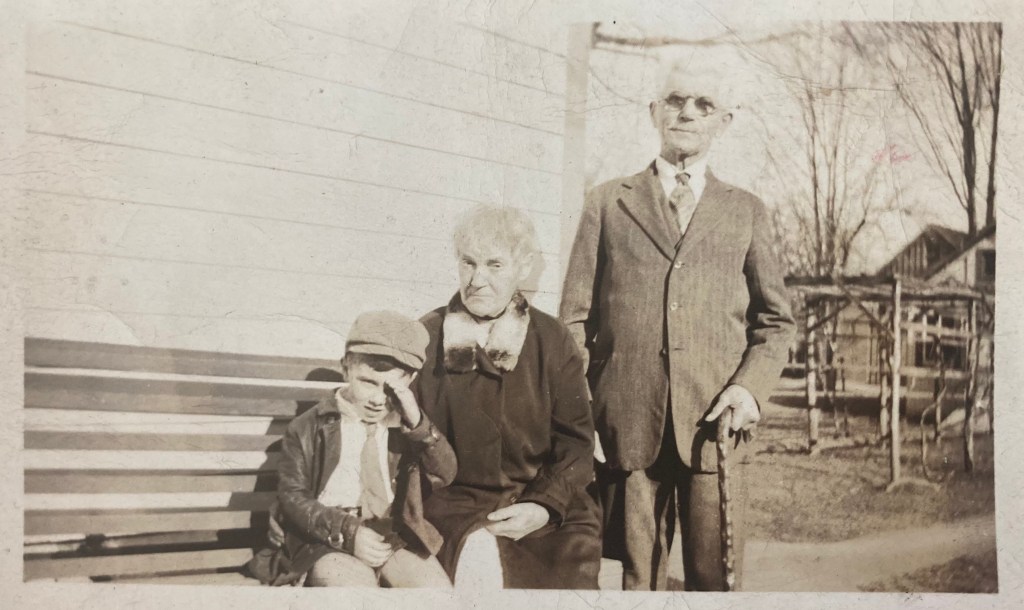
Mary and Paul with grandson James circa 1932
Source: author’s personal collection
By 1920, the Seaman household had quieted, occupied only by Mary and Paul.36 Their son David married Alice Sullivan in February 1925.37 That was followed quickly when their son Ellis married Ruth Genevieve Boylhart in June 1925 in a ceremony that united two Long Island families. Mary became a grandmother three times over with the birth of Phyllis, James, and Robert.38 Yet even as her domestic responsibilities shifted and gradually lessened, her public work did not diminish. Instead, the authority she had accumulated through years of service allowed her to remain a stabilizing presence within Smithtown’s overlapping networks of reform, charity, and church life.
Mary lived to see the temperance movement achieve its greatest triumph. The ratification of the Eighteenth Amendment in 1919 and the onset of national Prohibition represented, for women like Mary, the culmination of decades of disciplined and often unheralded labor. In January 1928, she hosted the W.C.T.U. at “a victory dinner,” an annual event celebrating the amendment’s passage and reaffirming the moral vision that had sustained reformers through years of petitioning, organizing, and local activism.39 Prohibition promised not merely the elimination of the saloon but the restoration of domestic stability: reduced violence within the home, protection of family wages, and the reinforcement of community order. For reformers who had witnessed the rise of cities, the expansion of alcohol consumption, and the perceived erosion of traditional moral restraints, the amendment appeared to confirm their belief that sustained moral activism could reshape American society. To gather around Mary’s table in celebration was to experience that victory as both political achievement and personal vindication.
Yet even as the movement reached its legislative peak, Mary confronted the physical vulnerabilities of advancing age. Newspapers in July 1931 reported that she had recovered from injuries sustained in an automobile accident that required hospitalization at Huntington Hospital, a reminder of both modern mobility and bodily fragility.40 Such episodes, along with periodic illnesses that increasingly kept her at home, gradually shifted her position within the community from active caregiver to recipient of care.
These years made visible the reciprocity embedded in the networks Mary had helped sustain. Friends, neighbors, and fellow church members visited, assisted, and kept watch, offering the same forms of attention she had long extended to others through the W.C.T.U., church auxiliaries, and charitable societies. The domestic space that had once hosted meetings, sewing sessions, and covered luncheons became a site of convalescence and support. By January 1935, Mary was under the care of Mrs. Frank Merky.41 By March, Mrs. Victoria Land of Hauppauge was residing at Mary’s Maple Avenue home to care for her during her final illness, ensuring that she did not face her last months alone.42 In this reversal lay a quiet testament to the communal bonds forged through decades of shared moral work.
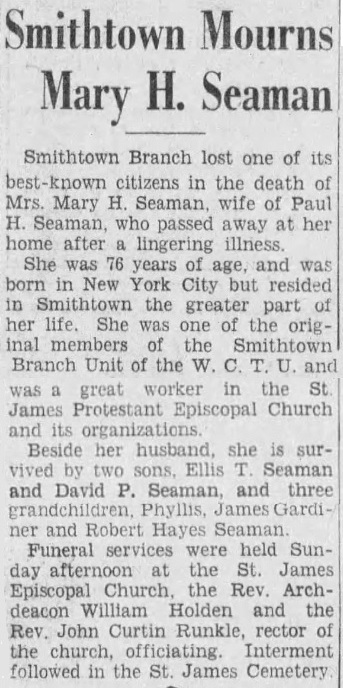
Mary Seaman’s obituary
Source: Brooklyn Eagle April 15, 1935
When Mary died on April 12, 1935, her obituary in the Brooklyn Daily Eagle described her as one of Smithtown’s best-known citizens, “one of the original members of the Smithtown Branch Unit of the W.C.T.U. and a great worker in the St. James Protestant Episcopal Church and its organizations.” The assessment was understated but accurate. She was survived by her husband Paul, sons Ellis and David, and three grandchildren. Funeral services were held at St. James Episcopal Church, with both the Reverend Archdeacon William Holden and the Reverend John Curtin Runkle officiating—a mark of respect that acknowledged her decades of faithful service.43
Mary Seaman’s life traced the arc of a community in transition. Born into a farming household in a small rural town, she witnessed Smithtown’s transformation into a semi-urban community increasingly bound to New York City. Her response was neither retreat nor resignation but engagement. Through temperance work, church leadership, and sustained charitable labor, she sought to make sense of a world that often seemed unsettled by growth and change. Reform was not an abstract ideology for Mary; it was a daily practice rooted in the belief that stable homes, sober habits, and organized compassion could preserve moral coherence amid uncertainty.
In winter, her grave disappears again beneath an unbroken stretch of snow in the churchyard of St. James Episcopal Church. The stone speaks not of the meetings held in her parlor, the funds carefully accounted for in her ledgers, the comfort bags assembled at her table, or the decades spent sustaining institutions that shaped Smithtown’s moral life. Yet the simplicity of the marker belies the density of the life it covers. To recover Mary Seaman’s story is to see what the stone does not show: the steady labor of a woman who, without holding formal power, helped build and defend a moral world amid profound transformation.
Endnotes
- Find a Grave, “Mary H. Seaman (1856-1935),” Memorial 77787730, citing Saint James Episcopal Church Graveyard, Saint James, Suffolk County, New York, accessed February 17, 2026, https://www.findagrave.com/memorial/77787730/mary-h-seaman.
- Although Mary’s grave records her year of birth as 1858, the early records of her life that were recorded by her parents note that her year of birth is 1856 (including as late as 1900). By the time Mary died in 1935, anyone who could have conclusively known her year of birth was gone. Mary had been self-reporting her year of birth on the census as anything from 1856-1860.
- 1860 U.S. Census, Agricultural Schedule, Town of Smithtown, Suffolk County, New York, John Haggerty farm, page 3, line 1, digital image, Ancestry (http://www.ancestry.com: accessed 2026).
- 1860 US census, Suffolk County, New York, population schedule, Smithtown Township, John Haggerty household, dwelling 141 family 149, digital image, Ancestry (http://www.ancestry.com: accessed February 2026); citing National Archives Microfilm Publication, page 19.
- 1870 US census, Suffolk County, New York, population schedule, Smithtown Township, John Haggerty household, dwelling 24 family 25, digital image, Ancestry (http://www.ancestry.com: accessed February 2026); citing National Archives Microfilm Publication M593, Roll 1101, page 124B.
- 1865 New York state census, Suffolk County, population schedule, Smithtown Township, Edward Smith household, page 58, digital image, Ancestry (http://www.ancestry.com: accessed February 2026).
- 1870 US census, Suffolk County, New York, population schedule, Smithtown Township, Cyril Burr household, dwelling 1168 family 1238, digital image, Ancestry (http://www.ancestry.com: accessed February 2026); citing National Archives Microfilm Publication M593, Roll 1101, page 547B.
- Suffolk County Department of Planning, Historical Population of Suffolk County Towns, 1850-2010 (Hauppauge, NY: Suffolk County Government, n.d.), p. 17, https://www.suffolkcountyny.gov/Portals/0/formsdocs/planning/Research/Historical_pop.pdf.
- 1880 US census, Suffolk County, New York, population schedule, Smithtown Township, John Haggerty household, dwelling 297 family 320, digital image, Ancestry (http://www.ancestry.com: accessed February 2026); citing National Archives Microfilm Publication 1245935, Roll 935, page 423A.
- “Died,” The Long-Islander (Huntington, NY), March 11, 1881, 2.
- Suffolk County Department of Planning, Historical Population of Suffolk County Towns, 1850-2010 (Hauppauge, NY: Suffolk County Government, n.d.), p. 17, https://www.suffolkcountyny.gov/Portals/0/formsdocs/planning/Research/Historical_pop.pdf.
- “Smithtown Local Record,” South Side Signal (Babylon, NY), December 28, 1889, 3.
- “U.S., World War I Draft Registration Cards, 1917–1918,” digital image, Ancestry.com (https://www.ancestry.com: accessed February 2026), entry for David Seamen, Suffolk County, New York; citing World War I Selective Service System Draft Registration Cards, 1917–1918, NARA microfilm publication, National Archives and Records Administration, Washington, D.C.
- “St. James,” The Port Jefferson Echo (Port Jefferson, NY), December 2, 1893, 2.
- New York State Military Museum, “New York, Abstracts of World War I Military Service, 1917–1919,” service record for Ellis Seaman, service no. 191-37-86, service start date August 12, 1918; New York State Adjutant General’s Office, Albany, NY; digital image, Ancestry.com (https://www.ancestry.com : accessed February 2026).
- “Smithtown Branch,” The Port Jefferson Echo (Port Jefferson, NY), January 29, 1898, 2.
- 1900 US census, Suffolk County, New York, population schedule, Smithtown Township, Paul Seaman household, dwelling 66 family 71, digital image, Ancestry (http://www.ancestry.com: accessed February 2026); citing National Archives Microfilm Publication 1241166, Roll 1166, page 3B.
- See Paul Boyer, Urban Masses and Moral Order in America, 1820–1920 (Cambridge, MA: Harvard University Press, 1978).
- “Smithtown Branch,” The Port Jefferson Echo (Port Jefferson, NY), October 9, 1897, 2.
- “Smithtown Branch,” Port Jefferson Echo (Port Jefferson, NY), July 20, 1907, 1; “Smithtown,” Long-Islander (Huntington, NY), July 14, 1922, 6; “SMITHTOWN,” Long-Islander (Huntington, NY), January 14, 1927, 11; “Smithtown,” Long-Islander (Huntington, NY), January 13, 1928, 5; “Smithtown,” Long-Islander (Huntington, NY), January 12, 1934, 4.
- “Smithtown,” Long-Islander (Huntington, NY), October 20, 1922, 6; “Smithtown Branch,” County Review (Riverhead, NY), November 3, 1922, 20.
- “Smithtown Branch,” County Review (Riverhead, NY), November 3, 1922, 20.
- “Smithtown,” Northport Observer (Northport, NY), January 11, 1929, 15.
- “Smithtown,” Long-Islander (Huntington, NY), May 14, 1926, 6.
- “Smithtown,” Long-Islander (Huntington, NY), September 21, 1928, 5; “Smithtown Notes,” Port Jefferson Echo (Port Jefferson, NY), September 20, 1928, 3.
- “Smithtown Branch,” Port Jefferson Echo (Port Jefferson, NY), July 17, 1909, 1.
- “St. James,” County Review (Riverhead, NY), January 8, 1931, 3; “Saint James,” Port Jefferson Echo (Port Jefferson, NY), January 1, 1931, 5.
- “Smithtown,” Northport Observer (Northport, NY), January 31, 1930, 3.
- “Smithtown,” Port Jefferson Echo (Port Jefferson, NY), May 31, 1928, 3.
- “Smithtown,” Long-Islander (Huntington, NY), May 30, 1930, 5; “Smithtown,” Northport Observer (Northport, NY), June 6, 1930, 7.
- “Smithtown,” Long-Islander (Huntington, NY), June 2, 1933, 4.
- “Smithtown,” Long-Islander (Huntington, NY), November 20, 1925, 11; “Smithtown,” Long-Islander (Huntington, NY), July 30, 1926, 11; “Smithtown,” Long-Islander (Huntington, NY), October 6, 1922, 6; “Smithtown,” Long-Islander (Huntington, NY), September 22, 1922, 6; “Smithtown,” Northport Observer (Northport, NY), October 4, 1929, 7; “Smithtown Branch,” County Review (Riverhead, NY), April 18, 1919, 10.
- 1910 US census, Suffolk County, New York, population schedule, Smithtown Township, Paul Seaman household, dwelling 72 family 72, digital image, Ancestry (http://www.ancestry.com: accessed February 2026); citing National Archives Microfilm Publication T624, Roll 1082, page 4A.
- New York State Department of Health, “Roseanna Haggarty death entry, 1917,” New York State Death Index, 1880–1956, Ancestry.com (https://www.ancestry.com : accessed February 2026), citing Certificate Number 7035.
- New York State Military Museum, “New York, Abstracts of World War I Military Service, 1917–1919,” service record for David Seaman, service no. 191-37-76, service start date May 26, 1918; New York State Adjutant General’s Office, Albany, NY; digital image, Ancestry.com (https://www.ancestry.com : accessed February 2026). New York State Military Museum, “New York, Abstracts of World War I Military Service, 1917–1919,” service record for Ellis Seaman, service no. 191-37-86, service start date August 12, 1918; New York State Adjutant General’s Office, Albany, NY; digital image, Ancestry.com (https://www.ancestry.com : accessed February 2026).
- 1920 US census, Suffolk County, New York, population schedule, Smithtown Township, Paul Seaman household, dwelling 72 family 72, digital image, Ancestry (http://www.ancestry.com: accessed February 2026); citing National Archives Microfilm Publication T625, Roll 1269, page 8B.
- “Marriage Licenses,” Brooklyn Times Union, February 27, 1925, 3.
- “Seaman-Boylhart,” Brooklyn Daily Eagle, June 24, 1925, 7.
- “Smithtown,” Long-Islander (Huntington, NY), January 13, 1928, 5.
- “Smithtown,” Long-Islander (Huntington, NY), July 17, 1931 7.
- “Smithtown,” Long-Islander (Huntington, NY), January 18, 1935, 4.
- “Smithtown,” Long-Islander (Huntington, NY), March 22, 1935, 4.
- “Smithtown Mourns Mary H. Seaman,” Brooklyn Daily Eagle, April 15, 1935, 13.

 Cemetery Tales