
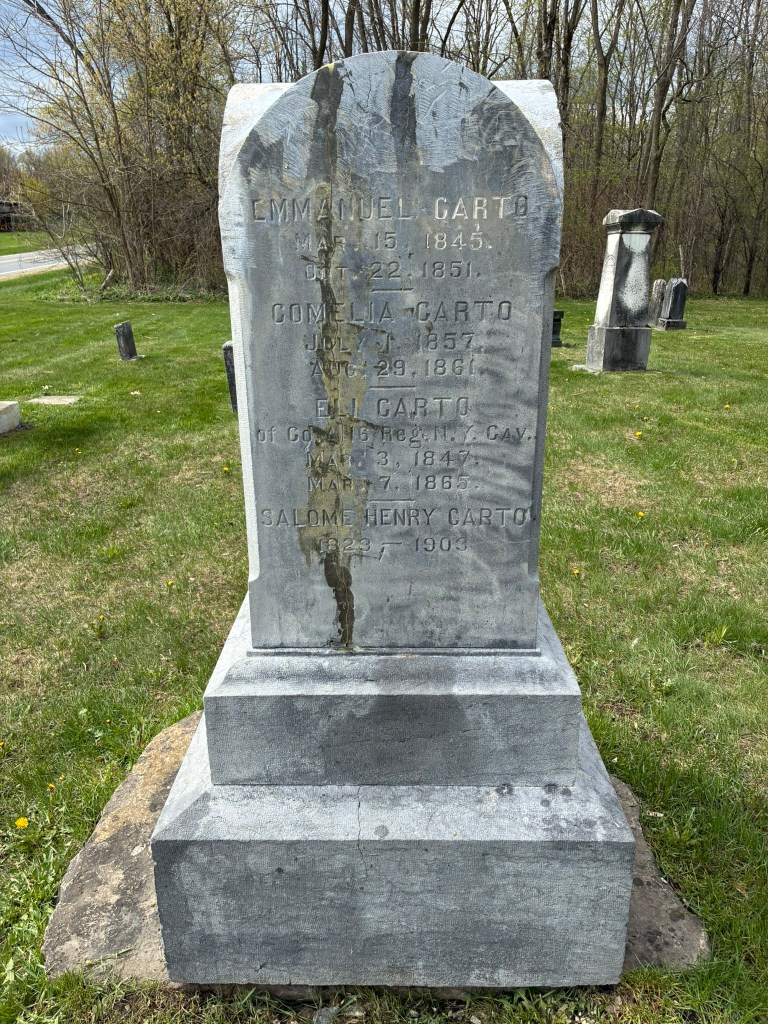
The side of the monument showing the lives of Eli, his mother Salome, and his siblings Emmanuel and Cornelia
Source: author’s personal collection
On a quiet stretch of Creek Road in Perry’s Mills, New York, a monument stands as both a record and a reconstruction. Today, its surface is clean, its cracks repaired, and its broken top restored—its inscriptions once again legible. Not long ago, however, the stone was weathered and fractured, its names fading into the surface, its meaning at risk of being lost. For Eli Carto, the inscription is brief: born March 3, 1847, died March 7, 1865, Company A, 16th New York Cavalry.1 It is the outline of a life reduced to service and death. The restoration of the stone mirrors the work required to recover Eli’s story. Those few words conceal a far richer life—one shaped by family, loss, labor, and a nation at war—and one that survives, like the monument itself, only through deliberate acts of preservation.
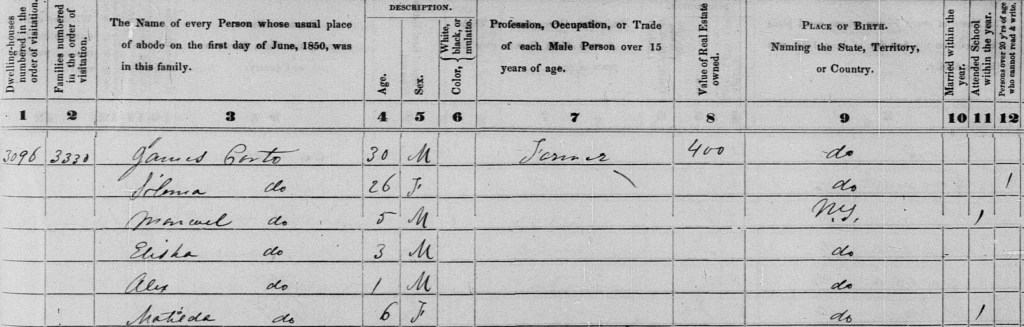
Eli and his family in the federal census in 1850.
Source: 1850 US census, Clinton County, New York, population schedule, Champlain Township.
To find the boy behind the soldier, one must look past the marble and into the ink-stained ledger of the mid-19th century records. The first trace of Eli’s life appears in the 1850 census. At three years old, he lived with his father, James, and mother, Salome, in the hamlet of Perry’s Mills along the western edge of the town of Champlain, New York. Both of his parents were natives of Canada and likely among the early wave of French-Canadian immigrants who crossed the border before the birth of Eli’s eldest sister, Mathilda, in 1844. By the time Eli was born, the household was already a busy one. Mathilda, six, and Emmanuel, five; they would later be joined by their infant brother, Alexander. Their father supported the family on a small farm valued at $400—modest even by local standards.2
While the historical record falls largely silent on the details of Eli’s childhood, the surviving traces of the Carto family during the 1850s reveal a household shaped by both growth and loss. In October 1851, tragedy struck when Eli’s older brother Emmanuel died at just six years old.3 With Emmanuel gone, Eli became the oldest surviving son, a position that likely carried increasing expectations for labor and responsibility on the family farm. Such loss, while devastating, was common in mid-19th-century America, where disease moved quickly and medical treatment remained limited. Scarlet fever, diphtheria, dysentery, and other infectious illnesses routinely claimed children before they reached adulthood.
Even as the family navigated grief, new members joined the household. In June 1853, James and Salome welcomed the birth of another daughter, Amelia.4 Four years later, Cornelia was born into the family as well.5 The 1860 census captures the Cartos in the midst of these transitions. Eli, now thirteen, lived with his parents and surviving siblings Mathilda, Alexander, Amelia, and Cornelia on their modest farm in Perry’s Mills.6 Within a year, however, the family faced loss once more when Cornelia died in August 1861 at the age of four.7
The historical record shows that deaths unfolded during Eli’s formative years, reshaping the structure of the household around him. Of the seven known children born to James and Salome Carto, only two would survive beyond their mid-thirties.8 One died so young that they never appeared in any historical record. For families like the Cartos, loss was not an interruption of daily life—it was woven into the fabric of it.
Eli’s early years were also shaped by the overlapping demands of farm labor and formal schooling. The 1860 census indicates that three children in the Carto household—likely Eli, Alexander, and Amelia—were attending school, a detail that places the family within a minority pattern for the town as a whole.9
In Champlain, schooling was not simply a default stage of childhood but a choice shaped by household stability, property ownership, and the ability to absorb the loss of labor that schooling required. For Eli, attending school meant leaving the farm each day for a walk of roughly one mile to a one-room schoolhouse and then returning home along the same route. In fair weather, the journey followed dirt roads cut between fields and fences, with the Great Chazy River marking a shifting boundary between work and learning. In winter, however, that same mile would have been far more punishing—snowdrifts, wind sweeping across open farmland, and the constant exposure that defined life along the northern border.
Eli’s daily walk to school reflected choices that many families in Champlain could not—or did not—make. Analysis of the town’s 1860 census reveals that property ownership was the strongest predictor of school attendance. Families with even modest real estate holdings sent children to school at significantly higher rates than landless households.10 The difference was not primarily one of wealth, but of stability. Small farms like the Cartos’ provided enough economic footing to permit children to spend at least part of the year in the classroom rather than entirely in the fields or labor market.
That distinction was especially significant for French Canadian immigrant families like the Cartos. Nearly half of the town’s school-age households were headed by Canadian-born parents, yet those households consistently reported lower school attendance rates than native-born families.11 Much of that disparity appears tied not to ethnicity itself, but to economics: Canadian-born residents were substantially less likely to own land and far more likely to work as day laborers, circumstances that made regular schooling difficult to sustain.
Against that backdrop, the Cartos stand out. Despite operating only a modest farm—valued at approximately $500 in land and improvements in 1860—James and Salome Carto consistently kept their children connected to formal education.12 For Eli, that commitment meant balancing the responsibilities of farm labor with the routines of the schoolhouse. Every day spent in class represented time unavailable for work at home, particularly during planting and harvest seasons when labor demands intensified.
What emerges is a portrait of schooling not as routine, but as deliberate investment. For Eli, the road to the schoolhouse was not only a physical journey along rural roads crossing the Great Chazy River, but also evidence of a family attempting to secure stability and opportunity within a community where many immigrant households remained economically precarious.
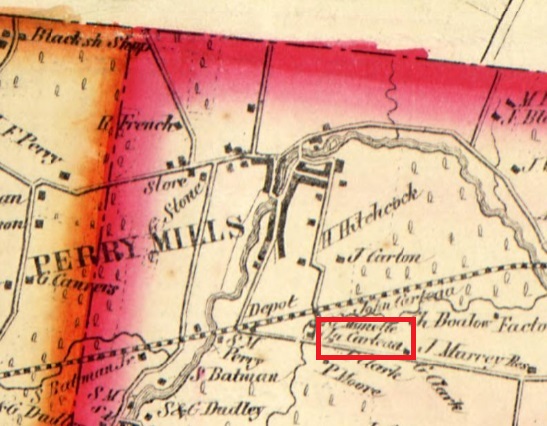
The railroad cutting between the farms of Eli’s father and grandfather (just north of the railroad)
Source: Ligowsky, A. Map of Clinton Co., New York. Philadelphia: O.J. Lamb, 1856.
Eli’s education unfolded alongside another force reshaping life in Perry’s Mills: the changing economy of northern New York agriculture. In 1850, while Eli was still a young boy, the Ogdensburg and Lake Champlain Railroad opened through the region, linking farms in Clinton County to expanding urban markets across the Northeast.13 The transformation was immediate and deeply personal. The tracks themselves cut directly through land owned by Eli’s father and grandfather, a visible reminder that even this quiet rural community was being drawn into a rapidly modernizing world.
For families like the Cartos, the railroad altered the meaning of farming. Agricultural goods could now move more easily beyond local markets, while manufactured products, newspapers, and outside influences flowed back into rural communities. The relative isolation that had once defined places like Perry’s Mills slowly began to erode, replaced by new opportunities as well as new economic pressures.
The 1860 agricultural census offers a detailed snapshot of how the Carto family navigated these changes. Their farm remained modest—just sixteen acres of improved land—but it was far from simple. Three horses provided labor, a milk cow supported butter production, and nine sheep yielded wool. The family also cultivated wheat, corn, oats, peas, beans, potatoes, buckwheat, and hay, reflecting a carefully diversified operation designed to reduce risk rather than maximize profit.14
Within the broader agricultural landscape of Champlain, the Cartos occupied the lower tier of landholding farmers. Farms in the town averaged substantially larger acreages and far greater cash values than their property, which was valued at approximately $500 in 1860.15 Yet families like the Cartos formed an important middle ground within the rural economy: they owned land and maintained independent farms, but operated with little margin for failure.
That economic position shaped Eli’s daily life. By his early teenage years—and especially after the death of his older brother Emmanuel—Eli’s labor had become essential to the household. On a farm of this size, work could not easily be divided or replaced.16 Seasonal rhythms structured daily existence: clearing and planting in the spring, tending crops through the summer, harvesting in the fall, and caring for livestock through the long northern winters. Even activities that appear minor in the agricultural census, such as butter production or wool processing, required sustained labor across the family.
The arrival of the railroad likely intensified these pressures. Larger farmers could increasingly specialize and produce surpluses for distant markets while absorbing poor yields or temporary labor shortages. Smaller operators like the Carto family faced a far more precarious reality, where crop failures, illness, or the loss of labor could threaten a household’s stability. Diversification remained necessary for survival even as competition and market expectations steadily increased.17
For Eli, these broader economic transformations were not abstract developments. They were experienced through work—through the physical demands of helping maintain a small farm that depended on every available hand. On farms like the Cartos’, every bushel, every animal, and every day of labor contributed directly to the family’s survival. In this sense, Eli’s adolescence was shaped not only by preparation for adulthood, but by immediate responsibility within a household that already depended upon his labor.
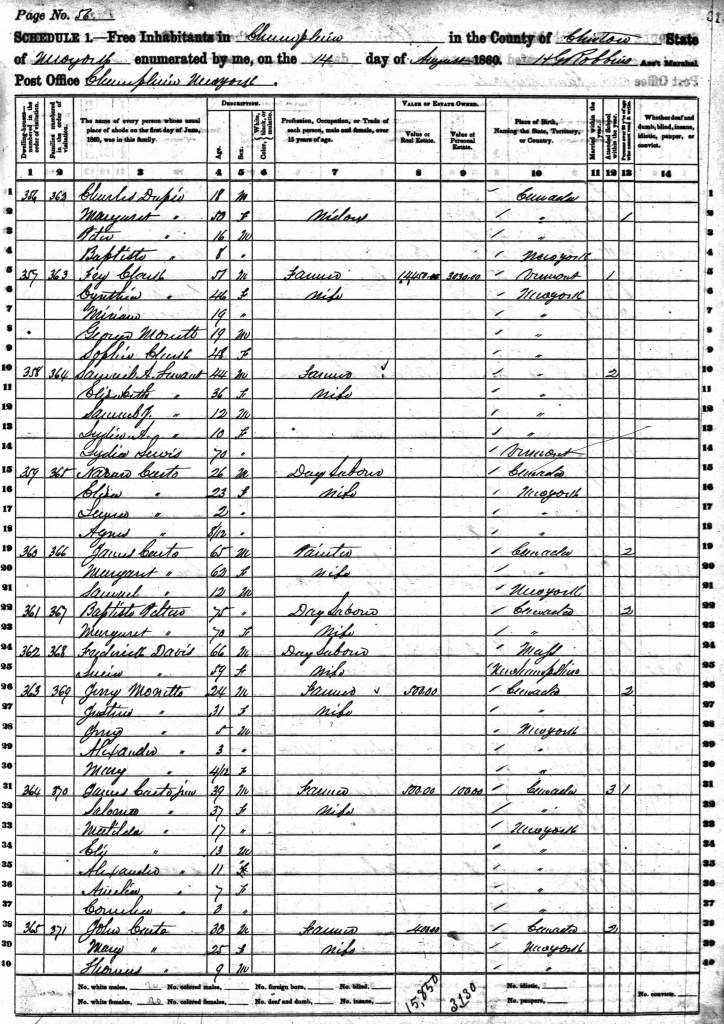
This single census page illustrates the larger network that surrounded Eli during his lifetime: his immediate family; his grandfather James and grandmother Margaret with uncle Samuel; his cousin George Monette (working for Fry Clark); and numerous other uncles, aunts, and cousins
Source: 1860 US census, Clinton County, New York, population schedule, Champlain Township.
Farming also extended beyond the immediate Carto household. Eli’s grandfather and uncle John operated nearby farms, and labor was likely shared among family members during the busiest periods of the agricultural year. Eli would have also spent considerable time with his uncles Eleazor and Samuel, both close in age to Eli.18 Together, these relationships formed a tightly connected rural network rooted in labor, kinship, and mutual dependence. Within a few years, however, that world would be tested by events unfolding far beyond Perry’s Mills.
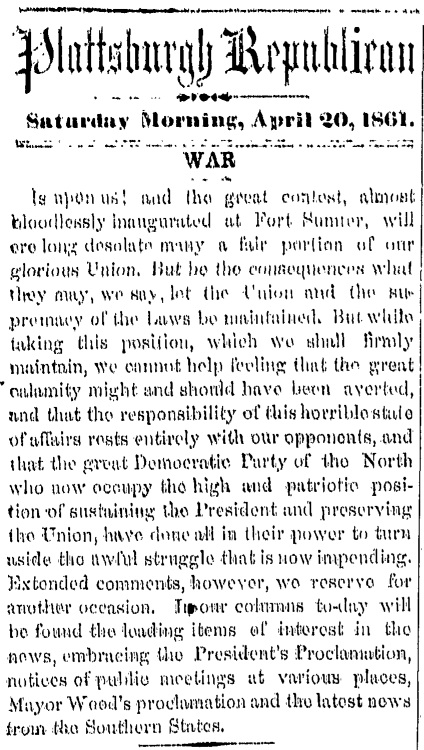
The sort of article Eli would have seen announcing the war in a local newspaper
Source: Plattsburgh (NY) Republican, April 20, 1861.
In April 1861, news reached Perry’s Mills that Confederate forces had fired on Fort Sumter.19 Even in this remote northern community near the Canadian border, the impact was immediate. Newspapers carried reports of the attack alongside President Lincoln’s call for 75,000 volunteers, bringing the national crisis into homes and conversations across Champlain. What had once seemed distant political tension was now open war.
By the fall of that year, the conflict had become personal for the Carto family. On October 2nd, Eli’s uncle Jerome enlisted as a private in Company D of the 34th New York Infantry, a company filled with men from the town.20 Less than two weeks later, George Monette joined Company H of the 60th New York Infantry.21 Men from communities like Perry’s Mills were no longer simply reading about the war—they were leaving home to fight it.
Both men would return home—but not unchanged. In September 1862, Jerome fought with the 34th New York Infantry at Antietam, one of the bloodiest single days in American history. The regiment suffered heavily near the Dunker Church, where Company D alone lost nine men killed or mortally wounded. Jerome himself lost the middle finger of his left in the fighting and eventually discharged because of those injuries.22 For communities like Champlain, battles such as Antietam were not experienced through casualty statistics alone. The wounded returned home carrying visible reminders of the war, while the dead left absences that reshaped families and neighborhoods alike.
Monette’s fate was quieter but no less tragic. He fell ill during his service and was discharged for disability on October 17, 1862.23 He returned home, died on July 9, 1863, and was buried within sight of Eli’s home.24 By then, war was no longer an abstraction for Eli. It had entered the community, the family, and the landscape itself.
We cannot know exactly what led Eli to enlist in December 1863 at the age of sixteen. But the influences surrounding him were impossible to ignore: a wounded uncle returned from Antietam, a relative who came home sick and later died, and a steady stream of news from a war that seemed both distant and increasingly personal. By the end of 1863, military service had become woven into the experience of families throughout Champlain, including the Cartos.
Eli enlisted on December 16, 1863, and was mustered into Company A of the 16th New York Cavalry twelve days later. At the time of his enlistment, he was described as five feet seven inches tall, with hazel eyes, dark hair, and a dark complexion.25 Raised on a farm where horses shaped daily labor and transportation, Eli’s decision to join the cavalry was hardly surprising.
He also did not enter service alone. Eli enlisted alongside his uncle Eleazor Carto, the brother of Jerome, who had been wounded at Antietam. The following year another uncle, Samuel Carto, joined the same regiment.26 Like many Civil War units, Company A of the 16th New York Cavalry was built not simply from individual volunteers, but from networks of families and communities who entered the war together.
Eli left no letters or diaries from his time in the service, but the history of the 16th New York Cavalry offers insight into the world he entered after leaving Perry’s Mills. For much of Eli’s enlistment, the regiment served in the defenses of Washington, D.C., patrolling the unsettled countryside of northern Virginia. This was not a quiet assignment. Cavalry units were constantly engaged in scouting, escort duty, picket service, and sudden skirmishes with Confederate forces operating beyond the capital.
In 1864 alone, the regiment participated in dozens of such engagements. These were not the decisive confrontations similar to Antietam, but a sequence of jagged, localized clashes that defined much of the war’s daily reality for cavalrymen. The cost was high, though often difficult to quantify. At Centreville in June 1864, the regiment reported thirty-nine casualties, thirty-four of them listed as missing—a stark indicator of the chaotic and disorienting nature of their service.. At Falls Church in August, another twenty-three were reported as casualties with fifteen missing. These figures do not just represent loss; they represent erasure. In a world of sudden ambushes and shattered formations, a soldier might vanish into the woods or a prison camp without a witness.27 For Eli, military service became a grinding rhythm of patrols, uncertainty, and exhaustion—a persistent, invisible danger that lacked the closure of a decisive battlefield.
Much of that danger came from Confederate partisan ranger John Mosby and the irregular cavalrymen who operated throughout the region Union soldiers came to call “Mosby’s Confederacy.” For men like Eli, Mosby’s command represented a uniquely unsettling enemy. They rarely fought as conventional troops or held fixed positions. Instead, they moved in small mounted groups, appearing suddenly along roads or near isolated outposts before disappearing just as quickly into the woods, farms, and back roads of northern Virginia.28
For a young cavalryman riding patrol, this meant that no movement was entirely routine. A quiet stretch of road could become a site of violence within moments. Fields, tree lines, and narrow lanes offered concealment to enemies who knew the landscape intimately, while civilians could provide information to either side. Uncertainty itself became part of military life. Long before his final skirmish, Eli had already spent months operating within a world where danger was often sudden, confusing, and difficult to anticipate.
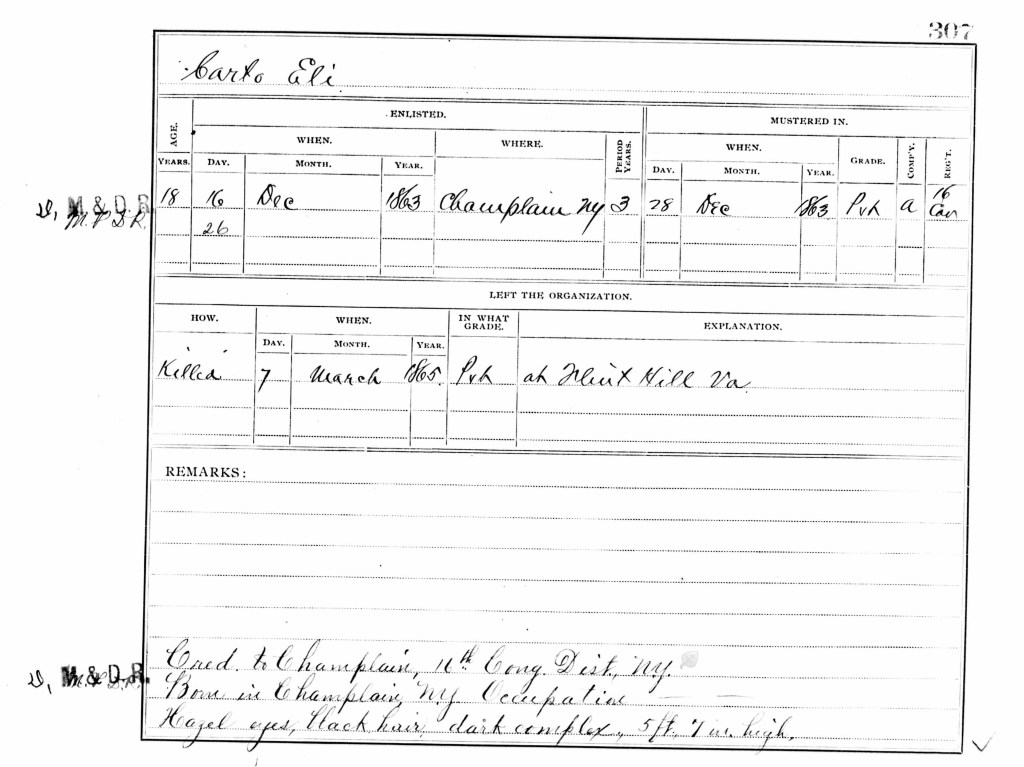
Eli’s Civil War muster role record showing all of the key information about his service
Source: New York State Archives
On March 7, 1865, just four days after his eighteenth birthday, Eli was part of a twenty-man patrol led by 2nd Lieutenant Olney Gault and Sergeant Otto Richter. It was another routine assignment in a war where uncertainty was constant and danger could emerge without warning. The patrol left camp in Vienna, Virginia, rode toward Fairfax Courthouse, and then turned back toward Vienna along the familiar roads of northern Virginia.29
Near Flint Hill, the patrol spotted mounted men emerging from nearby woods. Within moments, the encounter dissolved into confusion. Orders were given, the patrol attempted to form line, and then the cohesion of the unit suddenly collapsed. In the chaotic retreat that followed, Eli Carto was shot and killed. He was the only Union soldier to die on the field that day, though another later succumbed to his wounds.30
In many ways, the skirmish that ended Eli’s life was typical of the war he had been fighting for more than a year: a brief and disorienting clash between small mounted units in the contested landscape of northern Virginia. The skirmish that ended Eli’s life was not unusual in form, but it became extraordinary because of how quickly the patrol collapsed.
What unfolded near Flint Hill survives in unusually detailed testimony: the formal report of Colonel Nelson B. Sweitzer, the account of Lieutenant Olney Gault, and the sharply critical statement of Sergeant Otto Richter. Taken together, these reports do more than reconstruct a minor skirmish. They expose the fragile behavioral code Civil War soldiers were expected to uphold when fear, confusion, and violence arrived faster than instruction.
Historians have shown that Union soldiers operated within a culture of “embattled courage,” where manhood was measured not simply by willingness to fight, but by the ability to resist panic and remain steady under pressure. Courage, in this sense, was never entirely individual. It depended upon the behavior of other men and could collapse as quickly as discipline itself.31
That expectation sits beneath every line of the reports describing Eli Carto’s final patrol.
The force itself was small—one lieutenant, one sergeant, and twenty men—moving through northern Virginia, a landscape where contact with the enemy was intermittent but always possible. When Confederate horsemen appeared, both Gault and Richter agreed that the patrol was caught unprepared. Richter’s account is precise and procedural. The patrol, he noted, was “marching in column by twos, without an advance guard or flankers,” a formation that left the men vulnerable to sudden attack.32 Under such conditions, discipline mattered immediately. Once enemy horsemen appeared, the patrol’s survival depended not simply on weapons or numbers, but on whether the men continued to move and respond together.
When the enemy emerged—“about thirty mounted men,” according to Richter—the patrol entered the moment in which those expectations were tested.33 What followed is less a disagreement about facts than a divergence in how breakdown itself was interpreted.
Richter describes a sequence in which he calls for formation and Gault hastily issued an order three times for the unit to form into line. When Richter moves to the right of the line, he looks around and notices—almost immediately—Gault “galloping from the field to the rear,” followed by the men.34 In Richter’s telling, leadership failed at the exact moment it is most needed: not after resistance collapses, but before it can even begin. The crucial issue was not retreat alone, but the disappearance of visible steadiness at the moment fear began to spread.
Gault’s report confirms the retreat but frames it differently. He wrote that upon realizing the enemy was “too strong,” the men broke and he ordered them to fall back.35 In his version, retreat was not abandonment but adaptation to overwhelming force. Within Civil War culture, however, the legitimacy of retreat depended not only upon military necessity, but upon whether withdrawal preserved order and cohesion. A retreat conducted under control could still be interpreted as courageous; one that dissolved into panic could not.
It is precisely along that fault line where Gault’s and Richter’s accounts diverge. Richter’s condemnation is not simply tactical—it is deeply personal. Upon reviewing the reports, Colonel Nelson Sweitzer, commander of the 16th New York Cavalry, concluded that Gault “did not…endeavor to inspire the men to meet the attack.”36 In the language of the Civil War soldier, inspiration meant more than encouragement; Colonel Sweitzer’s critique—that Gault failed to ‘inspire’—was not a vague sentiment: it was a technical indictment. Officers were expected to display visible steadiness under pressure so that other men would remain steady as well. When that performance failed, panic spread quickly. Once the lieutenant turned to the rear, the meaning of movement itself changed: what might have begun as an organized withdrawal dissolved into flight. Eli was caught inside that collapse.
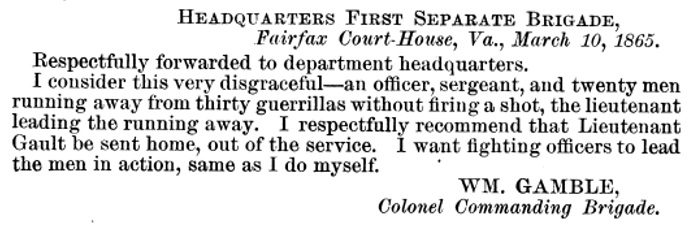
The brigade commander’s final assessment of the skirmish in which Eli Carto perished
Source: The War of the Rebellion: a Compilation of the Official Records of the Union and Confederate Armies
When brigade commander William Gamble reviewed the reports, his judgment was blunt: “I respectfully recommend that Lieutenant Gault be sent home, out of the service. I want fighting officers to lead the men in action, same as I do myself.”37 Under the scrutiny of leadership, Eli’s final moments transformed a chaotic skirmish into a referendum on leadership as Gault’s flight became seen as the literal catalyst for the patrol’s breakdown. By galloping to the rear, Gault didn’t just seek safety; he effectively dissolved the legal and moral structure of the patrol. At that moment, the twenty men ceased to be a unit of the United States Army and became twenty individuals fleeing for their lives. Eli, caught in the friction of that transition, was left exposed. By the end of April 1865, Gault was discharged—another casualty, in a sense, of the skirmish that claimed Eli Carto’s life.38 The army’s decision to send Gault home was an attempt to excise a contagion of fear before it could spread further into the ranks of men recruited from towns like Champlain.
In that sense, Eli’s death cannot be separated from the breakdown of the group discipline Civil War soldiers believed defined courage itself. Manhood, as many soldiers understood it, depended not on the absence of fear but on the ability to remain composed and visible within a unit under strain. Once command ceased to hold the patrol together, the expectations surrounding courage and discipline collapsed in practice, even if they remained powerful ideals.
Eli’s final experience of war was defined not by the presence of enemy force alone, but by the sudden dissolution of the unit meant to contain it. In the space where discipline was supposed to hold, it instead fractured. And in that fracture—where movement replaced formation and fear replaced command—Eli was killed. There was no large battle, no dramatic last stand, only a brief and disordered encounter on a Virginia road that left an eighteen-year-old cavalryman dead far from the home he had left behind.
Yet Eli’s death did not end his place within the Carto family’s story. The family he left behind continued to live through many of the same cycles of labor, illness, and loss that had shaped Eli’s own childhood.
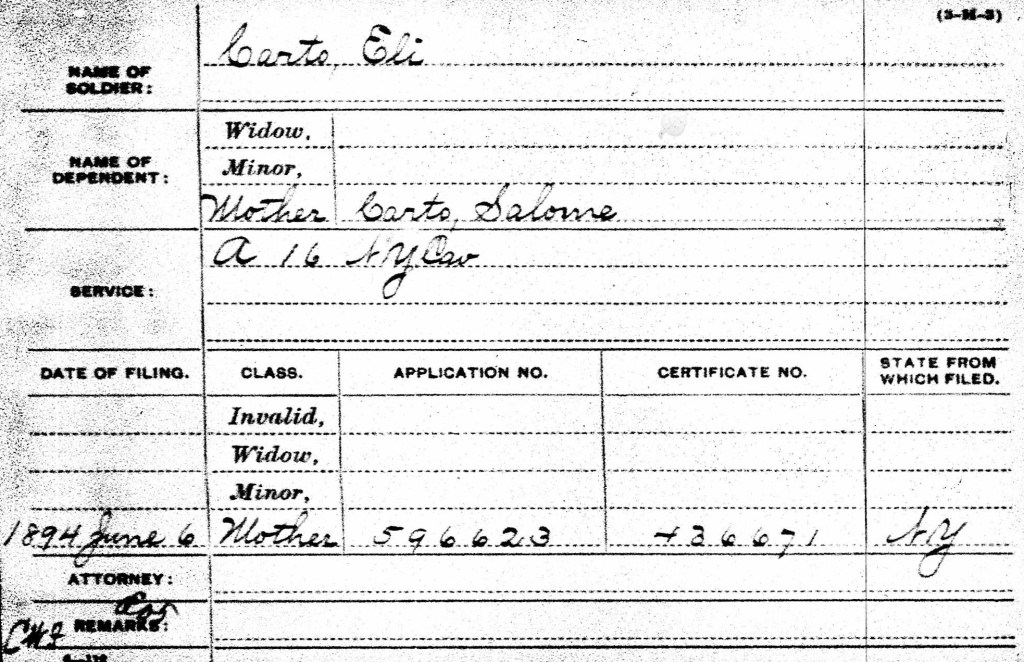
Documentation for the pension application submitted by Eli’s mother Salome in 1894
Source: Civil War Pension Index, National Archives
In January 1880, Eli’s father James died at the age of fifty-nine.39 During the years after Eli’s death, James and Eli’s younger brother Alexander—the last surviving son from the household of Eli’s childhood—had steadily transformed the family’s prospects. The small sixteen-acre farm of Eli’s youth had grown into an eighty-five-acre operation valued at approximately $5,000 and producing nearly $1,000 worth of agricultural goods annually.40 For a brief moment, the Carto family appeared to have achieved a degree of economic stability that earlier years had rarely allowed.
That stability proved fragile. Within two years, both Alexander and his wife Virginia died from tuberculosis, leaving behind two young daughters in the care of Eli’s aging mother, Salome.41 Once again, loss reshaped the structure of the family.
It was during this period that Eli, dead for nearly thirty years, began to provide for the household once more. In 1894, Salome successfully applied for a military pension based on Eli’s Civil War service.42 In the absence of Social Security or any broader public safety net, the pension became an important source of support for a grandmother raising orphaned grandchildren. Even decades after his death on a Virginia road, Eli’s service continued to sustain the family he had left behind.
When Salome died in 1903, she was laid to rest in Perry’s Mills beside her husband and several of her children. Their gravestone gathers the family into a single narrative of survival and loss: Emmanuel, dead in childhood at six; Cornelia, gone at four; Alexander, dead at thirty-one; and Eli, remembered simply as the soldier of the family.43 Yet Eli alone is absent from the ground beneath the stone.
His body never returned from Virginia. Somewhere near Vienna, in a grave now lost to time, Eli Carto was buried far from the roads, fields, and river that shaped his life. The monument in Perry’s Mills is therefore not a grave in the traditional sense, but a cenotaph—a marker erected in place of a missing body. Without it, there would be little in his hometown to testify that he had lived there at all.
That absence gives the stone its power. It does more than commemorate Eli’s military service. It restores him to the family and community from which he was separated by war. At the same time, it binds his story to those of his siblings, revealing how profoundly mortality shaped the lives of rural families in the nineteenth century. On the Carto monument, childhood death, disease, war, and premature loss are all gathered into a single family history carved into stone.
What survives of Eli’s life beyond that monument exists only in fragments: census entries, agricultural schedules, pension applications, and the terse language of military reports describing the moment of his death. Reconstructing his story from those scattered records becomes its own form of restoration, much like the recent preservation of the gravestone itself. The repaired monument on Creek Road now makes visible not simply the memory of one young soldier, but the broader world he inhabited—a world of immigrant families, precarious farms, fragile lives, and a war that reached even the remote northern edge of New York. The inscription on the stone remains brief. But behind those few lines lies a life far larger than the space allotted to it.
Endnotes
- Find A Grave, “Eli Carto (1847–1865),” Memorial 29906221, citing Perry’s Mill’s Cemetery, Champlain, Clinton County, New York, accessed May 11, 2026, https://www.findagrave.com/memorial/29906221/eli-carto.
- 1850 US census, Clinton County, New York, population schedule, Champlain Township, James Carto household, dwelling 3096 family 3330, digital image, Ancestry (http://www.ancestry.com: accessed May 14, 2026); citing National Archives Microfilm Publication M432, 1009 rolls, page 469A.
- Find A Grave, “Emmanuel Carto (1845–1851),” Memorial 29906127, citing Perry’s Mill’s Cemetery, Champlain, Clinton County, New York, accessed May 11, 2026, https://www.findagrave.com/memorial/29906127/emmanuel-carto.
- 1900 US census, Tolland County, Connecticut, population schedule, Vernon Township, Walter Plummer household, dwelling 357 family 469, digital image, Ancestry (http://www.ancestry.com: accessed May 14, 2026); citing National Archives Microfilm Publication, Roll 151, page 19.
- Find A Grave, “Cornelia Carto (1857–1861),” Memorial 29906179, citing Perry’s Mill’s Cemetery, Champlain, Clinton County, New York, accessed May 14, 2026, https://www.findagrave.com/memorial/29906179/cornelia-carto.
- 1860 US census, Clinton County, New York, population schedule, Champlain Township, James Carto Jr. household, dwelling 364 family 370, digital image, Ancestry (http://www.ancestry.com: accessed May 14, 2026); citing National Archives Microfilm Publication M653, page 615.
- Find A Grave, “Cornelia Carto (1857–1861),” Memorial 29906179, citing Perry’s Mill’s Cemetery, Champlain, Clinton County, New York, accessed May 14, 2026, https://www.findagrave.com/memorial/29906179/cornelia-carto.
- 1900 US census, Clinton County, New York, population schedule, Champlain Township, Salome Carto household, dwelling 364 family 363, digital image, Ancestry (http://www.ancestry.com: accessed May 14, 2026); citing National Archives Microfilm Publication roll 1018, page 25.
- 1860 US census, Clinton County, New York, population schedule, Champlain Township, James Carto Jr. household, dwelling 364 family 370, digital image, Ancestry (http://www.ancestry.com: accessed May 14, 2026); citing National Archives Microfilm Publication M653, page 615.
- While families with modest real estate holdings ($1–$700) reported a school attendance rate of 79%, that figure dropped precipitously to 49% for households without any real estate.
- Ethnic origin was a significant factor in educational access: of the 686 qualifying households, those with Canadian-born heads reported a school attendance rate of 50%, compared to 73% for households headed by New York natives.
- 1860 US census, Clinton County, New York, population schedule, Champlain Township, James Carto Jr. household, dwelling 364 family 370, digital image, Ancestry (http://www.ancestry.com: accessed May 14, 2026); citing National Archives Microfilm Publication M653, page 615.
- Doherty, Lawrence. “General History of the O. & L. C. Railroad.” The Railway and Locomotive Historical Society Bulletin, no. 58A (1942): 91–98. http://www.jstor.org/stable/43504337.
- 1860 U.S. Census, Agricultural Schedule, Champlain, Clinton County, New York, p. 7, line 32, entry for James Carto farm; digital image, Ancestry (http://www.ancestry.com: accessed May 14, 2026).
- Across the 224 farms of Champlain in 1860, the average farm contained roughly eighty-five acres of improved land with an average cash value exceeding $4,000, while the Carto farm possessed sixteen acres of improved land and was valued at approximately $500.
- For more information on the comparative structure of northern farms, see Allan Kulikoff’s The Agrarian Origins of American Capitalism (Charlottesville: University Press of Virginia, 1992).
- For more information on railroads and market integration in northern agriculture, see William Cronon’s Nature’s Metropolis (New York: W.W. Norton, 1991).
- 1860 US census, Clinton County, New York, population schedule, Champlain Township, James Carto Sr. household, dwelling 360 family 366, digital image, Ancestry (http://www.ancestry.com: accessed May 14, 2026); citing National Archives Microfilm Publication M653, page 615.
- “War,” Plattsburgh (NY) Republican, April 20, 1861, p. 2, col. 1.
- New York State Division of Military and Naval Affairs, “34th Infantry Regiment Roster,” entry for Jerome Carto, in Annual Report of the Adjutant-General of the State of New York for the Year 1900, Register No. 23 (Albany: Lyon Company, 1901), 171, accessed May 14, 2026, https://dmna.ny.gov/historic/reghist/civil/rosters/Infantry/34th_Infantry_CW_Roster.pdf.
- New York State Division of Military and Naval Affairs, “60th Infantry Regiment Roster,” entry for George Monett, in Annual Report of the Adjutant-General of the State of New York for the Year 1900, Register No. 23 (Albany: Lyon Company, 1901), 765, accessed May 14, 2026, https://dmna.ny.gov/historic/reghist/civil/rosters/Infantry/60th_Infantry_CW_Roster.pdf.
- National Archives and Records Administration, “Special Schedules of the Eleventh Census (1890) Enumerating Union Veterans and Widows of Union Veterans of the Civil War,” Series M123, Record Group 15, entry for Jerome Carto, Warren Township, Worcester County, Massachusetts, p. 1, line 12, accessed via 1890 Veterans Schedules, Ancestry (http://www.ancestry.com: accessed May 14, 2026).
- New York State Archives, “Civil War Muster Roll Abstracts of New York State Volunteers, United States Sharpshooters, and United States Colored Troops [ca. 1861–1900],” entry for George Monett, box 1103-1104, accessed via New York, U.S., Civil War Muster Roll Abstracts, 1861–1900, Ancestry (http://www.ancestry.com: accessed May 14, 2026).
- Records of the Office of the Quartermaster General, Record Group 92, “Card Records of Headstones Provided for Deceased Union Civil War Veterans, ca. 1879–ca. 1903,” entry for George Monett (60th NY Infantry), National Archives at Washington, D.C., accessed via U.S., Headstones Provided for Deceased Union Civil War Veterans, 1879–1903, Ancestry (http://www.ancestry.com: accessed May 14, 2026).
- New York State Archives, “Civil War Muster Roll Abstracts of New York State Volunteers, United States Sharpshooters, and United States Colored Troops [ca. 1861–1900],” entry for Eli Carto, box 547, p. 307, accessed via New York, U.S., Civil War Muster Roll Abstracts, 1861–1900, Ancestry (http://www.ancestry.com: accessed May 14, 2026).
- Eleazor Carto, Champlain Town Clerks’ Registers of Men Who Served in the Civil War, ca. 1861–1865, Collection (N-Ar)13774, Box 12, Roll 8, New York State Archives, Albany. Samel Carto, Champlain Town Clerks’ Registers of Men Who Served in the Civil War, ca. 1861–1865, Collection (N-Ar)13774, Box 12, Roll 8, New York State Archives, Albany.
- Frederick Phisterer, New York in the War of the Rebellion, 1861 to 1865, 3rd ed., vol. 2 (Albany: J. B. Lyon Company, 1912), 940–51, accessed via “16th Cavalry Regiment Table,” New York State Military Museum and Veterans Research Center, https://museum.dmna.ny.gov/application/files/7516/1375/9236/16thCavTable.pdf.
- For more information on John Mosby, see Jeffry D. Wert, Mosby’s Rangers: The 43rd Battalion, Virginia Cavalry, Its Friends and Foes (New York: Simon & Schuster, 1990).
- Olney K. Gault, “Report of Lieut. Olney K. Gault, Sixteenth New York Cavalry,” March 8, 1865, in The War of the Rebellion: A Compilation of the Official Records of the Union and Confederate Armies, series 1, vol. 46, pt. 1 (Washington, DC: Government Printing Office, 1894), 546-7.
- Ibid.
- For the best overview on courage during the Civil War, see Gerald F. Linderman, Embattled Courage: The Experience of Combat in the American Civil War (New York: Free Press, 1987).
- Otto Richter, “Report of Sergeant Otto Richter, Sixteenth New York Cavalry,” March 8, 1865, in The War of the Rebellion: A Compilation of the Official Records of the Union and Confederate Armies, series 1, vol. 46, pt. 1 (Washington, DC: Government Printing Office, 1894), 547-8.
- Ibid, p 548.
- Ibid.
- Olney K. Gault, “Report of Lieut. Olney K. Gault, Sixteenth New York Cavalry,” March 8, 1865, in The War of the Rebellion: A Compilation of the Official Records of the Union and Confederate Armies, series 1, vol. 46, pt. 1 (Washington, DC: Government Printing Office, 1894), 546.
- Nelson B. Sweitzer, “Report of Colonel N.B. Sweitzer, Sixteenth New York Cavalry,” March 8, 1865, in The War of the Rebellion: A Compilation of the Official Records of the Union and Confederate Armies, series 1, vol. 46, pt. 1 (Washington, DC: Government Printing Office, 1894), 545-6.
- W.M. Gamble, “Report of Colonel W.M. Gamble, Commanding Brigade,” March 8, 1865, in The War of the Rebellion: A Compilation of the Official Records of the Union and Confederate Armies, series 1, vol. 46, pt. 1 (Washington, DC: Government Printing Office, 1894), 546.
- New York State Division of Military and Naval Affairs, “16th Cavalry Regiment Roster,” entry for Olney R. Gault, in Annual Report of the Adjutant-General of the State of New York for the Year 1900, Register No. 23 (Albany: Lyon Company, 1901), 847, accessed May 14, 2026, https://dmna.ny.gov/historic/reghist/civil/rosters/cavalry/16thCavCW_Roster.pdf.
- Find A Grave, “James Carto (1820–1880),” Memorial 29906027, citing Perry’s Mill’s Cemetery, Champlain, Clinton County, New York, accessed May 14, 2026, https://www.findagrave.com/memorial/29906027/james-carto.
- 1880 U.S. Census, Agricultural Schedule, Champlain, Clinton County, New York, p. 9, line 8, entry for Alexander Carto farm; digital image, Ancestry (http://www.ancestry.com: accessed May 14, 2026).
- Find A Grave, “Alexander Carto (1849–1881),” Memorial 29906054, citing Perry’s Mill’s Cemetery, Champlain, Clinton County, New York, accessed May 14, 2026, https://www.findagrave.com/memorial/29906054/alexander-carto.
- U.S. Pension Application for Eli Carto, mother Salome Carto, filed June 6, 1894, Application No. 596623, Certificate No. 436671, New York; U.S., Civil War Pension Index: General Index to Pension Files, 1861–1934; Records of the Department of Veterans Affairs, 1773–2007, Record Group 15; National Archives, Washington, D.C., digital image, Ancestry (http://www.ancestry.com: accessed May 14, 2026).
- Find A Grave, “Salome Carto (1823–1903),” Memorial 205509823, citing Perry’s Mill’s Cemetery, Champlain, Clinton County, New York, accessed May 14, 2026, https://www.findagrave.com/memorial/205509823/salome-carto.

