Frederick’s Tale

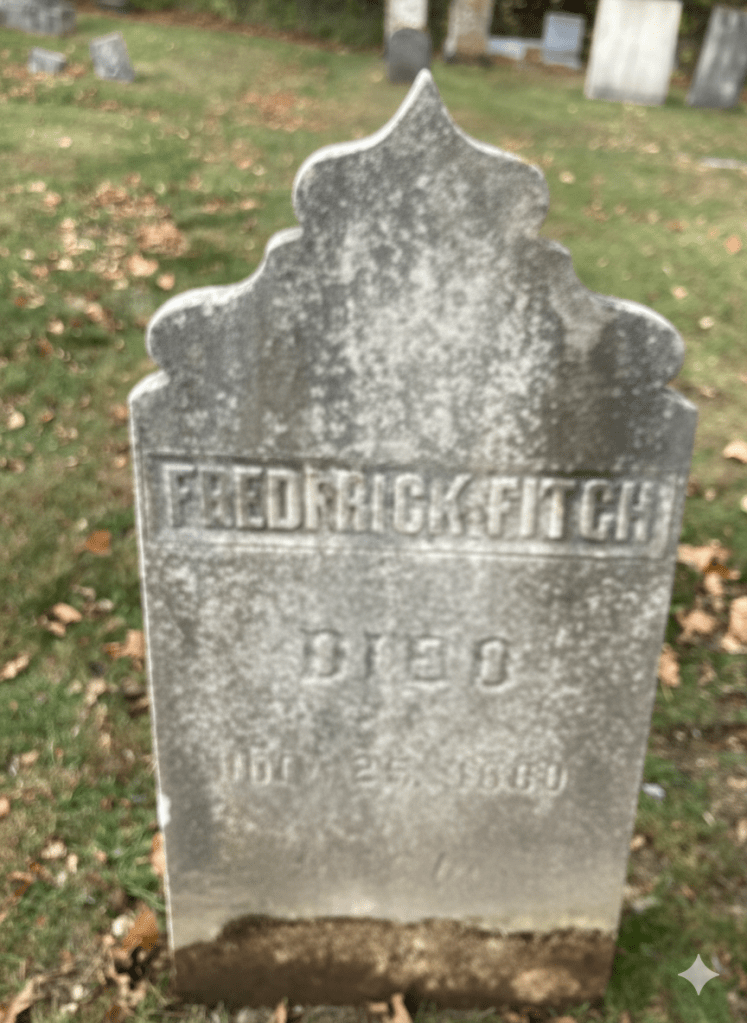
Frederick Fitch’s grave in Maple Hill Cemetery, Champlain, NY

Source: author’s personal collection

Frederick Fitch’s grave lies tucked away in Maple Hill Cemetery on a small rise bordered by the steady hum of traffic along a state highway in Champlain, New York. There he rests beside his wife, their unadorned markers recording only their names and years, the brief inscriptions fading beneath lichen and age. Nothing in those simple inscriptions suggests the long journey that brought them to Champlain from New England or the changing rural world through which they passed. Yet Frederick’s life traces the broader story of many men born in the closing years of the eighteenth century—men who cleared new farms, raised families on uncertain land, and labored through the slow transformation of nineteenth-century America.

Frederick Fitch was born when the young American republic was still defining its ideals. He came into the world in Coventry, Connecticut, on February 27, 1785, the son of John and Anna Fitch—four years before the adoption of the Constitution by the United States. His father, a veteran of the Revolutionary War, was the youngest son in a world where younger sons faced challenges. Primogeniture, though legally weakened after the Revolution, remained powerful in custom, still steering land toward eldest sons and forcing younger ones to find their own path. Historian Paul E. Johnson has described the moral and social pressure this created among New England farmers: “New England men…grew up confronting two uncomfortable facts. The first was the immense value their culture placed on land ownership… the second was that in the late eighteenth century increasing numbers of men owned no land.”1 As Johnson’s observation suggests, opportunity was scarce in older towns. In Coventry’s population of 2,130 in 1790, younger men like John Fitch had little chance of securing a homestead. By 1800, he had moved his family, including 15-year-old Frederick, to Chittenden County, Vermont, where he was documented as farming his own land by 1820.2 John also served as a constable and justice of the peace—a man who had fought for the nation’s creation and then returned home to uphold its laws.3 For men like John Fitch, landownership was both the reward and the proof of independence. In the agrarian imagination of early America, land was not merely property; it was the moral foundation of citizenship.

By the time Frederick reached adulthood, he faced the same challenge his father had known: farmland in Vermont was dwindling, and his older brother, John, would eventually inherit the family farm. In the early nineteenth century, the quest for land drew New England’s sons westward and northward in search of independence and opportunity. The frontier, once bounded by the Hudson River, had shifted into the Adirondack borderlands and the northern reaches of New York, Vermont, and Maine—regions whose forests and meadows offered the independence that New England’s settled towns could no longer provide.4 

Frederick’s own journey followed that course. On February 10, 1813, at age twenty-seven, he married Nancy Bunker in Huntington, Vermont, one of the mountain towns that had flourished during the state’s post-Revolutionary settlement boom.5 Their early years were likely marked by hardship and hope in equal measure. By the time their first children—Adaline, Theodore, and Henry—were born before 1816, the couple was looking toward the Champlain Valley. By 1820, Frederick and Nancy followed his older brother Solomon across the lake to settle in Champlain, a swiftly expanding agricultural settlement at Clinton County’s northern extremity on the Canadian border.6

Champlain was a frontier town in transition when Frederick arrived. Between 1810 and 1820, its population exploded from 1,210 residents to 1,618—a 34% increase in a single decade.7 Roads were poor, and winters severe, but the land was cheap and fertile, and for men like Frederick, that was enough. In the 1820 census, he appears as a farmer, head of a household of five, with two members “engaged in agriculture.”8 It was the modest beginning of a dream that had defined generations: the transformation of wilderness into home.

To the modern reader, the phrase “independent farmer” may evoke pastoral simplicity, but in the 1820s it carried a dense web of moral, religious, and political meaning as well. The value of a freehold farm extended well beyond its acres; it sustained a moral order that defined a man’s autonomy, his role within the family, and his place in the republican nation. For men like Frederick, these ideals were not abstractions but the framework of daily life. Independence meant steady labor. His children grew alongside the farm, contributing their hands to the cycles of planting and harvest. By 1830, nine people lived in the household—parents, sons, and daughters—forming the core of the agricultural workforce centered in the household. By 1840, that number had grown to eleven. Their daily lives would have followed the rhythm of the northern seasons: clearing fields in spring, haying and harvesting through summer and fall, and enduring long winters of mending tools, carding wool, and cutting firewood.9
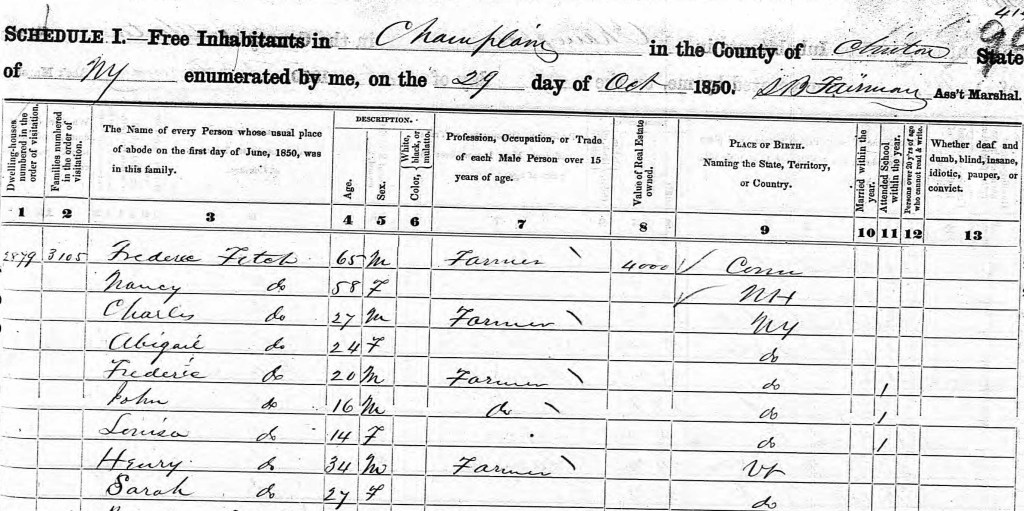
The Fitch household in 1850 that included Frederick, Nancy, and their children and daughter-in-law Sarah

The Fitch household in 1850 that included Frederick, Nancy, and their children and daughter-in-law Sarah

Source: 1850 US census, Clinton County, New York, population schedule, Champlain Township.

By the 1850s, the family’s long years of labor had matured into a measure of stability—even as the rural world around them was beginning to shift.10 The 1850 federal census records a nine-person household ranging in age from 14 to 65: Frederick (65) and his wife Nancy (58); their son Henry (34) and his wife Sarah (27); sons Charles (27), Frederick Jr. (20), and John (16); and daughters Abigail (24) and Louisa (14). Four men in the household—Frederick, Henry, Charles, and Frederick Jr.—were listed as farmers, a concentration of adult male labor that helps explain the family’s relative prosperity. The farm itself was valued at $4,000, a substantial figure for Clinton County and one notably above the Champlain township average of $2,763.11 

The 1850 agricultural census reveals a farm organized with care and conscious balance. Fitch’s one hundred acre operation—eighty acres improved and twenty in woodlot or pasture—placed him in roughly the upper 40% of Champlain farms by size. His ratio of improved to unimproved land was notably more intensive than the township average (seventy-five improved to fifty-six unimproved), indicating a farm more fully cleared and actively cultivated than most of his neighbors’. This level of improvement likely reflects the presence of four adult men in the household, whose labor made such sustained clearing and cultivation possible. Fitch’s livestock holdings further point to a diversified and comparatively prosperous enterprise. With three horses, seven milk cows, seven other cattle, and thirty sheep, the Fitch herd exceeded local averages in every category except horses, marking the family as part of the township’s substantial middle tier of agricultural producers.12

The presence of sheep offers another window into the household economy of the Fitch farm. Of the 220 farmers in Champlain in 1850, 166 (roughly 75%) kept sheep. Frederick’s flock of thirty placed his household in the top 15% of owners with wool production even higher. Maintaining such a sizable flock was a deliberate choice enabled by the household economy fueled by the women who traditionally bore responsibility for wool processing and textile preparation. Wool production would have provided the Fitch family with yet another commodity for exchange, one that could be bartered for skilled services such as blacksmithing or coopering. In this way, the flock reflects not only household capability but also the family’s strategic engagement with the local economy.13

The farm’s cropping pattern likewise reflects a household transitioning from self-sufficient yeomanry to active participants in a changing market economy. Of the 220 farms in Champlain, all but sixteen harvested wheat in 1850; even in this near-universal crop, the Fitch family’s yield of 170 bushels placed them within the top 15% of local producers. Their 250 bushels of oats similarly exceeded the town average, ranking them in roughly the top 20%. In butter and cheese production, however, the Fitch household reached its highest standing: their butter output placed them among the top 10% of producers in Champlain, while their cheese production ranked in the top 16%—almost certainly the result once more of a household economy driven by the Fitch women.14 In practical terms, the family not only sustained itself comfortably but also produced surpluses for sale, revealing their growing engagement with the market economy.
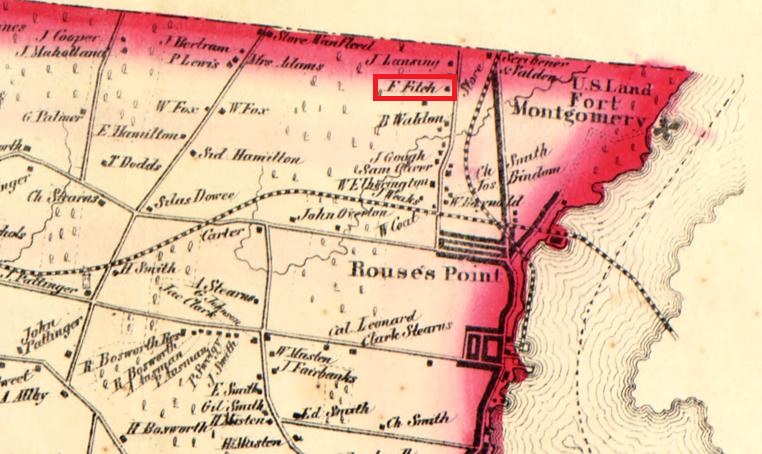
1856 map of Champlain showing the location of the Fitch farm nearby to the railroad and Canadian border

1856 map of Champlain showing the location of the Fitch farm nearby to the railroad and Canadian border

Source: Ligowsky, A. Map of Clinton Co., New York. Philadelphia: O.J. Lamb, 1856. Map. https://www.loc.gov/item/2009583837/.

As Frederick achieved independence, the world around him was changing. By the 1850s, upstate New York was no longer the frontier. The Ogdensburg and Lake Champlain Railroad, with its eastern terminus ending in Champlain within sight of the Fitch farm, connected the farmlands of northern New York to rapidly growing cities in the northeast and southern Canada.15 Market integration was transforming the region, binding farmers to distant prices and urban demand. The ideal of the self-sufficient yeoman was giving way to the reality of a competitive market economy as the expanding Midwest and improved rail transport flooded eastern markets with cheaper grain, forcing smallholders to specialize or scale back.16

The broader regional trends became more visible in the 1860 census, where the value of Fitch’s farm had declined modestly to $3,500 from $4,000 a decade earlier. More significant than the decrease in land value, however, was the contraction of the household itself. By 1860, only four people remained at home: Frederick and Nancy, along with two of their sons, Charles and Frederick Jr. As sons and daughters married or moved away to establish their own households, the loss of labor—particularly the women who had supported dairying and textile production—caused the farm’s outputs to align more closely with township averages in both livestock and crop yields. The number of horses fell from three to two, and milk cows from seven to four. The sheep flock, which had numbered thirty in 1850, had fallen to five, a clear sign that the labor-intensive wool work could no longer be sustained.17 This change also reflected broader economic shifts: as textile production became increasingly industrialized in New England, the Fitch family would no longer rely on household wool as a viable commodity for trade.

In nearly every respect, Fitch’s production now fell slightly below Champlain’s township averages. His crop yields tell the same story: thirty-six bushels of wheat (compared to a town average of forty-six), forty of corn (below the average of sixty-nine), and 500 of oats (somewhat above the typical 436). The continued emphasis on oats may indicate a pragmatic shift toward fodder crops to support a reduced herd rather than a focus on commercial grain sales. His potato harvest (100 bushels, against a local mean of 182) and his butter production (400 pounds, compared to a township average of 380)—further reflect a scaled-back operation aimed at subsistence with limited surplus. Together, these figures depict a farm adjusting to diminishing household labor and the aging of its patriarch, rather than one actively expanding or seeking profit in an increasingly competitive agricultural economy.18

Such contraction was not unusual. Across the North, aging farmers often found themselves unable to keep pace with the accelerating modernization of agriculture. Mechanization, improved plows, reapers, and threshers, and new market-oriented breeds favored younger men with capital and ambition. The decline in Fitch’s equipment value (from $100 in 1850 to $75 in 1860) illustrates this generational divide.19 Frederick was nearing the end of his working life, still maintaining the land that had sustained his family for more than four decades, but now doing so on a reduced scale. His two sons almost certainly managed the physically demanding work their father could no longer perform.20

Seen through the 1860 census, the Fitch farm captures a pivotal moment in the transformation of northern agriculture: a household that had begun in the spirit of yeoman self-sufficiency now operated within an increasingly integrated market economy. No longer was the household economy a primary driver in decision making. The adjustments visible in Frederick’s final decade—the contraction of livestock, shifts in cropping patterns, a move toward selective specialization, and a smaller household—suggest not simple decline but a farmer responding pragmatically to changing prices, labor shortages, and regional competition while his family aged and began to seek out their own opportunities. Even late in life, Frederick was not merely enduring agricultural change but negotiating it, adapting his practices to the new economic currents reshaping rural New York.
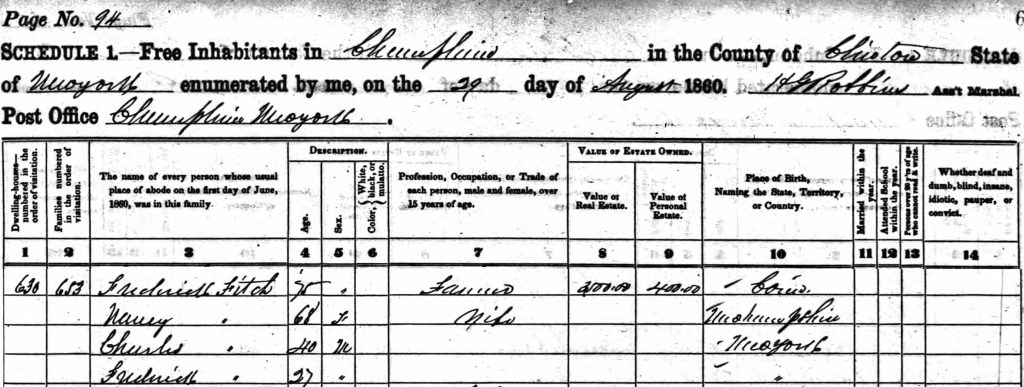
The 1860 census showed Frederick’s household shortly before he passed away in July 1860

Source: 1860 US census, Clinton County, New York, population schedule, Champlain Township.

By the time Frederick died in Champlain on July 27, 1860, at the age of 75, the society he had helped build was giving way to a new one. The Civil War loomed, ushering in an age of industrialization, urban growth, and restless movement that favored younger men better positioned to adopt the increasingly capital-intensive practices reshaping American agriculture. Some pressed farther west, pursuing the same agrarian dream that had once brought Frederick to the Champlain frontier—a chance to own land, raise a family, and live by their labor. Viewed through census data and agricultural returns, Fitch’s life may appear ordinary, yet within those numbers lies the story of a man whose choices reflected the broader economic transformation of the American countryside. To read Frederick’s story is to glimpse a central thread in the American experience: the enduring search for rootedness in a world of movement. That legacy endures in Champlain today, where the Fitch farm remains in the hands of his descendants—a rare continuity in a region where most family farms have long since vanished.

Endnotes

  1. Paul E. Johnson, “The Modernization of Mayo Greenleaf Patch: Land, Family, and Marginality in New England, 1766–1818,” The New England Quarterly 55, no. 4 (December 1982): 489–490.
  2. 1800 US census, Chittenden County, Vermont, population schedule, Huntington Township, page 1, John Fitch household, digital image, Ancestry (http://www.ancestry.com: accessed 2025); citing National Archives Microfilm Publication M32, Roll 51. 1820 US census, Chittenden County, Vermont, population schedule, Huntington Township, page 1, John Fitch household, digital image, Ancestry (http://www.ancestry.com: accessed 2025); citing National Archives Microfilm Publication M33, Roll 127.
  3. “Chittenden County,” The Vergennes Gazette and Vermont and New-York Advertiser (Vergennes, Vermont, USA), November 1, 1798, 3, https://www.newspapers.com/.
  4. See Alan Taylor, Liberty Men and Great Proprietors: The Revolutionary Settlement on the Maine Frontier, 1760–1820 (Chapel Hill: University of North Carolina Press, 1990) for an overview of frontier settlement in the early republic. Taylor focuses on Maine but highlights the moral as well as economic motives for migration.
  5. “Nancy Bunker,” entry in “Geneanet Community Trees Index” 2022, Ancestry (http://www.ancestry.com: accessed 2025), record 7821956846.
  6. 1820 US census, Clinton County, New York, population schedule, Champlain Township, Frederick Fitch household, page 3, digital image, Ancestry (http://www.ancestry.com: accessed 2025); citing National Archives Microfilm Publication M33, Roll 66.
  7. Clinton County NYGenWeb, “The 1810 Census for Clinton County, New York,” accessed November 16, 2025, https://clinton.nygenweb.net/1810.htm. U.S. Census Office, Census for 1820 (Washington, DC: U.S. Census Office, 1821), 22, table of aggregates for New York State, Town of Champlain; https://www.census.gov/library/publications/1821/dec/1820a.html.
  8. 1820 US census, Clinton County, New York, population schedule, Champlain Township, Frederick Fitch household, page 3, digital image, Ancestry (http://www.ancestry.com: accessed 2025); citing National Archives Microfilm Publication M33, Roll 66.
  9. 1830 US census, Clinton County, New York, population schedule, Champlain Township, Frederick Fitch household, page 5, digital image, Ancestry (http://www.ancestry.com: accessed 2025); citing National Archives Microfilm Publication M19, Roll 85. 1840 US census, Clinton County, New York, population schedule, Champlain Township, Frederick Fitch household, page 15, digital image, Ancestry (http://www.ancestry.com: accessed 2025); citing National Archives Microfilm Publication Roll 276.
  10. See Christopher Clark, The Roots of Rural Capitalism: Western Massachusetts, 1780–1860 (Ithaca: Cornell University Press, 1990) for an overview of the broader social, economical, and ideological changes seen in a rural community from 1790-1860.
  11. 1850 US census, Clinton County, New York, population schedule, Champlain Township, Frederick Fitch household, dwelling 2879 family 3105, digital image, Ancestry (http://www.ancestry.com: accessed 2025); citing National Archives Microfilm Publication, Roll 490, Page: 454a.
  12. 1850 U.S. Census, Agricultural Schedule, Town of Champlain, Clinton County, New York, Frederick Fitch farm, page 2, line 35, digital image, Ancestry (http://www.ancestry.com: accessed 2025).
  13. Ibid.
  14. Ibid.
  15. Doherty, Lawrence. “General History of the O. & L. C. Railroad.” The Railway and Locomotive Historical Society Bulletin, no. 58A (1942): 91–98. http://www.jstor.org/stable/43504337.
  16. For more information on how Midwestern grain and the introduction of railroads forced changes to eastern agriculture, see William Cronon, Nature’s Metropolis: Chicago and the Great West (New York: W. W. Norton & Company, 1991).
  17. 1860 U.S. Census, Agricultural Schedule, Town of Champlain, Clinton County, New York, Frederick Fitch farm, page 6, line 2, digital image, Ancestry (http://www.ancestry.com: accessed 2025).
  18. Ibid.
  19. Ibid.
  20.  1860 US census, Clinton County, New York, population schedule, Champlain Township, Frederick Fitch household, dwelling 630 family 653, digital image, Ancestry (http://www.ancestry.com: accessed 2025); citing National Archives Microfilm Publication, Roll 653_736, Page: 657.
Karl’s Tale

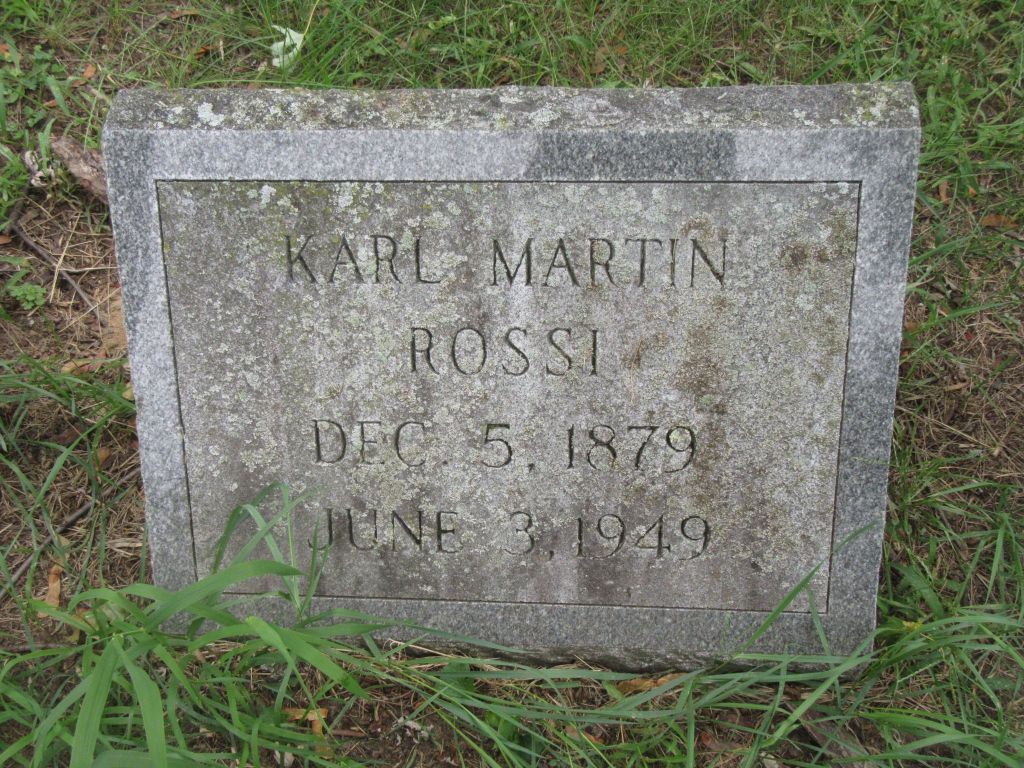
The grave of Karl Rossi in Schenectady, NY

Source: Find a Grave

Karl Rossi’s granite gravestone lies quietly among those of his family in Vale Cemetery in Schenectady, NY.1 Its inscription lists only his birth and death dates—a modest marker for a life that carried him across an ocean into a land that was often unwelcoming to newcomers. His life captures the story of countless German immigrants who sought belonging in an America that both needed and distrusted them.

Karl’s story begins in Heiligenstadt, Germany when he was born on December 5th, 1877, to parents Georg and Kathrina. Nestled in Thuringia, a region transforming rapidly in the late nineteenth century from a medieval market town to a modern municipality, Heiligenstadt offered opportunity to some but hardship to many. Karl lost his father at nine and his mother twelve years later, leaving him without parental support in a society where wages stagnated and prospects for advancement were narrowing for working-class men amid the disruptions of industrialization.

Seeking stability and opportunity, Karl joined the thousands of Europeans sailing for America. He arrived in New York Harbor aboard the Carpathia on August 27th, 19032—a vessel that, less than a decade later, would become famous for rescuing survivors of the Titanic. Like many Germans, he likely traveled by rail from Thuringia to a North Sea port and then by ferry to Liverpool, the principal hub for transatlantic crossings. His journey placed him among the vast tide of migrants who reshaped American cities in the early twentieth century, leaving behind rural uncertainty for the industrial promise of steady wages and self-made futures.

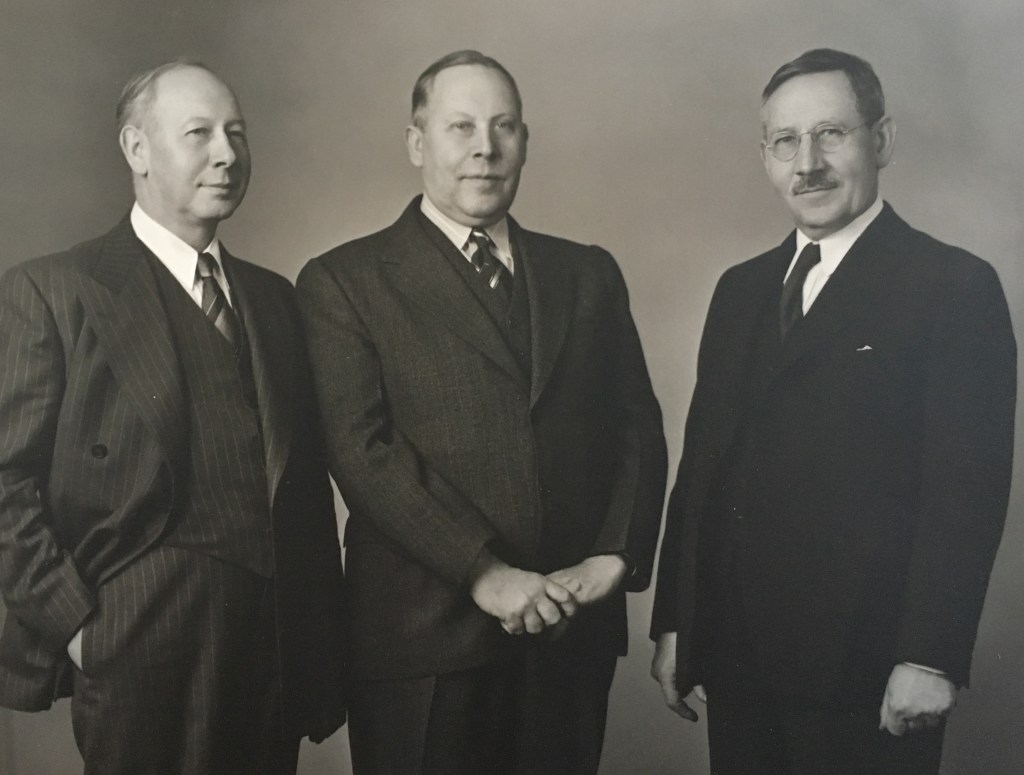
Three brothers: Henry, Phillip, and Karl Rossi

Source: author’s personal collection

By 1909, Karl had begun to carve out his new beginning, boarding at 609 Cutler Avenue in Schenectady, NY, and working as a toolmaker.3 The city was dominated by General Electric and the American Locomotive Company, both major employers of immigrant labor. Boardinghouses proliferated, offering cheap but crowded accommodations, and German newcomers clustered in certain wards, preserving their language and customs while adapting to American life.4 Karl’s days would have been long and his wages modest, but the hum of German, Italian, and Slavic voices that filled his neighborhood reflected the cosmopolitan rhythm of a city built by migrants.

By 1910, Schenectady’s German community was well established, even as new waves of Italians and Eastern Europeans arrived. Lutheran and Catholic parishes anchored neighborhoods, while Vereine—mutual aid societies—offered fellowship, hosted dances, and provided a safety net for members in need. German-language papers such as Das Deutsche Journal and the Schenectady Herold sustained a shared sense of identity.5 For Karl, these institutions offered comfort and connection, linking the world he had left behind to the one he was building anew.

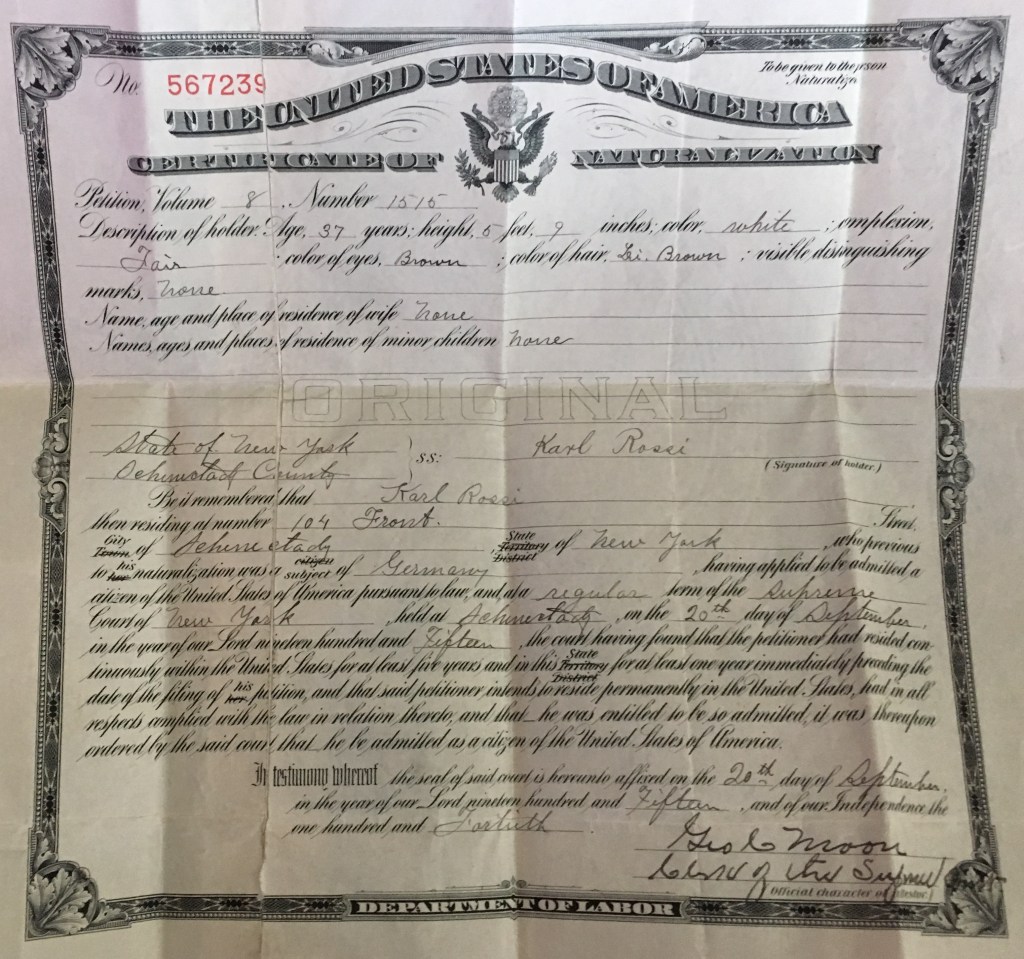
Karl’s 1915 naturalization certificate

Source: author’s personal collection

The shifting nature of life in Schenectady saw Karl living at 1042 Delamont Avenue by 1910. Three years later he was boarding at 821 Hamilton Street. By 1915, he had moved again and was boarding with Margaret Weast and her two daughters at 104 Front Street.6 In the midst of these changes, Karl became secretary and treasurer of S.R. Manufacturing Company, and on September 20th, 1915, took a defining step in his new life when he became a naturalized citizen of the United States.7

Not long after Karl became a citizen, the United States entered The Great War—now fighting against his native Germany. The conflict placed German Americans like Karl in a difficult position. Across the nation, the government’s Committee on Public Information (CPI) fueled anti-German sentiment, casting suspicion on immigrants who were often derided as “Huns” or “spies.” The ensuing campaign for “100 percent Americanism” led to the suppression of German culture: newspapers were closed, schools dropped German from their curricula, and entire communities saw their heritage erased.8 In some towns, German books were burned and street names changed.9 Even prominent figures were not immune—General Electric’s chief consulting engineer, Charles Proteus Steinmetz, himself German-born, was viewed warily for his heritage and political views.10 Such pressures hastened the decline of public German identity, eroding a cultural fabric that had once defined cities like Schenectady. For Karl, still without family or property, the war years must have felt especially precarious. 

The S.R. Manufacturing Company offers a glimpse into Karl’s life during Schenectady’s industrial golden age. Operating out of 56 Weaver Street, the firm was a diversified small-scale manufacturer—typical of the city’s entrepreneurial spirit—producing everything from marine engines to everyday goods like clothes-line pulleys. Its flagship product, the “Mohawk” Marine Motor, named for the nearby river, catered to both canal commerce and the region’s growing demand for recreational engines.11 This adaptability enabled S.R. Manufacturing to thrive in the shadow of industrial giants such as GE and ALCO, serving as a modest yet vital part of the city’s manufacturing ecosystem.

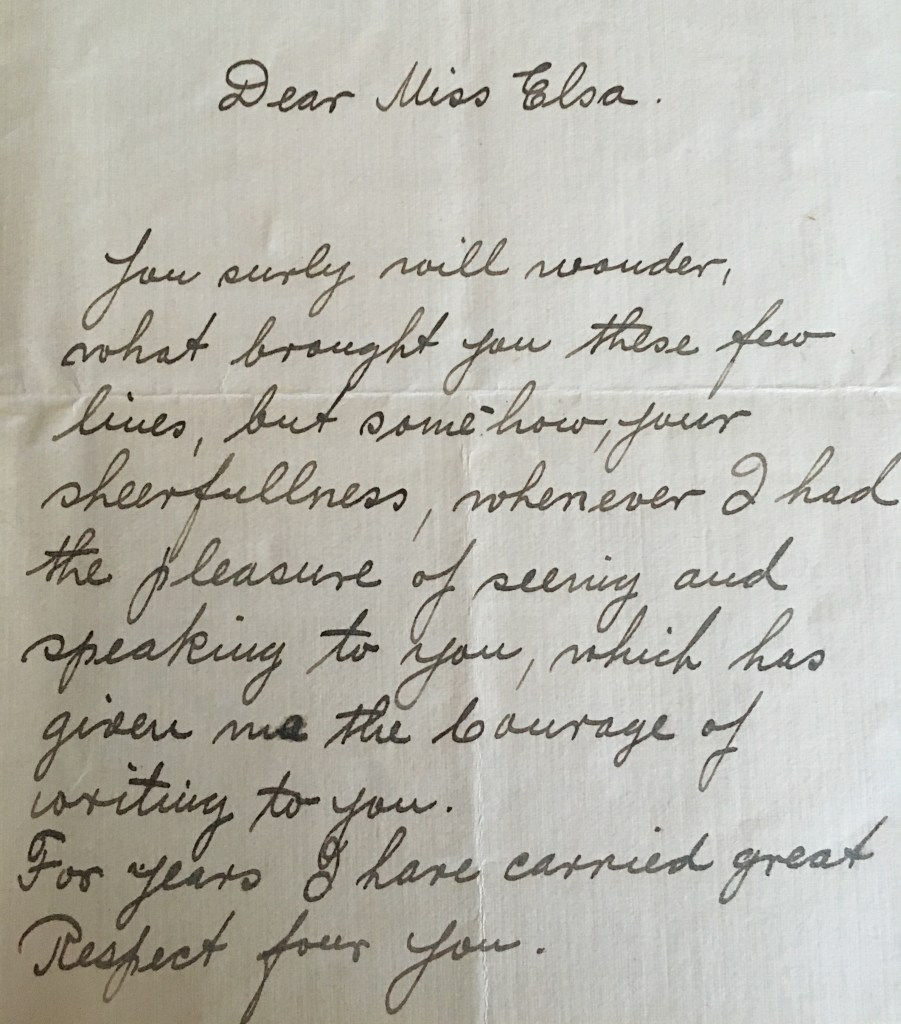
First page of the original letter from Karl to Elsa

Source: author’s personal collection

The 1920 census found forty-one-year-old Karl still living with Margaret Weast and her family while continuing to build the business.12 His purchase of a brick home at 34 North Ferry in Schenectady suggests the business was thriving. While living there, a chance encounter with Elsa Peper, the daughter of a Schenectady family of German descent, would change Karl’s life. The beginning of their courtship survives in a letter he wrote to her:

Dear Miss Elsa,
You surely will wonder, what brought you these few lines, but somehow your sheerfullness [sic], whenever I had the pleasure of seeing and speaking to you, which has given me the courage of writing to you. 

For years I have carried great Respect for you.

Next Thursday in the Albany Armory (Albany) Mr. McCormack will give a concert. Would you be so kind of giving me the pleasure of your company. 

I am not sure, if you remember my name, but the other day during your Vacation, when you were waiting in Weaver Street for your folks to take home I had a few pleasant words with you so you might know, who is writing these few lines.

A few lines will bring great happiness or should you decide otherwise. Fate must so willed it. Believe me yours sincerely,
Karl Rossi, 34 North Ferry Street
13

The letter reflects the conventions of early twentieth-century courtship. At a time when propriety and parental approval carried great weight, written correspondence offered a socially acceptable—and often preferred—means of expressing interest. Historians note that “correspondence courtship” allowed men to express their intentions respectfully while giving women the opportunity to respond privately and with dignity.14 One contemporary guide reminded parents that “Our daughters and our sons are our most precious possessions, are treasures far outweighing gold and gems, and we cannot too closely guard them from mistakes at the outset of their lives.”15 Karl’s tone—measured, cheerful, and deferential—echoed these expectations and conveyed genuine respect. His invitation to a John McCormack concert at the Albany Armory was equally significant: McCormack, the celebrated Irish tenor, drew large immigrant audiences who found in his performances a blend of refinement and sentiment that bridged the distance to the Old World.16

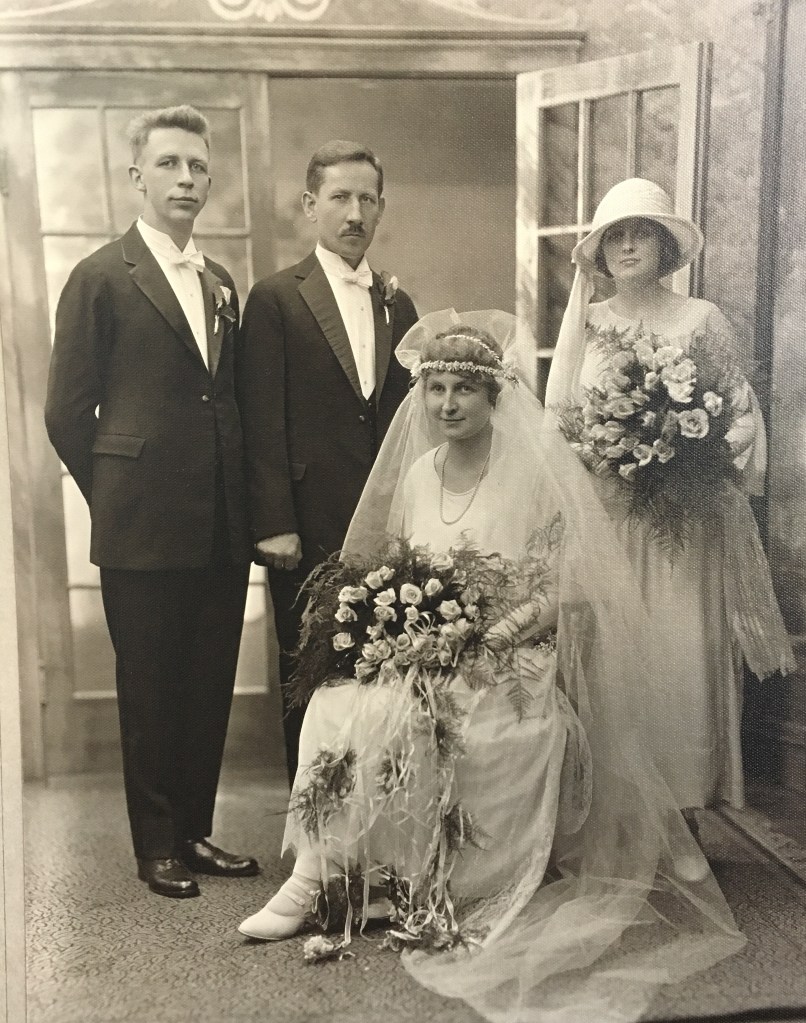
Wedding photo of Karl and Elsa

Source: author’s personal collection

Although little evidence survives of Karl’s courtship with Elsa beyond the initial letter, the relationship clearly flourished: the two were married on June 25, 1924. A wedding announcement in the local paper described the details of their union:

“Elsa S. Peper, daughter of Mr. and Mrs. Fred W. Peper of 612 Crane Street, and Karl M. Rossi of 34 North Ferry Street, were married last Wednesday by Rev. Karl Schloede. The bride was attended by Florence Peper and the best man was Alfred Peper. She wore white crepe romaine and shadow lace and carried a shower bouquet of white roses and lilies of the valley. Her attendant wore light blue crepe de chine and carried butterfly roses. Following the ceremony a reception was held at the bride’s home for the immediate members of the family. After a wedding trip south, Mr. and Mrs. Rossi will be at home after July 6.”17

Such announcements were typical of the period. In many immigrant communities, weddings served not only as private milestones but also as public affirmations of heritage and belonging.

Karl and Elsa’s family grew quickly after their marriage. Their first child, Karl Jr., was born in August 1925, followed by daughter Elsa in July 1927 and, later, a son named Alfred in honor of Elsa’s brother. To accommodate their growing household, the Rossis moved to 954 St. David’s Lane in nearby Niskayuna, a home valued at $15,000 by 1930, a sign of their rising prosperity.18

The 1930s brought both hardship and endurance for the Rossi family. In 1930, their son Alfred died, and in 1939 they lost another young child, Philip.19 Although infant and child mortality had declined by this time, it still cast a long shadow over American families. For Karl and Elsa, these losses must have been devastating, yet they also reinforced the centrality of family bonds. Many immigrant families responded to such grief by drawing closer together, finding strength in shared hardship.20 Economic uncertainty compounded their struggles: the 1929 stock market crash ushered in the Great Depression, shuttering factories, slashing shifts, and sending unemployment soaring across Schenectady. Small manufacturers like S.R. Manufacturing suffered as customers delayed purchases or defaulted on credit. Yet not all was sorrow—amid the turmoil, the Rossis welcomed a daughter, Joyce, in 1932.21

Karl’s experience in the 1930s was shaped not only by family but also by the institutions that anchored Schenectady’s immigrant life. German churches offered spiritual solace and reinforced social networks, while mutual aid societies provided health insurance, funeral benefits, and small business loans. Such associations formed vital safety nets during the Depression, embodying the ethic of Familie writ large—community as extended kin. Through participation in these institutions, Karl deepened his ties to both German and American society.

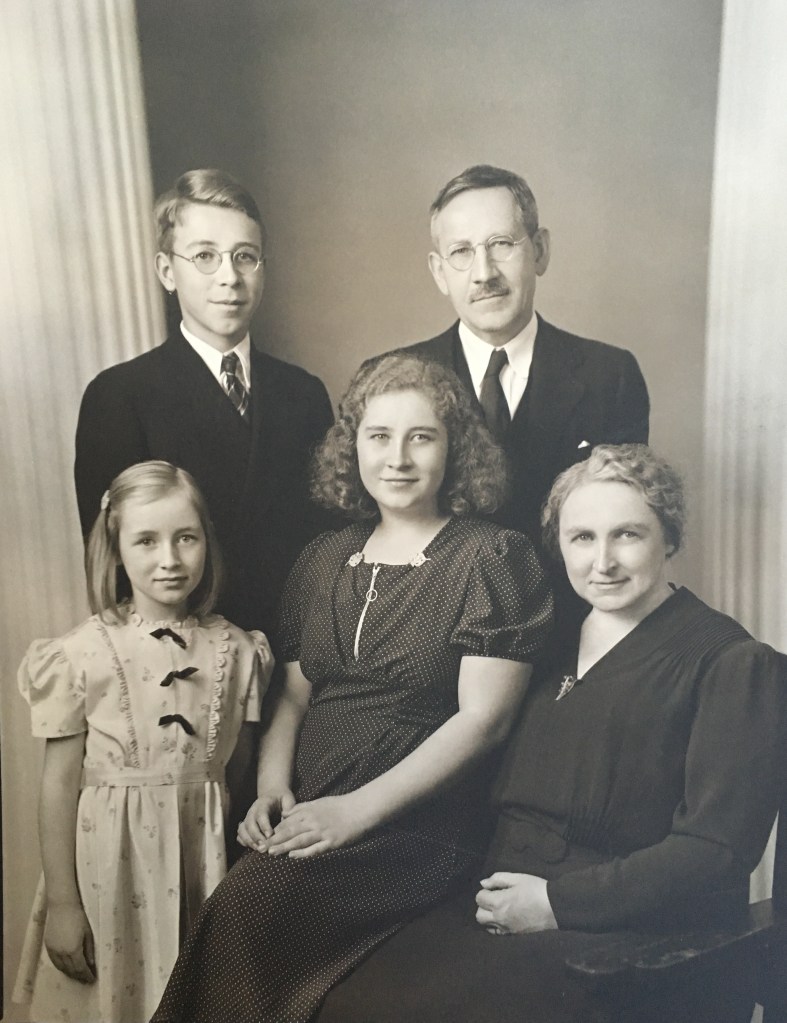
Rossi family circa 1940: Karl Jr and Karl Sr. in the back; Joyce, Elsa, and Elsa in the front

Source: author’s personal collection

By 1940, the Rossi family still lived on St. David’s Lane in Niskayuna. Owning their home suggested that they had weathered the Depression with some stability, yet the census reveals another story: the house’s value had fallen to $5,000, and Karl was working sixty hours a week—among the longest schedules of any neighbor.22  His determination hints at the ongoing effort required to sustain his business through the lingering effects of the Depression.

Even as Karl built a life in America, his ties to Germany endured in the years after World War II. In the immediate postwar period, when food, clothing, and tools were scarce, German Americans often sent care packages—flour, soap, fabric, small tools—to relatives struggling in the ruins of Europe. Historians have shown that this practice was widespread, an expression of enduring family obligation as German Americans wrestled with the belief that Germans, too, had been among Hitler’s victims. Like many immigrants, Karl and Elsa bore both the emotional and financial burden of aiding kin overseas. A letter received from Berlin in March 1949 attests to the impact of their generosity:

Berlin, 20.3.1949
Very honored Mr. Rossi!
I want to hurry and let you know that your food package from 4.12.48 and the clothing package from 17.1.49 arrived here yesterday and today.
I don’t know what words to find in my joy to thank you for your love and attention. The happiness that you once again brought to my home through your gifts is indescribable. All day long there is only one topic and that is: The great admiration for your mercy and the great understanding for our current plight. We are aware that you have an open heart and a strong feeling for your fellow human beings.

The Berlin letter underscores the enduring significance of transatlantic family ties in immigrant life. For German Americans, assisting kin in postwar Germany was both a moral obligation and a reaffirmation of identity and belonging across borders. Karl’s generosity—shaped by his own experiences of hardship and perseverance—reveals how family remained the foundation of his life’s story.

As Karl continued sending aid to family in Germany, he was quietly battling illness. He died at home in Niskayuna on June 3, 1949. Four days later, The New York Times published a brief obituary: “Karl Martin Rossi, partner of the S.R. Manufacturing Company here, died last night at his home after a two-year illness. He had been in the hardware manufacturing business for the last thirty-nine years.”23 By then, Karl had completed the full arc of the immigrant experience—from an orphaned youth in Thuringia to a respected husband, father, and business owner. His journey—marked by perseverance through war, prejudice, and depression—embodies the resilience of countless immigrants who built America’s industrial age not as magnates, but as steadfast craftsmen, neighbors, and parents devoted to family and humanity across borders.

Endnotes

  1. “Karl Rossi (1879–1949),” Memorial [231441874], Find a Grave, Accessed 10/10/2025, https://www.findagrave.com/memorial/231441874/karl_martin-rossi.
  2. The National Archives in Washington, DC; Washington, DC, USA; Passenger and Crew Lists of Vessels Arriving at New York, New York, 1897-1957; Microfilm Serial or NAID: T715; RG Title: Records of the Immigration and Naturalization Service, 1787-2004; RG: 85.
  3. Schenectady City Directory, 1909, Page 311, entry for Karl Rossi; digitized in U.S. City Directories, 1822–1995, database with images, Ancestry.com (http://www.ancestry.com : accessed 10/10/2025).
  4. Schenectady’s Immigrant Communities in the Late 19th and Early 20th Century, Schenectady County Historical Society Newsletter (Schenectady, NY: Schenectady County Historical Society, 2024), 13.
  5. Ibid.
  6. 1910 U.S. Census, Schenectady County, New York, population schedule, Schenectady Ward 7, Enumeration District (ED) 198, sheet 11B/12A, dwelling 272, Dorothy Van Debburg household; digital image, Ancestry (http://www.ancestry.com: accessed 10/10/2025); citing National Archives and Records Administration (NARA) microfilm: 1375091. Schenectady City Directory, 1911, Page 488, entry for Karl Rossi; digitized in U.S. City Directories, 1822–1995, database with images, Ancestry.com (http://www.ancestry.com : accessed 10/14/2025). Schenectady City Directory, 1915, Page 451, entry for Karl Rossi; digitized in U.S. City Directories, 1822–1995, database with images, Ancestry.com (http://www.ancestry.com : accessed 10/14/2025).  
  7. Certificate of Naturalization of Karl Rossi, Petition Volume 9, No. 1515, issued by the Supreme Court of New York, September 20, 1915, copy in the possession of the author.
  8. Mary J. Manning, “Being German, Being American: In World War I, They Faced Suspicion, Discrimination Here at Home,” Prologue 46, no. 2 (Summer 2014): 10. https://www.archives.gov/publications/prologue/2014/summer/being-german-being-american
  9. Library of Congress, “Shadows of War: German Americans during World War I,” accessed September 20, 2025, https://www.loc.gov/classroom-materials/immigration/german/shadows-of-war/.
  10. George Wise, “Proteus and the Great War,” Schenectady County Historical Society Newsletter 61, nos. 4-6 (April-June 2017): 6.
  11. Schenectady City Directory, 1919, Page 796, advertisement for “The S-R Manufacturing Company); digitized in U.S. City Directories, 1822–1995, database with images, Ancestry.com (http://www.ancestry.com: accessed 10/14/2025). Schenectady City Directory, 1927, Page 761, advertisement for “The S.R. Manufacturing Co); digitized in U.S. City Directories, 1822–1995, database with images, Ancestry.com (http://www.ancestry.com: accessed 10/14/2025).
  12. 1920 U.S. Census, Schenectady County, New York, population schedule, Schenectady Ward 1, Enumeration District (ED) 127, sheet 3A, dwelling 23, family 23, Margaret Weast household; digital image, Ancestry (http://www.ancestry.com: accessed 10/11/2025); citing National Archives and Records Administration (NARA) microfilm publication T625, roll 1262.
  13. Karl Rossi to Elsa Peper, circa 1922, copy in the possession of the author.
  14. Karen Lystra, Searching the Heart: Women, Men, and Romantic Love in Nineteenth-Century America (New York: Oxford University Press, 1989), 158–62.
  15. Margaret Elizabeth Munson Sangster, Good manners for all occasions, including etiquette of cards, wedding announcements and invitations (New York: Cupples & Leon company, 1919), 78, https://archive.org/details/cu31924014059103.
  16. Scott Spencer, “Wheels of the World: How Recordings of Irish Traditional Music Bridged the Gap between Homeland and Diaspora,” Journal of the Society for American Music 4, no. 4 (November 2010): 437–449.
  17. Newspaper wedding announcement clipping for Elsa S. Peper and Karl M. Rossi, June 1924, copy in the possession of the author.
  18. 1930 U.S. Census, Schenectady County, New York, population schedule, Niskayuna Township, Enumeration District (ED) 47-9, sheet 38A, dwelling 993, family 1030, Karl Rossi household; digital image, Ancestry (http://www.ancestry.com: accessed 10/14/2025); citing National Archives and Records Administration (NARA) microfilm publication, roll 2341378.
  19. “Alfred Rossi (?–1930),” Find a Grave Memorial ID 167504772, accessed 10/15/2025, https://www.findagrave.com/memorial/167504772/alfred-rossi. “Phillip Rossi (?–1939),” Find a Grave Memorial ID 167504771, accessed 10/15/2025, https://www.findagrave.com/memorial/167504771/philip-rossi.
  20. Kathleen Neils Conzen, “Ethnicity as Festive Culture: Nineteenth-Century German America on Parade,” in The Invention of Ethnicity, ed. Werner Sollors (New York: Oxford University Press, 1989), 47–76.
  21. 1940 US census, Schenectady County, New York, population schedule, Niskayuna Township, page 11B, family 38, Karl Rossi household; digital image, Ancestry (http://www.ancestry.com: accessed 2025); citing Roll: m-t0627-02774.
  22. Ibid.
  23. Maximilian Klose, “Molding Heritage Through Humanitarian Aid: German-Americans, Nazism, and Debates on Postwar German Suffering and Guilt,” Journal of Contemporary History 59, no. 3 (2024).
  24. Letter to Karl Rossi, March 20, 1949, copy in the possession of the author.
  25. “Karl M. Rossi,” New York Times, June 7, 1949, sec. Archives, https://www.nytimes.com/1949/06/07/archives/karl-m-rossi.html.

Salome’s Tale

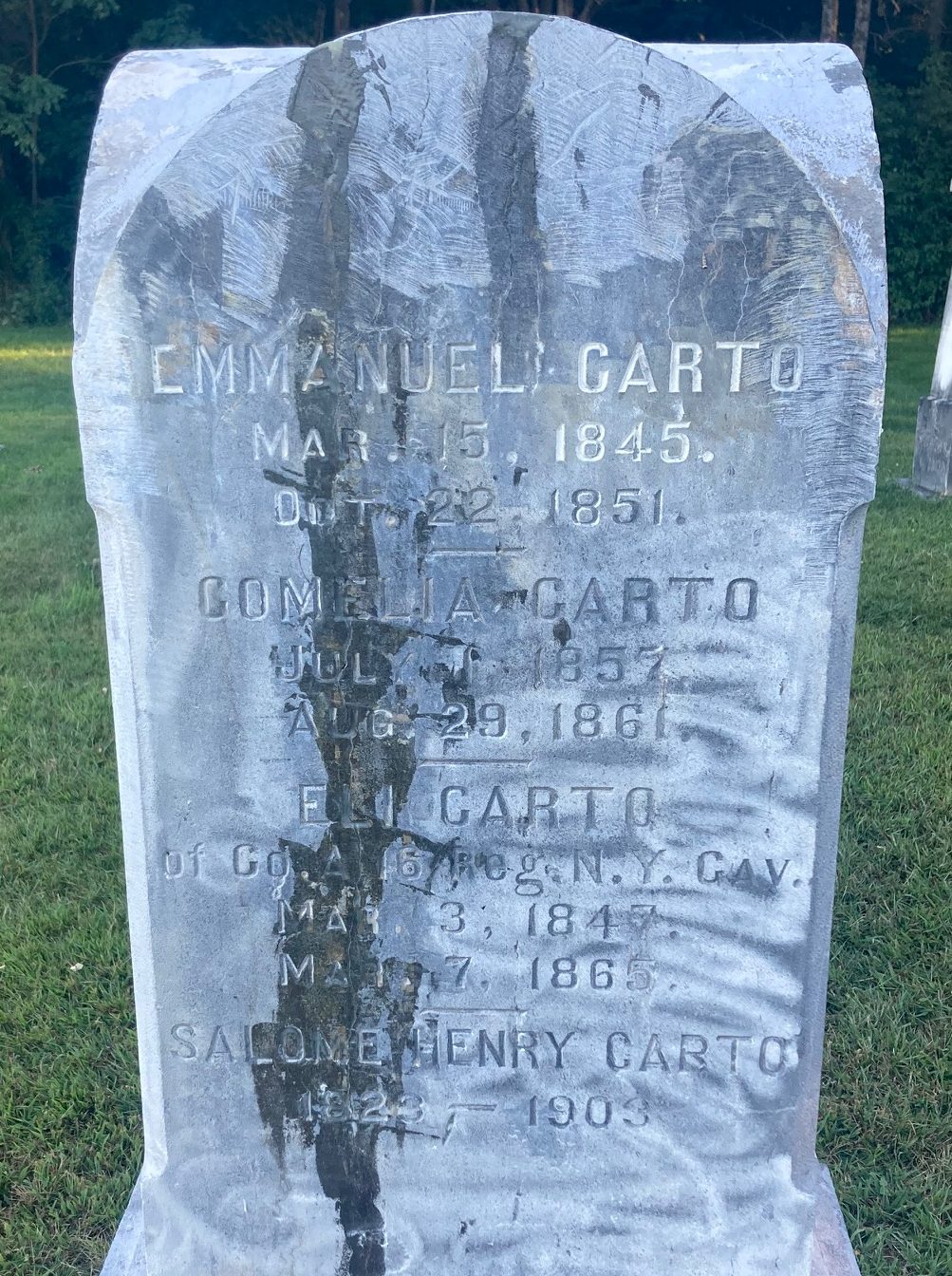
The grave of Salome Carto in Perry’s Mills, NY

Source: author’s personal collection

A weathered tombstone in a small cemetery in Perry’s Mills, New York, marks the final resting place of Salome Carto. To a passerby, it may seem like any other headstone in a small cemetery. Yet beneath it lies the story of a woman who weathered the hardships and turbulence of her century with extraordinary resilience.

Born Marie Salomée Boire on April 24, 1823, in Saint-Philippe, Quebec, Salome faced challenges at a young age. When she was only eleven, her father died, a tragedy that forced her widowed mother to hold together a household in an era when death often came early. By her teenage years, Salome had crossed the border into northern New York with her family, joining thousands of French Canadian migrants who would eventually seek farmland and opportunity just south of the border while still remaining close to their kin.1

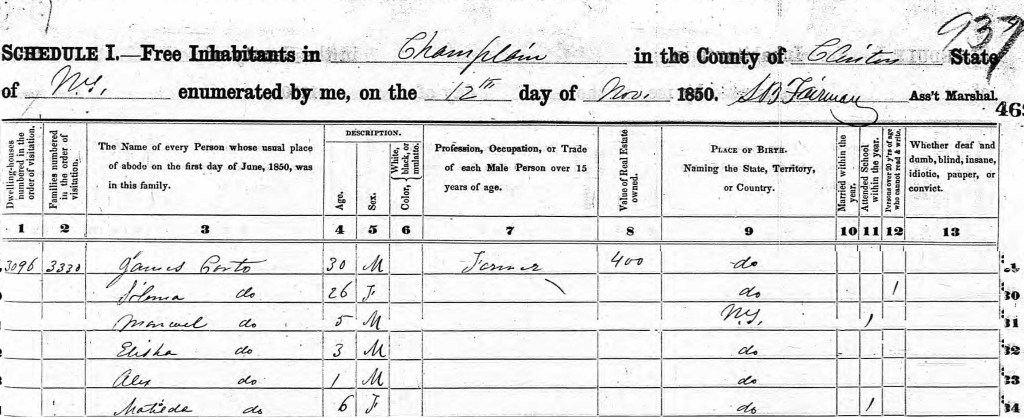
The first appearance of James and Salome’s family in the federal census in 1850.

Source: 1850 US census, Clinton County, New York, population schedule, Champlain Township.

At twenty, Salome married James Carto, a Canadian-born farmer, and settled in Perry’s Mills, a hamlet of Champlain where stony fields and small barns defined daily life. When the census taker called in 1850, the Cartos lived on a farm valued at $400 and had four children under the age of six: Mathilda (age 6), Manny (age 5), Elisha (age 3), and Alex (age 1).2 The family would expand with the arrival of daughter Amelia in 1851 and daughter Cornelia in 1857. Salome’s life as a mother of seven young children living on a rural farm would have been defined by arduous and constant cycles of domestic labor and emotional strain. Nineteenth century households were complex economic units, and as its manager, Salome was responsible for a myriad of tasks critical to the family’s survival, including food preservation, textile production, and childcare, all performed without modern conveniences. This demanding workload of farm life was always precarious. A sick cow, a bad harvest, or the loss of a child could throw the household into crisis. And for Salome, loss was never far away. Of her seven children, two—Manny (in 1851) and Cornelia (in 1861)—died before they reached school age. The empty chairs at the family table told a story repeated in countless rural homes, where two in five children never survived to see adulthood.3 

The Carto farm remained modest in 1860—just sixteen acres of worked land, at a slightly improved value of $500, a fraction of what most neighbors reported.4 The Cartos owned a handful of livestock—three horses, a cow, nine sheep—and relied on every member of the family to keep the place running. Children were not simply raised; they were put to work. Historian Steven Hahn has written that northern farm families leaned on “the labor of sons and daughters to maintain productivity, diversify tasks, and ensure continuity across the seasons.”5 For the Cartos, that meant sons planting oats and potatoes, daughters churning butter and tending animals, and Salome overseeing it all.6

The start of the Civil War added yet another burden to this fragile existence lived by the Cartos. Christmas 1863 saw Eli, Salome’s oldest but barely sixteen-year-old son, enlist in the Union Army after the conclusion of harvest. He went with his uncle Eleazor, perhaps emboldened by the tales of another uncle, Jerome, who had returned from Antietam maimed but alive. The young men joined the 16th New York Cavalry, a regiment sent not to the great battlefields, but to the thorny guerrilla war in northern Virginia. Their task was to track down Confederate ranger John Mosby, whose men seemed to strike from the shadows. As the commander of the 16th New York Cavalry noted about one engagement, “Small parties were seen about Leesburg, but would scatter to the woods when pursued.”7 For Salome, days stretched into months of worry. Then, in March 1865—just weeks before Appomattox—Eli was killed in Virginia in a small skirmish that is barely a footnote in the War of the Rebellion official records. His body never came home.8 The war ended soon after, but victory brought no comfort to a mother who had lost her eldest son. His absence was more than emotional: it left one less pair of hands to keep the Carto farm alive.

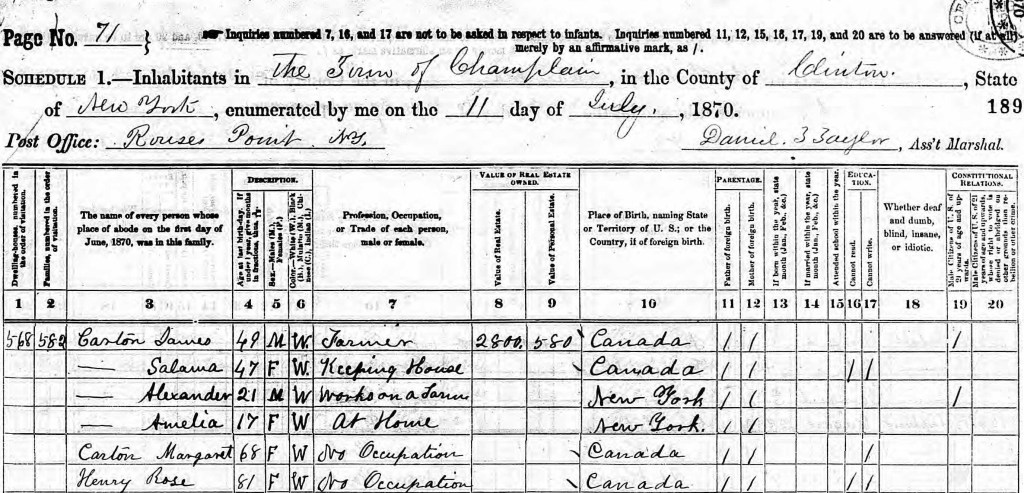
The Carto family had expanded by 1870 include the mothers of both James and Salome

Source: 1870 US census, Clinton County, New York, population schedule, Champlain Township.

Despite this devastating loss, the Carto family demonstrated remarkable resilience and an ability to adapt during the post-war period. The 1870 census reveals significant changes in the Carto farm. James, now with the help of his surviving son Alex, had doubled their improved land to 40 acres and increased the total value of the farm from $500 to $2,600. Their livestock holdings grew to 3 horses, 2 cows, 1 other cattle, 2 sheep, and 8 swine, with a total livestock value of $250. This expansion allowed them to increase their production of wheat, corn, oats, and potatoes as well. Most notably, their yearly butter production soared from 40 pounds in 1860 to 160 pounds by 1870, a significant increase that highlights the family’s intensified focus on dairy, while also producing 25 pounds of maple sugar and 125 pounds of honey to diversify their income sources.9 This pivot required more work for everyone, especially Salome and her daughters. 

The 1870s introduced another dynamic for the Cartos: providing for James’s mother, Margaret, and Salome’s mother, Rose. In the nineteenth-century United States, it was common for households to expand in this way, as families were the primary source of care and support for aging relatives.10 While this arrangement reflected prevailing cultural expectations, it also added new burdens to the household, complicating Salome’s already demanding work of coordinating care, labor, and resources within the family.

The 1870s brought other changes for Salome and her family. Male members of the Carto household increasingly pursued employment outside the home. James, remembered locally as “our old stand-by bridge fixer,” was repeatedly compensated for his work maintaining bridges in Perry’s Mills.11 Meanwhile, Alex earned wages as town constable.12 While this work undoubtedly helped the Carto family expand the wealth of their household, it also likely meant that Salome’s role as supervisor of the household economy became more critical. The decade further marked the first recorded instance of the Cartos subscribing to a local newspaper.13 This development is particularly striking given that both James and Salome consistently reported on federal censuses that they could neither read nor write. Although the precise reason for their subscription remains unknown, it may reflect several possible motivations: a desire for access to information beyond their immediate community, an interest in political affairs, or an intention to provide reading material for their children.

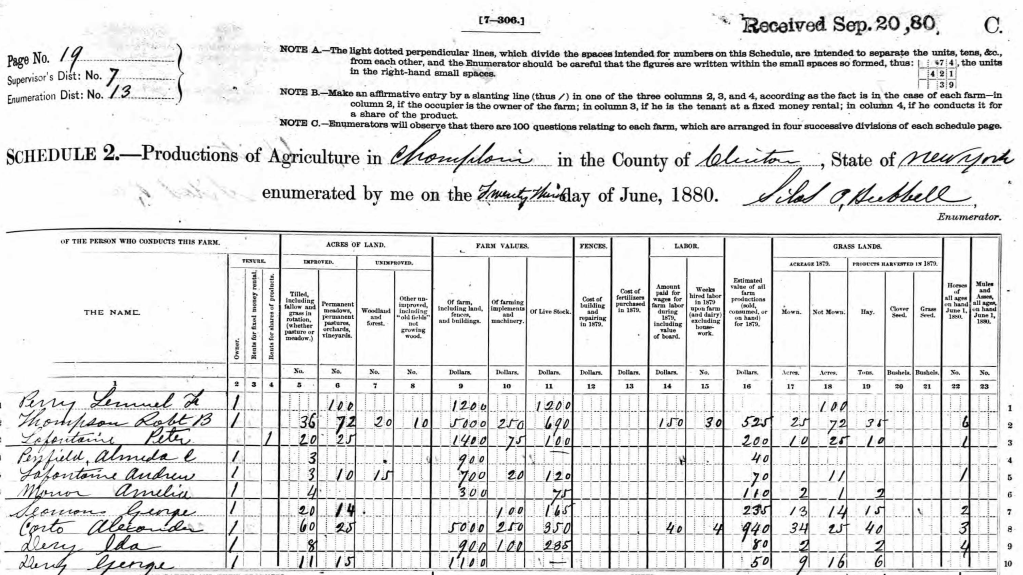
The 1880 agricultural census reveals the complexity of the farm that Salome would soon run on her own.

Source: 1880 U.S. Census, Agricultural Schedule, Town of Champlain, Clinton County, New York.

By 1880, the Carto farm had undergone yet another decade of expansion and transformation. The acreage of improved land rose to 60 acres, and the total value of the farm nearly doubled again to $5,000, with additional investments in machinery and livestock. Their herds grew to include four milk cows and a larger number of young cattle, reflecting a stronger emphasis on dairying; over 900 gallons of milk were sold to factories in 1879, signaling a shift from small-scale butter making toward commercial milk production. Grain cultivation diversified to include barley and buckwheat alongside oats, wheat, and corn, while hay fields and seed production demonstrated careful management of the farm’s grasslands. Potatoes and apples were raised for both subsistence and market sale, and poultry flocks provided a steady supply of eggs. The insight from 1880 portrays a farm that had not only stabilized but grown more prosperous, combining traditional mixed farming with a new commercial orientation in dairy and diversified crops. The most telling sign from the census was that the family reported hiring farm labor in 1879.14

Circumstances changed markedly for Salome during the 1880s, severely testing her resilience. In 1880, James died, leaving her a widow at fifty-seven. Her son Alex temporarily assumed management of the farm, but he succumbed to tuberculosis in November 1881. The burden deepened when Alex’s young wife, Virginia, died of the same disease in June 1882. Tuberculosis, which haunted so many rural households in the nineteenth century, left two little girls—Clarissa (b. 1878) and Cornelia (b. 1880)—without parents. At an age when many women might have expected to lean on grown children, as James and Salome had once provided for their own elderly mothers, Salome instead became the sole head of a household with two children under four where the weight of survival fell squarely on her shoulders. She rose each morning not only to tend her few acres but to guide two young girls through a childhood shaped by absence. In the post war period, widows and older women often assumed new responsibilities as heads of households, bridging the needs of younger generations while sustaining the economic life of the family.15 Salome’s experience echoed this wider pattern, turning her home into a place where caregiving and subsistence labor merged in the wake of loss.

The absence of census records for 1890 obscures a full picture of Salome’s final years. Nonetheless, scattered documentary evidence offers glimpses into the life she sought to provide for her granddaughters. A pivotal development came with the passage of the Dependent and Disability Pension Act of 1890, which extended benefits to mothers of fallen soldiers. In June 1894, Salome successfully applied for and received a modest pension based on Eli’s service.16 While the amount was limited, it carried a deeper significance: formal recognition that her son’s sacrifice—and, by extension, her own—was valued by the nation. Around this time, newspapers reported that Clara enrolled at the Plattsburgh Normal School.17 This fact further supports the notion that Salome valued education and sought to open educational opportunities for her granddaughters.

Salome’s granddaughter Clara Carto circa 1898

Source: Provided to author by family member.

By the turn of the century, Salome’s granddaughters had grown into young women. Clara became a teacher, one of the few professional paths open to women at the time, while Cornelia remained at home. Salome reported in 1900 that she had given birth to seven children, but only two remain alive.18 This final disclosure underscores the profound experiences of loss that marked her life, including the death of at least one child absent from surviving historical records.

Salome’s final appearance in the historical record came in March 1903, when her granddaughter Cornelia married Richard Upton in Perry’s Mills. A local newspaper noted that “The service was performed by Rev. H. C. Petty, and was witnessed by only the immediate relatives of the contracting parties.”19 Less than two months later, on May 16, Salome passed away, having lived long enough to see her granddaughter wed. She was laid to rest in Perry’s Mills, the village where her life had unfolded amid decades of hardship and endurance. 

Salome life, though largely absent from public records of distinction, reflects the quiet endurance of many nineteenth-century rural women whose labor, resilience, and grief were borne largely within the domestic sphere. Salome’s persistence amid repeated loss, her role in sustaining her household, and her care for successive generations position her story as part of the broader narrative of women’s indispensable yet often unacknowledged contributions to family and community life.

  1. 1900 US census, Clinton County, New York, population schedule, Champlain Township, page 25, family 362, Salame Carto household; digital image, Ancestry (http://www.ancestry.com: accessed 2025); citing FHL microfilm: 1241018. ↩︎
  2. 1850 US census, Clinton County, New York, population schedule, Champlain Township, dwelling 3096 family 3330, James Carto household; digital image, Ancestry (http://www.ancestry.com: accessed 2025); citing National Archives Microfilm Publication M432, 1009 rolls. ↩︎
  3. Michael R. Haines, Estimated Life Tables for the United States, 1850-1900 (September 1994). NBER Working Paper No. h0059, Available at SSRN: https://ssrn.com/abstract=190396 ↩︎
  4. 1860 U.S. Census, Agricultural Schedule, Town of Champlain, Clinton County, New York, Page: 7; Line: 32, Ancestry (http://www.ancestry.com: accessed 2025). ↩︎
  5. Steven Hahn, The Roots of Southern Populism: Yeoman Farmers and the Transformation of the Georgia Upcountry, 1850–1890 (New York: Oxford University Press, 1983), 23–26. ↩︎
  6. For information regarding the shifting family dynamic from a patriarchal system to one where women, as mothers, were increasingly responsible for the moral and emotional development of their children, see Mary P. Ryan, Cradle of the Middle Class: The Family in Oneida County, New York, 1790-1865. Cambridge: Cambridge University Press, 1981. ↩︎
  7. Nelson B. Sweitzer, report of March 14, 1865, in The War of the Rebellion: A Compilation of the Official Records of the Union and Confederate Armies, ser. 1, vol. 46, pt. 1 (Washington, DC: Government Printing Office, 1894), 552. ↩︎
  8. New York State Archives, Cultural Education Center, Albany, New York; New York Civil War Muster Roll Abstracts, 1861-1900; Archive Collection #: 13775-83; Box #: 891; Roll #: 547, Ancestry (http://www.ancestry.com: accessed 2025). ↩︎
  9. 1870 U.S. Census, Agricultural Schedule, Town of Champlain, Clinton County, New York, Page: 6; Line: 31, Ancestry (http://www.ancestry.com: accessed 2025). ↩︎
  10. See Steven Ruggles, Prolonged Connections: The Rise of the Extended Family in Nineteenth-Century England and America (Madison: University of Wisconsin Press, 1987) for more information on the role of families in caring for aging relatives. ↩︎
  11. The Plattsburgh Sentinel, “Perry’s Mills,” December 24, 1875, 3. Plattsburgh Republican, “Proceedings of the Board of Supervisors – 1878,” February 1, 1879, 4. Plattsburgh Republican, “Town Accounts,” January 17, 1880, 4. ↩︎
  12. Plattsburgh Republican, “Town Accounts,” December 27, 1873, 2. ↩︎
  13. The Plattsburgh Sentinel, “Receipts for the Plattsburgh Sentinel,” December 15, 1876, 3. ↩︎
  14. 1880 U.S. Census, Agricultural Schedule, Town of Champlain, Clinton County, New York. p. 19, record 8, Ancestry (http://www.ancestry.com: accessed 2025). ↩︎
  15. For more information on the transitions women made in the post-war period, see Tamara K. Hareven, Family Time and Industrial Time: The Relationship between the Family and Work in a New England Industrial Community (New York: Cambridge University Press, 1982). ↩︎
  16. U.S. Pension Application for Eli Carto, mother Salome Carto, filed June 6, 1894, Application No. 596623, Certificate No. 726671, New York; U.S., Civil War Pension Index: General Index to Pension Files, 1861–1934; Records of the Department of Veterans Affairs, 1773–2007, Record Group 15; National Archives, Washington, D.C., Ancestry (http://www.ancestry.com: accessed 2025). ↩︎
  17. Plattsburgh Daily Press, “Perrys Mills,” September 23, 1897, 4. The Plattsburgh Sentinel, “Perry’s Mills,” December 3, 1897, 8. Cardinal Points, “Agenda Items,” January 1, 1898, 1. ↩︎
  18. 1900 US census, Clinton County, New York, population schedule, Champlain Township, page 25, family 362, Salame Carto household; digital image, Ancestry (http://www.ancestry.com: accessed 2025); citing FHL microfilm: 1241018. ↩︎
  19. Plattsburgh Republican, “Wedding at Perrys Mills,” March 21, 1903, 1. ↩︎

Oscar’s Tale

Oscar Wilson’s life is known to few people alive today. His grave sits in a small cemetery alongside a rural road that cuts through farm fields in a southern section of Champlain, NY. He shares his gravestone with his parents and three brothers in the back corner of the cemetery. Were it not for that grave, his life would largely be lost to time. With that grave as a starting point, however, we can use Oscar’s life as a way to shed light on the harsh reality of life for children in the 19th century.

Oscar was born in 1845 to parents Leander and Betsy Wilson. His parents wed in 1839 and immediately began to expand their family with the births of Mariah, Alonzo, Mary, Louisa, and George before Oscar joined the family in 1845.1

The location along the Ridge Road in Champlain, NY where the Wilson farm once stood.

Source: author’s personal collection

Oscar’s early life would have revolved around the rhythm of farming. The Wilson family operated one of the smallest farms in Champlain. At only six acres, their farm was the third smallest of the 220 farms located in the town of Champlain in 1850. Their farm was so small that it was entirely missed when OJ Lamb prepared a map of the town in 1856.2 Despite its diminutive size, the Wilson farm was still a complex operation. The 1850 agricultural census reports that the family had two horses, a milk cow, two heads of cattle, five sheep, and one pig. The family also produced 50 bushels of both corn and potatoes, eight pounds of wool, 75 pounds of butter, and five tons of hay. The family also sold slaughtered livestock, market gardens, and homemade goods worth $31.3 While Oscar was too young to have worked on the farm, his siblings were undoubtedly important contributors to the farm economy. Historian Steven Mintz notes that in antebellum rural families, “children were seen as economic assets” and often assumed labor responsibilities from the age of five or six.4 The Wilson family farm was both a workplace and a home, where intergenerational cooperation helped rural families survive amid uncertain economic conditions. The presence of Oscar’s grandmother Rachel in the 1850 census underscores the extended family importance on rural farms.5

Line 11 of the mortality schedule represents the only appearance of Oscar Wilson on a historical record.

Source: U.S. Census Mortality Schedules, New York, 1850-1880; New York State Education Department, Office of Cultural Education; Albany, New York; Year: 1850; Roll: M1; Line Number: 11. Ancestry (http://www.ancestry.com: accessed 2025).

The only appearance Oscar makes in the historical record is a single entry in the 1850 mortality schedule. We learn from that record that four-year-old Oscar died on June 6th, 1849 after a week-long bout with croup.6 While hardly known today, croup was a dreaded infection in the 19th century. The term “croup” was used broadly to describe a variety of respiratory conditions in children marked by a barking cough and labored breathing. Modern scholars recognize that 19th-century cases of fatal croup were often caused by diphtheria—a bacterial infection that obstructed the airway with a thick membrane, often leading to suffocation.7 Oscar’s rapid demise is tragically consistent with the severe and often untreatable nature of diphtheritic croup. Of the 52 people listed on the 1850 mortality schedule for Champlain, croup was the second most frequent cause of death at five cases (~10%). The only more frequent cause of death was consumption (tuberculosis) with six cases. The primary difference between the two inflictions is that consumption killed mostly adults in Champlain (only one person who died of consumption was under the age of twelve), while all of the lethal cases of croup targeted young children. Four-year-old Oscar was the oldest child to die of croup in Champlain’s 1850 mortality schedule.8

The Wilson family stone in Waters Cemetery, Champlain, NY

Source: author’s personal collection

When Oscar died in 1849, he represented the first death in the Wilson family and was one of the earliest burials in Waters Cemetery in southern Champlain near the border with the town of Chazy. He would be joined in the cemetery by infant brother Johnny in 1853 and older brothers Alonzo and George in the early 1860s. Parents like Leander and Betsy Wilson lived with this uncertainty as an unavoidable fact of life. In the absence of effective antibiotics, antitoxins, and vaccines, children were vulnerable to sudden and often unstoppable infections that meant roughly 40% of children in the United States died before the age of five, with infectious diseases such as diphtheria, scarlet fever, whooping cough, and tuberculosis accounting for the majority of deaths.9 Oscar’s grave, simple though it may be, is emblematic of an era in which early death was not a statistical abstraction but a lived and recurring trauma. His brief life, preserved only in stone and a single line on the mortality schedule, remains a powerful lens into the fragile world of childhood in 19th-century rural America.

Footnotes:

  1. 1850 US census, Clinton County, New York, population schedule, Champlain Township, dwelling 2567, family 2781, Leander Wilson household; digital image, Ancestry (http://www.ancestry.com: accessed 2025); citing National Archives Microfilm Publication M432, 1009 rolls.
  2. Ligowsky, A. Map of Clinton Co., New York. Philadelphia: O.J. Lamb, 1856. Map. https://www.loc.gov/item/2009583837/.
  3. 1850 US census, Clinton County, New York, US Selected Federal Census Non-Population Schedules, 1850-1880, Champlain Township, Archive Collection Number: A2; Roll: 2; Page: 803; Line: 14. Ancestry (http://www.ancestry.com: accessed 2025); citing National Archives Microfilm Publication.
  4. Mintz, Steven. Huck’s Raft: A History of American Childhood. Cambridge: Harvard University Press, 2004, p. 55.
  5. 1850 US census, Clinton County, New York, population schedule, Champlain Township, dwelling 2567, family 2781, Leander Wilson household; digital image, Ancestry (http://www.ancestry.com: accessed 2025); citing National Archives Microfilm Publication M432, 1009 rolls.
  6.  U.S. Census Mortality Schedules, New York, 1850-1880; New York State Education Department, Office of Cultural Education; Albany, New York; Year: 1850; Roll: M1; Line Number: 11. Ancestry (http://www.ancestry.com: accessed 2025).
  7. Humphreys, Margaret. “Childhood Disease and the Rise of Preventive Medicine.” The Journal of Pediatrics 126, no. 1 (1995): 135–141.
  8. U.S. Census Mortality Schedules, New York, 1850-1880; New York State Education Department, Office of Cultural Education; Albany, New York; Year: 1850; Roll: M1; Line Number: 11. Ancestry (http://www.ancestry.com: accessed 2025).
  9. Haines, Michael R., Estimated Life Tables for the United States, 1850-1900 (September 1994). NBER Working Paper No. h0059, Available at SSRN: https://ssrn.com/abstract=190396