
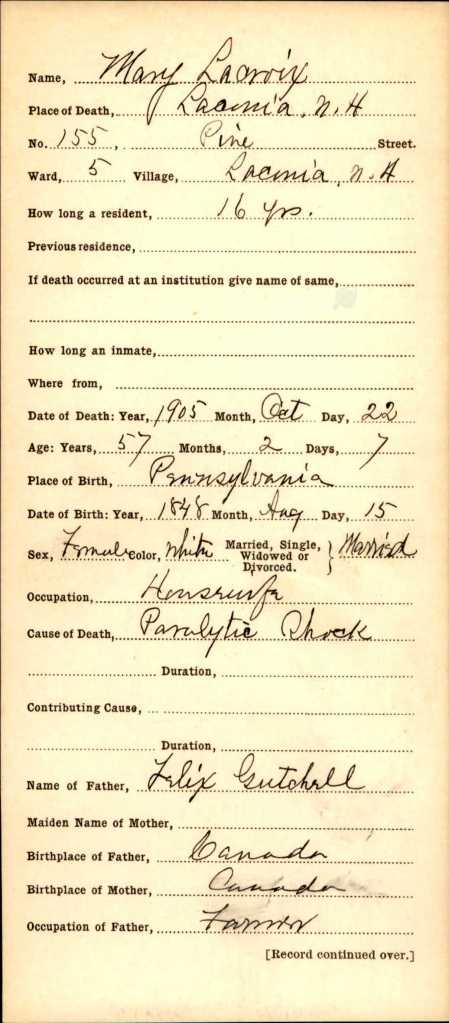
Mary Lacroix’s death certificate
Source: New Hampshire Division of Archives & Records Management
Somewhere in Saint Lambert’s Cemetery in Laconia, New Hampshire, lies the grave of Mary Lacroix. The record of her passing on October 22, 1905, is sparse: death by paralytic shock, an address on Pine Street, and a marital status of married.1 It tells us little about the life that preceded her death, and nothing about the accumulated weight of grief, displacement, and endurance that shaped its course. The turning point in Mary’s life came suddenly, in a crowded saloon in the bustling industrial village of Keeseville, far from Laconia, where immigrant communities and economic change often collided. Her tale opens a window into immigration, ethnic conflict, justice, and widowhood in the nineteenth century—and illuminates the life of someone whose grave has no marker.
Mary’s story begins far from Laconia, in the world of mid-nineteenth-century French-Canadian migration. She was born on August 15, 1848, in Pennsylvania, the daughter of Félix Gutchell and Marie Louise Biron.2 Her parents were natives of Canada, part of the great migration of French Canadians into the industrial towns of the United States during the nineteenth century, as economic pressures in Quebec encouraged many families to seek opportunities south of the border.3 Her father’s family history illustrates how complicated the paths of immigration could be: Félix was born in Canada to parents who were both born in Germany.4 Félix and Marie Louise left Quebec for Pennsylvania sometime between the birth of their eldest child, Félix, around 1837, and their daughter Esther in 1840. By the time Mary was born in 1848, the couple had been joined by Rosa, born around 1842, Sarah, around 1843, and Rebecca, around 1846. Mary’s younger sister Olive was the last child born in Pennsylvania, joining the family in 1851.5
The family left Pennsylvania for Chesterfield, New York, when Mary was a small child, eventually settling in the industrial village of Keeseville.6 Straddling the border between Clinton and Essex Counties along the Ausable River, Keeseville had grown by the 1850s into a bustling industrial center anchored by enterprises such as the Ausable Horse Nail Company, a large horseshoe nail manufacturer that had ten machines producing about 100 tons of horse nails by 1863. The Ausable Horse Nail Company alone employed up to 240 men at its peak, most of them young Irish or French-Canadian immigrants who worked dangerous jobs feeding hot iron into machines, sorting nails, and packing boxes, earning wages that typically ranged between eight and fifteen dollars per week. This was the world in which the Gutchell family would make its home.
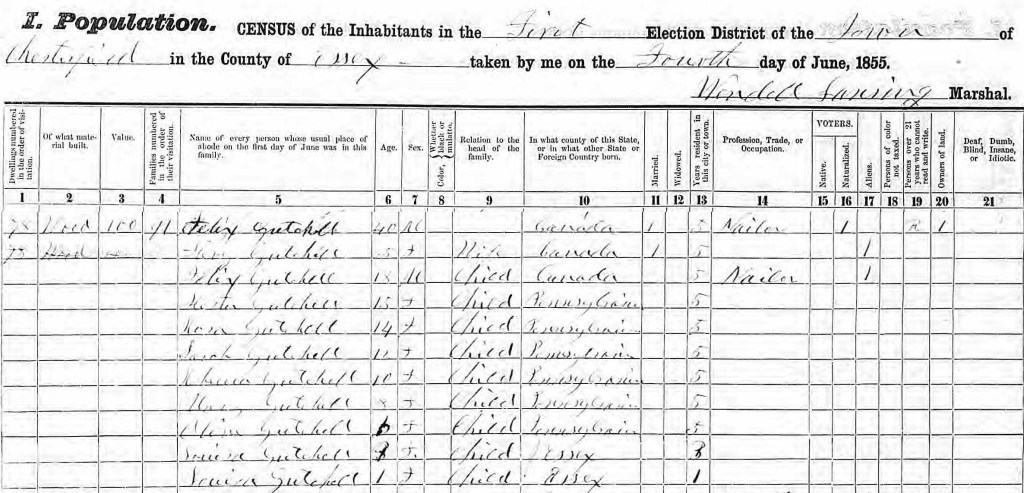
Mary’s first appearance in New York state living in Chesterfield with her parents and eight siblings
Source: 1855 New York state census, Essex County, New York, population schedule, Chesterfield Township.
The 1855 New York State census finds Mary living in a large household headed by her forty-year-old father and thirty-five-year-old mother. The household included eight of Mary’s siblings, from her eighteen-year-old brother Felix, the family’s only son, to her infant sister Louisa.7 The size of the household also reflected the economic reality of working-class immigrant families, where the wages of multiple family members could be essential to making ends meet. The record does not tell us precisely why the Gutchells came to Keeseville, but the availability of industrial work was likely an important factor; both Mary’s father and brother found employment in the area’s horse-nail companies.
By 1860, the federal census found eleven-year-old Mary attending school and living with her parents and several siblings on the Chesterfield side of Keeseville. The family now included two younger brothers, Henry, born in 1856, and Joseph, listed as just one month old. Older sisters Esther and Rosalie remained in the household, as did younger sisters Olive and Louisa.8 But the absences speak as loudly as the additions. Her brother Felix had already established his own household in Keeseville with his young wife, Eliza, and their infant son Henry, and continued to work as a nailer.9 Sarah was no longer in the household, while Mary’s sister Rebecca had crossed the river and was working as a servant in the household of Alvira Sawyer.10 Mary’s father, like her brother Felix, continued to earn his living as a nailer, tying the family directly to the industry that had transformed Keeseville into one of the region’s leading manufacturing centers.
The stability that families like the Gutchells struggled to build proved fragile. Like thousands of young men from northern New York, Mary’s older brother Felix enlisted in the Union Army, joining Company D of the 153rd New York Infantry. On September 19, 1864, he was mortally wounded in the third battle of Winchester and died of those wounds eleven days later.11 He was twenty-four years old and left behind a young wife and five-year-old son. For Mary, who was only fifteen, Felix’s death marked an early loss within her immediate family.
Only three weeks after her brother succumbed to his wounds, Mary married Moses Laundry on October 22, 1864, at the age of sixteen.12 She was young even by the standards of the era, but early marriage was common among working-class immigrant women for whom domestic life and economic partnership were deeply intertwined. Moses was himself a young French-Canadian immigrant, the son of David and Gertrude Laundry, who had arrived in the United States before 1850.13 The 1870 census records Moses as twenty-three years old, working as a nailer and unable to read or write. In 1870, Moses and Mary reported a personal estate of $150 and shared a rented home with Moses’s parents and a brother in Keeseville.14 More than twenty years after the Laundry family arrived in the United States, they still lived in a rented home rather than owning property of their own.
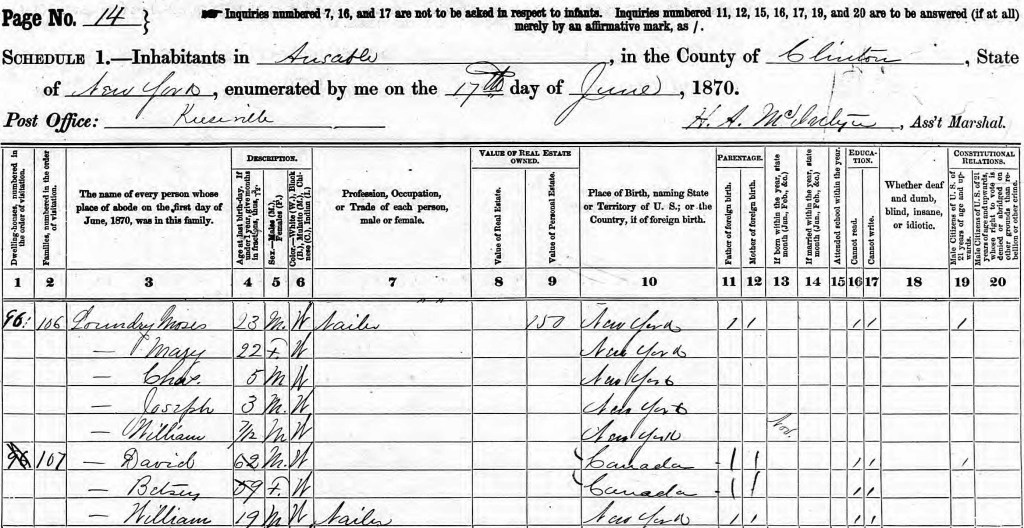
Mary, her husband Moses, and their children sharing a home with Moses’s parents and brother
Source: 1870 US census, Clinton County, New York, population schedule, Ausable Township.
Mary and Moses began building their family almost immediately after their marriage. Their son Charles was born in 1865, followed by Joseph in 1867 and William in 1869.15 But even as the family grew, loss arrived early: on September 4, 1870, their youngest son, William, died.16 When William died, Mary was already pregnant with another child. By the spring of 1871, she was eight months along.17
On the evening of Saturday, March 4, 1871, Mary’s life changed when Moses did not return home from work. The end of the six-day work week was a regular occasion for the men of Keeseville’s factories to gather in the village’s many saloons and drinking houses. At least sixteen drinking establishments operated in Keeseville in 1870 alone.18 That night, Moses and his friend Seraphin Crevier, a twenty-year-old French-Canadian immigrant, stopped at the Ausable House on Main Street. Shortly afterward, Moses and Crevier left the saloon and became involved in a street altercation with James Corcoran, a twenty-four-year-old Irish laborer known as a “fighting man.” Corcoran was also associated with the Port Kent Hill Gang, which had harassed Crevier on multiple occasions, including once chasing him to the door of his boarding house. When Moses stepped in to break up the fight, Crevier slashed him across the neck with his knife. Moses was taken home by wagon, where pregnant Mary and their children were waiting. Despite attempts to stop the bleeding, Moses died around nine o’clock the following morning. He was twenty-five years old.19
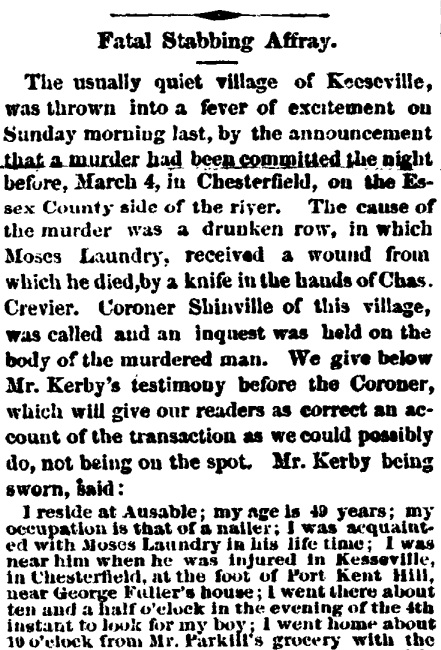
The newspaper article providing details about the death of Mary’s husband, Moses Laundry
Source: Plattsburgh Republican., March 11, 1871, Page 3
Moses Laundry’s death quickly became a subject of public discussion in Keeseville. One local newspaper almost immediately framed the tragedy through the lens of temperance, blaming alcohol for the killing and using Laundry’s death to strengthen its argument against the village’s saloon culture. The newspaper even noted that the Laundry family could potentially sue the saloon owner for damages of up to $2,500.20 But the temperance account captured only part of what was happening in Keeseville. Beneath the immediate role of alcohol lay deeper tensions: intense economic competition between Irish and French-Canadian workers for dangerous, low-paying jobs, and a masculine culture in which physical courage and reputation could become alternative measures of status. For men with few avenues to economic advancement or social standing, the street could become a theater where disputes over honor, reputation, and hierarchy were played out.21
Keeseville’s ethnic divisions were reinforced by geography and community institutions. French-Canadian immigrants clustered on the Clinton County side of the Ausable River in what contemporaries called a “Little Canada,” a francophone neighborhood populated largely by families from Quebec. They developed their own social and religious institutions, including a Catholic congregation separate from the Irish-dominated parish on the Essex County side.22 Mary and Moses lived within this French-Canadian community, even as economic competition between Irish and French-Canadian workers created tensions across the river.
For Mary, none of these larger historical forces mattered in the immediate aftermath. What mattered was that she was eight months pregnant, had two surviving young children, lived in a rented house, and had just lost her husband. On April 22, 1871—forty-nine days after Moses died—she gave birth to a son. She named him William Moses.23 The name joined the names of both the son and husband she had lost within the previous year—a quiet yet eloquent detail in the surviving record of her life.
A widow in 1871 with three small children, including a newborn, and no property had few options. Historians of working-class women’s lives in the nineteenth century have documented how difficult it was for women to sustain households on their wages alone. For many working-class widows, remarriage was as much an economic decision as a personal one. On November 30, 1872, less than two years after Moses’s death, Mary married Joseph LaCroix at St. John’s Church in Keeseville, New York.24 Joseph, like Moses before him, was a French-Canadian immigrant laborer who moved through the same francophone networks, neighborhoods, and Catholic institutions that had shaped Mary’s life.25 The marriage took place in the same church whose records, preserved more than a century later, help researchers reconstruct the fragments of the Laundry family’s life.
By 1875, Mary and Joseph LaCroix continued to live in Keeseville with their combined family. The New York State census identified Joseph and Mary, along with all of the children—including the three fathered by Moses Laundry—under the surname Cross.26 Cross was an anglicized rendering of LaCroix, the sort of surname adaptation that appears frequently in the records of French-Canadian immigrants navigating English-speaking institutions.27 Mary and her children would move through the records as Laundry, Cross, and LaCroix over the years, creating a shifting paper trail that would complicate any attempt to reconstruct their lives.
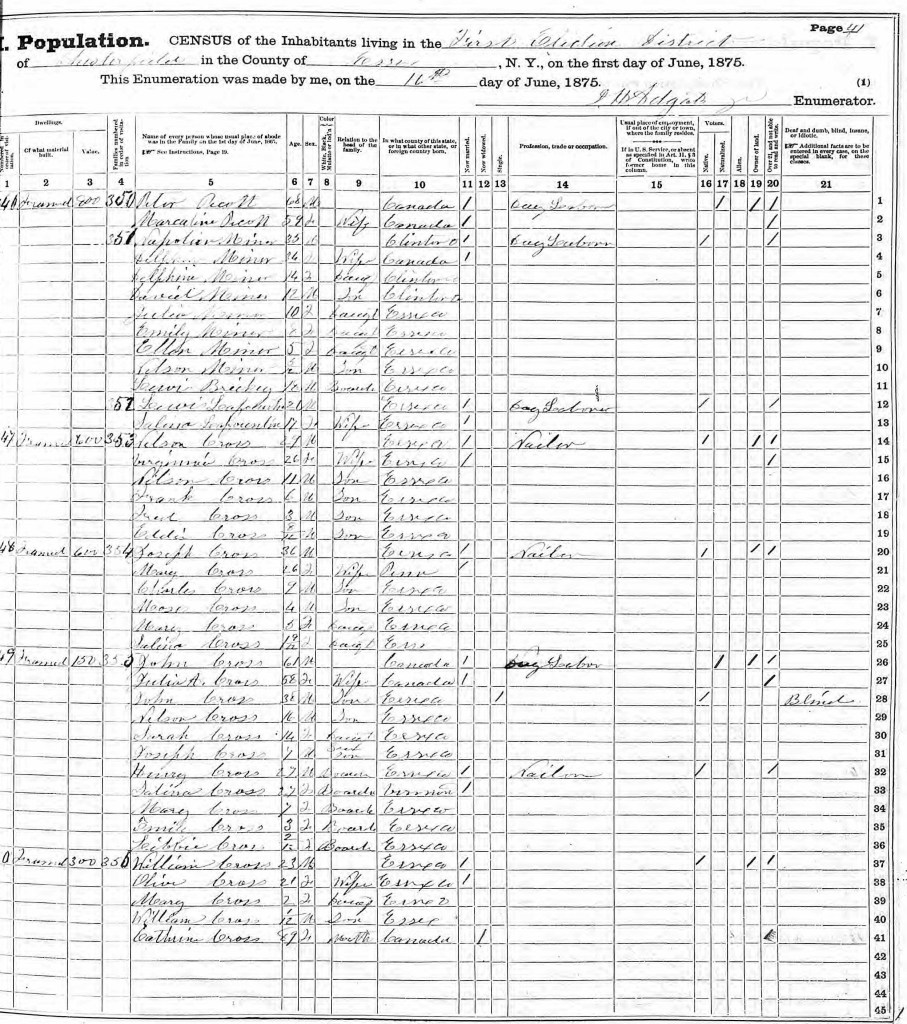
Mary’s children with Moses had adopted the Cross name by 1875 while surrounded by the families Joseph’s parents and brothers
Source: 1875 US census, Essex County, New York, population schedule, Chesterfield Township.
The early years of marriage to Joseph saw Mary experiencing an extraordinary pattern of pregnancy: six children in nine years. Celina was born September 8, 1873, less than a year after the wedding; Felix followed in 1875, Elizabeth in 1877, Julia in 1879, Edward in 1880, and Henry on March 10, 1882.28 In naming her second son Felix, Mary honored both her father and the brother she had lost at Winchester more than a decade earlier.
The 1880s brought geographic upheaval for Mary and her family. For reasons the historical record does not make explicit — economic opportunity, unemployment, family networks, or some combination of all three — the LaCroix family left their long-established community in the Keeseville area and began moving. By 1885 they were in Cicero, Illinois, a working-class suburb of Chicago, where daughter Dora was born that November.29 By 1888 they were in New Haven, Connecticut, welcoming twins George and Georgina on March 4.30 By 1890 they had settled in Laconia, New Hampshire, where the 1900 census would finally fix them in place at 155 Pine Street.31
This sequence of moves — Keeseville to Cicero to New Haven to Laconia, across a span of roughly five years — tells a story that is familiar to many working-class immigrant families of the period. One study of immigrants in the North Atlantic economy has shown that geographic mobility was not exceptional among immigrant workers but normative; families followed the rhythms of industrial hiring, moving between mill towns and factory cities as employment contracted and expanded.32 Mary and Joseph were part of this mobile proletariat, following labor from place to place, raising children as they went, never appearing to own a home.
What such mobility costs in terms of social roots, community support, and stability is difficult to quantify but easy to contemplate. The French-Canadian immigrant networks that had sustained Mary in Keeseville — the church of St. John’s, the neighbors who shared her language and her faith, the extended family connections that provided informal support — had to be rebuilt from scratch with each move. For French-Canadian immigrant families generally, the parish did more than provide religious community; it offered continuity as families shifted from one industrial town to the next, a continuity Mary’s family had to reconstruct four times over.33
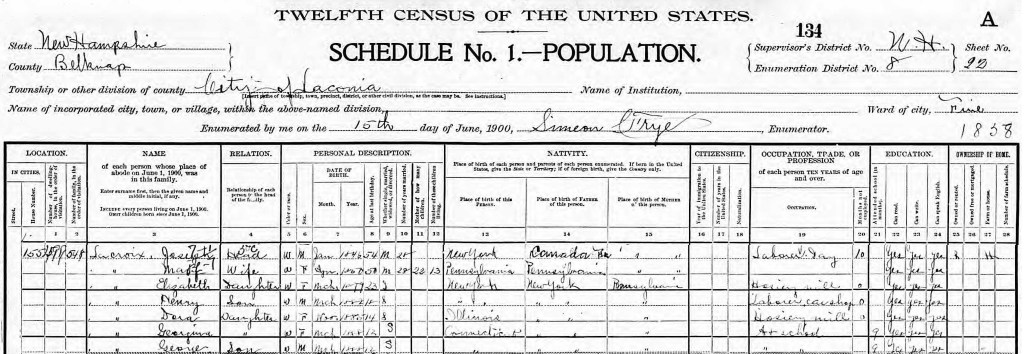
Mary and her family in the 1900 census with five of their children living at 155 Pine Street, Laconia, NH
Source: 1900 US census, Belknap County, New Hampshire, population schedule, Laconia Township.
The 1900 federal census finds Mary, age fifty, and Joseph, age fifty-four, still living with many of their children. Elizabeth, Henry, Dora, and the twins Georgina and George continue to reside with their parents. Joseph was working as a day laborer, but had been unemployed for ten months of the previous year. The family’s economic position rested heavily on its children: twenty-three-year-old Elizabeth and fourteen-year-old Dora both worked at a hosiery mill, while eighteen-year-old Henry worked in a car shop.34 Survival for French-Canadian families required everyone to play a role, even if it meant a young teen stopped going to school to seek employment.
Mary’s response to one census taker’s question about her children is among the most revealing details of her life. She reported that she had given birth to twenty-two children, of whom thirteen were still alive.35 From approximately her sixteenth year until into her forties, Mary’s body was almost continuously engaged in the work of gestation, birth, nursing, and loss. The nine children she lost were not abstractions; they were infants and toddlers she held, nursed, named, and buried. Yet the census enumerator recorded their absence matter-of-factly, in the standard columns provided for the purpose, as if it were ordinary.36 The nine deaths in Mary’s family are largely invisible in the historical record; only two can be identified by name. Her infant son William died in 1870, while her son Joseph survived into adulthood only to die of typhoid fever in Laconia in 1892, at the age of twenty-five.37 Her losses were not confined, then, to the fragile first years of childhood; they could come after years of watching a child grow into adulthood. And the children who survived were themselves shaped by that same economic pressure, their childhoods converted, like those of countless children of French-Canadian immigrants, into an economic asset.
The late 1890s and early 1900s required Mary to draw on the resilience formed by years of losing her children. Her mother Marie died before 1900, likely in 1896; her father Félix followed on October 17, 1903, at the age of eighty-six.38 Since at least 1892, Félix and Marie had made their home in Plattsburgh with the family of their daughter Sarah and her husband, Joseph Forkey — a household that had, by 1900, achieved something Mary’s own family never had: a home of their own, at 50 Cornelia Street.39 That stability was the product of collective labor. Five of Sarah and Joseph’s children, ranging from twenty-nine-year-old Sarah to twenty-two-year-old Josephine, still lived at home, and four of the five were employed — two as dressmakers, two as clerks. Combined with Joseph’s work as a barber, the household had five adults working full-time, with no stretch of unemployment in the year before the census.40 It was this large, fully employed family that gave Mary’s aging parents the security her own household, scattered across four states, could not have provided.
The deaths of her parents were part of a pattern of loss that had followed Mary throughout her life. She had been confronting death since at least her brother Felix’s mortal wounding at Winchester in 1864. In the decade before her own death, she lost her sister Rebecca and Rebecca’s husband, and then her sister Sarah Forkey and her husband, Joseph — the same Sarah who had cared for Mary’s parents in their final years.41 Then, in 1905, Mary’s nephew William Forkey was killed at a Plattsburgh paper mill when his clothing caught in a rapidly revolving shaft.42 His death was a stark reminder of the dangers that industrial work continued to pose to immigrant families like Mary’s.
Mary herself died on October 22, 1905, in Laconia, New Hampshire, at the age of fifty-seven. The cause of death was recorded as paralytic shock.43 The date was quietly significant: forty-one years earlier to the day, a sixteen-year-old girl had married Moses Laundry at St. John’s Church in Keeseville.
Mary’s life gives shape to a history that scholars have been assembling for decades: a story of downward mobility, ethnic tension, dangerous industrial labor, crowded and unsanitary housing, endemic infant mortality, and the near-total absence of social safety nets for families when disaster struck. Mary’s world was shaped by forces she did not choose and could not control: the agricultural collapse in Quebec that sent her parents south, the rise and decline of the industrial economy in Keeseville that employed her family, the street-level ethnic violence that killed her husband in March 1871 over competition for modest wages, and the labor market fluctuations that sent her family ricocheting between Illinois, Connecticut, and New Hampshire in the 1880s.
Yet Mary’s life resists reduction to a catalog of misfortune. She survived the death of her first husband, raised a large family, learned to read and write, remarried, moved repeatedly in search of economic stability, and navigated a world that offered women of her class and origin few resources for doing so. The name she gave her final son from her first marriage, William Moses, is perhaps the most telling single act in the documentary record of her life. It was the act of a woman who refused to let loss be the only story. She had buried a son named William in September 1870 and husband Moses in March 1871. Seven weeks after her husband’s death, Mary gave birth to a son and named him William Moses, joining the names of the son and husband she had lost within the previous year. We cannot know what the name meant to Mary, but it stands as the clearest surviving act of remembrance in the documentary record of her life.
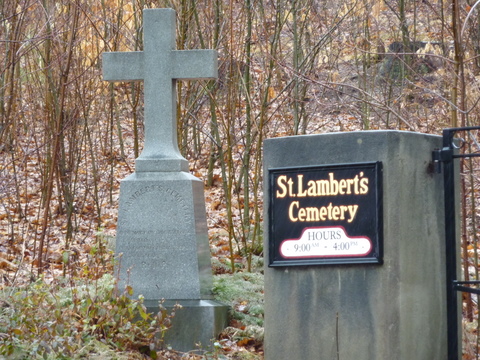
The gates of Saint Lambert’s Cemetery in Laconia
Source: FindAGrave.com
Somewhere in Saint Lambert’s Cemetery, there is ground that holds Mary, but no stone marks her grave. For a woman whose name shifted repeatedly in the records—Gutchell, Laundry, LaCroix, Cross—even the place where she was buried carries no marker to fix her name in stone. But Mary did not wait for the world to mark what mattered to her. In April 1871, with no stone cut for the child and husband she had recently buried, she made her own act of memory: she named a living child after the dead. This telling of her life is offered in that same spirit — not a stone, but a name, set down so that hers would not go unmarked twice.
End notes
- Find A Grave, “Mary Gutchell Lacroix (1848–1905),” Memorial 246106860, Saint Lamberts Cemetery Laconia, Belknap County, New Hampshire, accessed August 15, 2026, https://www.findagrave.com/memorial/246106860/mary-lacroix. New Hampshire Division of Archives & Records Management, New Hampshire Death Records, 1650–1969, Mary Lacroix, death certificate, October 22, 1905, Ancestry (http://www.ancestry.com: accessed August 13, 2026).
- 1855 New York state census, Essex County, New York, population schedule, Chesterfield Township, Felix Gutchell household, dwelling 78 family 91, digital image, Ancestry (http://www.ancestry.com: accessed August 8, 2026); page 11.
- Historian Yves Frenette has documented how bleak agricultural prospects in Quebec pushed farmers to sell their land and join a growing landless working class, while debt, unemployment, and the hope for better wages encouraged hundreds of thousands of French Canadians to seek opportunities south of the border. See Yves Frenette, “La genèse d’une communauté canadienne-française en Nouvelle-Angleterre: Lewiston, Maine, 1800–1880,” Historical Papers / Communications historiques 24, no. 1 (1989): 75–99.
- 1900 US census, Clinton County, New York, population schedule, Plattsburgh Township, Joseph Addison household, dwelling 130 family 145, digital image, Ancestry (http://www.ancestry.com: accessed July 15, 2026); citing National Archives Microfilm Publication roll 1018, page 8A.
- 1855 New York state census, Essex County, New York, population schedule, Chesterfield Township, Felix Gutchell household, dwelling 78 family 91, digital image, Ancestry (http://www.ancestry.com: accessed August 8, 2026); page 11.
- Ibid.
- Ibid.
- 1860 US census, Essex County, New York, population schedule, Chesterfield Township, Felix Gutchell household, dwelling 205 family 189, digital image, Ancestry (http://www.ancestry.com: accessed August 8, 2026); citing National Archives Microfilm Publication, page 26.
- 1860 US census, Clinton County, New York, population schedule, Ausable Township, Ocule Brunel household, dwelling 2965 family 2942, digital image, Ancestry (http://www.ancestry.com: accessed August 15, 2026); citing National Archives Microfilm Publication, page 420.
- 1860 US census, Clinton County, New York, population schedule, Ausable Township, Alvira Sawyer household, dwelling 3033 family 3005, digital image, Ancestry (http://www.ancestry.com: accessed August 15, 2026); citing National Archives Microfilm Publication, page 430.
- New York State Archives, “Civil War Muster Roll Abstracts of New York State Volunteers, United States Sharpshooters, and United States Colored Troops [ca. 1861–1900],” entry for Felix Gutchell, box 257, accessed via New York, U.S., Civil War Muster Roll Abstracts, 1861–1900, Ancestry (http://www.ancestry.com: accessed August 15, 2026).
- Birth, Marriage, and Death records for St. John’s Church, Keeseville, NY.
- 1850 US census, Essex County, New York, population schedule, Willsboro Township, David Landree household, dwelling 1585 family 1641, digital image, Ancestry (http://www.ancestry.com: accessed August 8, 2026); citing National Archives Microfilm Publication, page 26.
- 1870 US census, Clinton County, New York, population schedule, Ausable Township, Moses Loundry household, dwelling 96 family 106, digital image, Ancestry (http://www.ancestry.com: accessed August 15, 2026); citing National Archives Microfilm Publication, page 14. 1870 US census, Clinton County, New York, population schedule, Ausable Township, David Loundry household, dwelling 96 family 107, digital image, Ancestry (http://www.ancestry.com: accessed August 15, 2026); citing National Archives Microfilm Publication, page 14.
- 1870 US census, Clinton County, New York, population schedule, Ausable Township, Moses Loundry household, dwelling 96 family 106, digital image, Ancestry (http://www.ancestry.com: accessed August 15, 2026); citing National Archives Microfilm Publication, page 14.
- Birth, Marriage, and Death records for St. John’s Church, Keeseville, NY.
- Ibid.
- “A Correction,” Essex County Republican, February 23, 1871, 3, col. 2.
- “Fatal Stabbing Affray,” Plattsburgh Republican, March 11, 1871, 3, col. 4.
- “Temperance,” Essex County Republican, April 13, 1871, 3, с. 3-4.
- Darren Phaneuf, “‘Fighting Men’ or ‘Breathing Holes of Hell’: Labor, Class, and Ethnic Tensions in Keeseville, New York, During the 1870s” (Senior History Honors Project, 1995), 15-16.
- Ibid., 8-9.
- Find A Grave, “William Moses Landry (1871–1948),” Memorial 246101483, Highland Cemetery, Ipswich, Essex County, Massachusetts, accessed August 15, 2026, https://www.findagrave.com/memorial/246101483/william-moses-landry.
- Birth, Marriage, and Death records for St. John’s Church, Keeseville, NY.
- 1860 US census, Essex County, New York, population schedule, Chesterfield Township, Joseph Cross household, dwelling 318 family 303, digital image, Ancestry (http://www.ancestry.com: accessed August 8, 2026); citing National Archives Microfilm Publication M653_753, page 40.
- 1875 New York state census, Essex County, New York, population schedule, Chesterfield Township, Joseph Cross household, dwelling 348 family 354, digital image, Ancestry (http://www.ancestry.com: accessed August 15, 2026); page 41.
- For more information on the anglicization of French-Canadian names, see Gerard J. Brault, The French-Canadian Heritage in New England (Hanover and London: University Press of New England, 1986).
- US census, Essex County, New York, population schedule, Chesterfield Township, Joseph Cross household, dwelling 209 family 227, digital image, Ancestry (http://www.ancestry.com: accessed August 15, 2026); citing National Archives Microfilm Publication Roll 832, page 12C. “U.S., World War I Draft Registration Cards, 1917–1918,” digital image, Ancestry.com (https://www.ancestry.com : accessed August 15, 2026), entry for Edward Lacroix, Belknap County, New Hampshire; citing National Archives and Records Administration, Washington, D.C. “U.S., World War II Draft Registration Cards, 1942,” digital image, Ancestry.com (https://www.ancestry.com : accessed August 15, 2026), entry for Henry Lacroix, New Haven County, Connecticut; citing National Archives and Records Administration, Washington, D.C., Record Group Number 147; Series Number M1962.
- Find A Grave, “Dora K. LaCroix Cross Collette (1885–1909),” Memorial 227395362, Saint Lamberts Cemetery, Laconia, Belknap County, New Hampshire, accessed August 15, 2026, https://www.findagrave.com/memorial/227395362/dora-k.-collette.
- Find A Grave, “George Lacroix (1888–1962),” Memorial 228064257, Sacred Heart Cemetery, Laconia, Belknap County, New Hampshire, accessed August 15, 2026, https://www.findagrave.com/memorial/228064257/george-lacroix. Find A Grave, “Georgeanna LaCrosse Bezio (1888–1956),” Memorial 237870884, Sacred Heart Cemetery, Laconia, Belknap County, New Hampshire, accessed August 15, 2026, https://www.findagrave.com/memorial/237870884/georgeanna-bezio.
- 1900 US census, Belknap County, New Hampshire, population schedule, Laconia Township, Joseph Lacroix household, dwelling 499 family 541, digital image, Ancestry (http://www.ancestry.com: accessed August 15, 2026); citing National Archives Microfilm Publication Roll 944, page 22A.
- For more information on the migration patterns of immigrants, see Bruno Ramirez, On the Move: French-Canadian and Italian Migrants in the North Atlantic Economy, 1860–1914 (Toronto: McClelland & Stewart, 1991).
- For more information on the role of the parish in the lives of French Canadian immigrants, see Mason Wade, “The French Parish and ‘Survivance’ in Nineteenth-Century New England,” in A Franco-American Overview, Vol. 2, New England (Part 2), ed. Madeleine Giguere (Cambridge, Mass.: National Materials Development Center, 1981).
- 1900 US census, Belknap County, New Hampshire, population schedule, Laconia Township, Joseph Lacroix household, dwelling 499 family 541, digital image, Ancestry (http://www.ancestry.com: accessed August 15, 2026); citing National Archives Microfilm Publication Roll 944, page 22A.
- Ibid.
- For more information on “Little Canada” and the high infant mortality among French-Canadian families, see Frances H. Early’s French-Canadian Immigrants in the Mill City: A Study of the French-Canadian Community of Lowell, Massachusetts, 1865–1900 (Ph.D. Dissertation / Concordia University).
- New Hampshire, U.S., Death and Burial Records Index, 1654-1949,” digital image, Ancestry.com (https://www.ancestry.com : accessed August 15, 2026), entry for J.H. Cross, Belknap County, New Hampshire.
- No death record, obituary, or cemetery record for Marie Gutchell has been located. Her death is confirmed to have occurred before the 1900 census, in which she does not appear in Félix’s household, and before Félix’s December 1903 obituary, which does not list her among his survivors. The year 1896 comes from an undocumented Ancestry family tree maintained by a descendant; it has not been independently verified and is offered here as the best available estimate rather than a confirmed date. New York State Department of Health, “Felix Gutchell death entry, 1903,” New York State Death Index, 1880–1956, Ancestry.com (https://www.ancestry.com : accessed August 15, 2026), citing Certificate Number 40097.
- “Obituary – Felix Gutchell,” The Plattsburgh Sentinel and Clinton County Farmer, December 18, 1903, 5, col. 6. Felix’s obituary notes that he had lived with the Forkey family for 24 years, but the earliest corroborating evidence is the 1892 Plattsburgh city directory that places Félix at 50 Cornelia Street along with a listing for Sarah and Joseph’s daughter Olive at the same address.
- 1900 US census, Clinton County, New York, population schedule, Plattsburgh Township, Joseph Addison household, dwelling 130 family 145, digital image, Ancestry (http://www.ancestry.com: accessed July 15, 2026); citing National Archives Microfilm Publication roll 1018, page 8A.
- Find A Grave, “Rebecca Gutchell Case (1846–1894),” Memorial 17313184, Old Mount Calvary Cemetery, Burlington, Chittenden County, Vermont, accessed August 15, 2026, https://www.findagrave.com/memorial/17313184/rebecca-case. Find A Grave, “Useb Case (1837–1903),” Memorial 17313177, Old Mount Calvary Cemetery, Burlington, Chittenden County, Vermont, accessed August 15, 2026, https://www.findagrave.com/memorial/17313177/useb-case. Find A Grave, “Sarah Gutchell Forkey (1843–1905),” Memorial 154875136, Riverside Cemetery Plattsburgh, Clinton County, New York, accessed August 15, 2026, https://www.findagrave.com/memorial/154875136/sarah-forkey. Find A Grave, “Joseph A. Forkey (1831–1904),” Memorial 154874733, Riverside Cemetery Plattsburgh, Clinton County, New York, accessed August 15, 2026, https://www.findagrave.com/memorial/154874733/joseph_a-forkey.
- “William Forkey Killed,” Plattsburgh Republican, February 11, 1905, 1, col. 3.
- New Hampshire Division of Archives & Records Management, New Hampshire Death Records, 1650–1969, Mary Lacroix, death certificate, October 22, 1905, Ancestry (http://www.ancestry.com: accessed August 13, 2026).

