
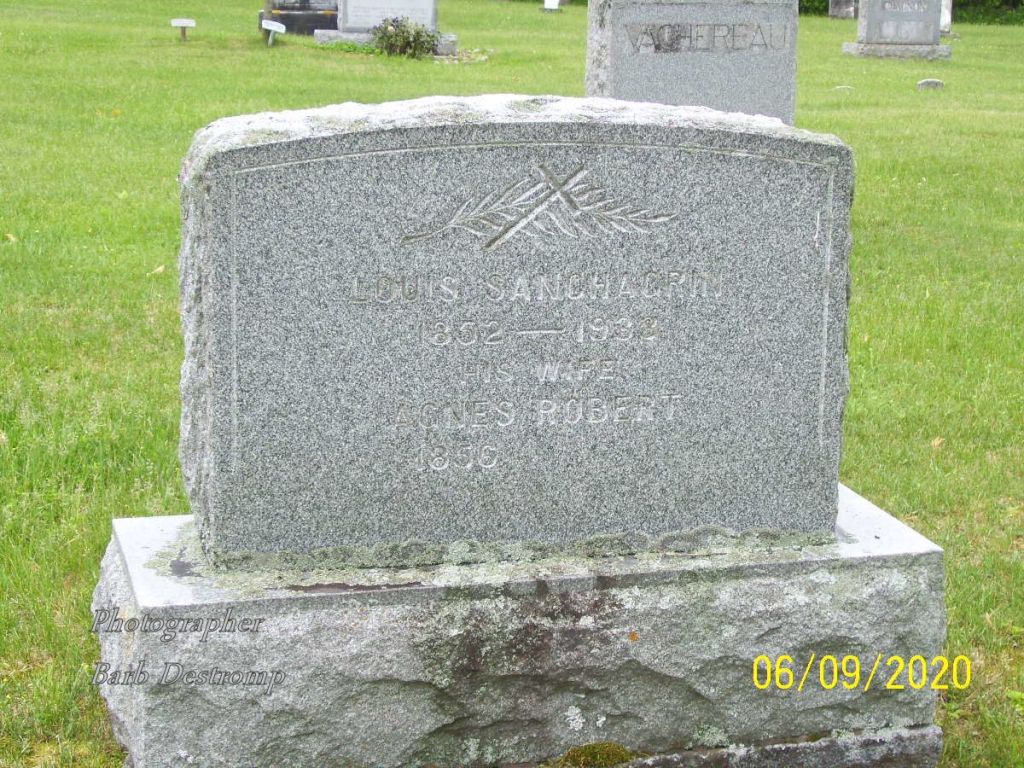
The Sanchagrin grave in Old Saint Mary’s Cemetery
Source: FindAGrave
In the quiet grounds of Old Saint Mary’s Cemetery atop Prospect Hill in the village of Champlain, New York, a modest granite headstone bears two names: Louis Sanchagrin and Agnès Robert. The stone is ornamented only with a small carved cross and a sprig of laurel.1 At first glance, it offers little more than a broad outline of a life. Yet Louis’s life mirrors, in many respects, the story of Champlain itself—a village perched on the western shore of Lake Champlain, defined by water, the border, immigrant labor, and industrial ambition. His experiences—marked by personal grief, labor, and community—offer a window into how ordinary people navigated the transformation that remade the North Country’s economy in the half-century after the Civil War. To follow his life is to trace the pulse of a village in motion, revealing how history resides not in grand events, but in the everyday rhythms.
Louis Sanchagrin was born in 1852 in Champlain, the son of Louis Sanchagrin Sr. and Emelie St. Jean, both of Canadian origin. The elder Louis appears in census records under a range of spellings—“Soshigran,” “Sshagon,” “Sashagra,” and even “Sawyer”—a reflection of enumerators’ frequent struggles with French-Canadian surnames. He arrived in Clinton County before 1840 and built his livelihood on Lake Champlain, appearing in the 1850 census as a sailor and in 1860 as a boatman, residing in a modest dwelling along Champlain village’s waterfront. The family was large and expanding: by the time young Louis was born, his parents had already welcomed at least eight children—Josette, Adolphine, Antoine, Solomon, William, David, Henry, and Adline. More children followed, including Josephine in 1857 and Aurelia in 1862. When the census taker visited the family in 1860, the family numbered ten and none of the children, including Louis, were recorded as attending school.2
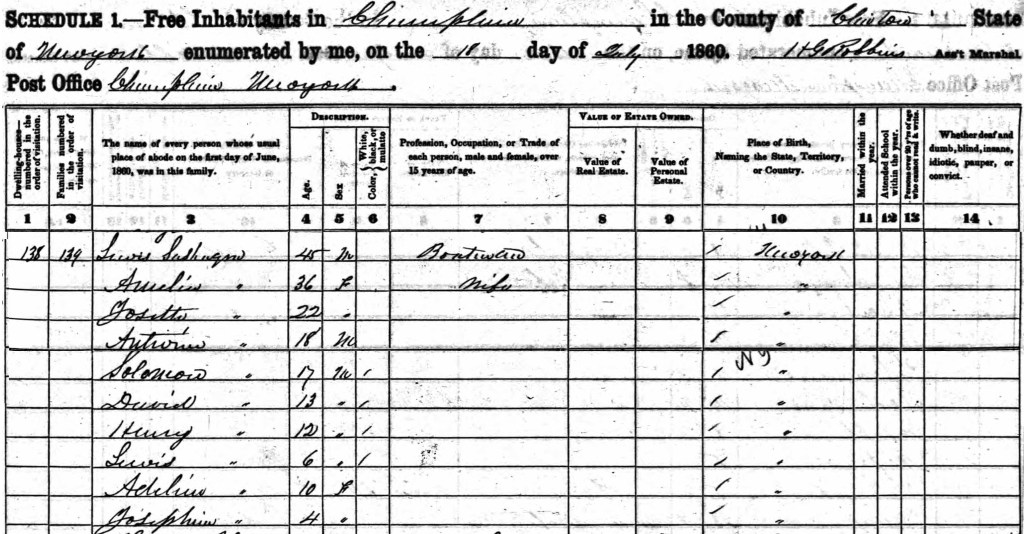
The Sanchagrin family in 1860 just before the start of the Civil War
Source: 1860 US census, Clinton County, New York, population schedule, Champlain Township.
Lake Champlain in the mid-nineteenth century was a working body of water. For families like the Sanchagrins, it was not a scenic backdrop but a vital economic lifeline. Canal boats carried timber, iron ore, farm produce, and manufactured goods between the lake’s landings and wider markets via the Champlain Canal and, ultimately, the Hudson River.3 Along the shore, sailors and boatmen formed a close-knit community, bound to the seasonal rhythms of ice and open water. Louis grew up immersed in this environment, learning its rhythms and dangers, its culture of hard physical labor and strong bonds among those who lived and worked along the shore. This was the life his father had navigated, and the one Louis himself would eventually enter as a young adult. Before that future could unfold, however, the family would be transformed by the ravages of war.
The outbreak of the Civil War in April 1861 must have seemed, to many families in Champlain, both distant and immediate. For working-class Franco-American households like the Sanchagrins, the conflict was likely discussed at the docks and in the village, woven into the rhythms of labor and conversation. At nine years old, Louis would have absorbed these conversations at the margins—hearing talk of enlistments, of battles far to the south, of duty and uncertainty. Young men watched with a mix of excitement and resolve as neighbors and friends signed enlistment papers, imagining themselves defenders of the Union or seekers of honor. For a boy on the waterfront, the war was not fought in sight, but it was unmistakably present.
The war took on personal meaning for Louis and the rest of the Sanchagrin family in the fall of 1861. That September, fifteen-year-old David became the first to enlist, traveling to Whitehall, New York, where he joined Company A of the 53rd New York Infantry on September 20.4 His choice of regiment may reflect the Sanchagrin family’s pride in their French heritage, as the 53rd New York was organized as a French Zouave unit, known for its distinctive, brightly colored uniform.
Just weeks later, on October 24, Louis’s brother Antoine and his cousin Edward followed David into the service. They joined Company D of the 34th New York Infantry, a regiment composed largely of men from Champlain, where familiar faces filled the ranks.5 Like David and many young men of the village, Antoine was a laborer and unmarried at the time of his enlistment.6 In a matter of weeks, the Sanchagrin household was transformed. Pride in their service would have been tempered by anxiety over the dangers they faced. For nine-year-old Louis, the war now unfolded not as far-off news but as lived experience—visible in preparations, farewells at the station, and the sight of uniforms and muskets, a child glimpsing the adult world through the lens of honor and peril.
As the war ground on, the Sanchagrins experienced a slow accretion of fear. Reports from the front arrived in fragments—through letters, newspapers, and the occasional messenger. In the spring of 1862, David’s regiment was disbanded, and he was transferred to Company G of the 17th New York Infantry. His time there was brief. By July, he had been discharged and sent home, disabled by consumption contracted during his service.7 War now assumed a more immediate and personal reality for the family when Louis witnessed David’s return not as a triumphant homecoming, but as a visible sign of the war’s physical toll. Soon after, he watched too as another older brother, Solomon, enlisted in the 153rd New York Infantry on August 28.8
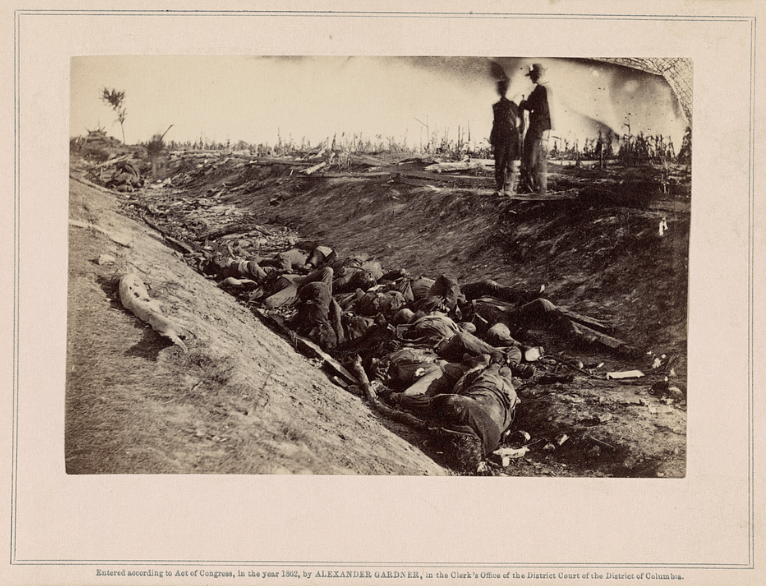
Photograph taken by Alexander Gardner in the “Bloody Lane” at Antietam, where Antoine Sanchagrin fought with Company D, 34th New York Infantry
Source: Gardner, Alexander, Copyright Claimant, Gardner, Alexander, photographer. Ditch on right wing, where a large number of rebels were killed at the Battle of Antietam. Antietam United States Maryland, 1862. [Sept] Photograph. https://www.loc.gov/item/2014646926/.
That fall, news from a distant battlefield reached Champlain in the wake of the Battle of Antietam on September 17, 1862. During the battle, Company D of the 34th New York Infantry found themselves in ferocious fighting at places like the West Woods and Bloody Lane. While their cousin Edward survived the fighting, Louis’s brother Antoine was reported wounded and missing.9 In a battle that left more than 22,000 men killed, wounded, or missing, the scale of loss was staggering—but for the Sanchagrin family, it was intensely personal. In time, the uncertainty gave way to finality: Antoine had died and was buried in an unmarked grave on the field. The family’s losses did not end there. David, weakened by consumption, never recovered and died before the year’s end.10 For young Louis, the war was no longer distant or abstract—it had become a source of profound and lasting grief.
The final years of the war brought no relief from the family’s mounting anxieties. Cousin Edward, who had survived Antietam, fell ill in early 1863 and died of disease.11 Meanwhile, Solomon endured numerous engagements with the 153rd New York Infantry before being wounded at the Battle of Winchester, Virginia, on September 19, 1864—nearly two years to the day after Antoine fell at Antietam. His injuries were not fatal, and he was mustered out on October 2, 1865, eventually returning to Champlain.12 Another of Louis’s brothers, Henry, enlisted in January 1865 with the 1st Frontier Cavalry and was discharged that July.13 He served along the Canadian frontier, patrolling the northern border and avoiding direct combat.
By the war’s end, the Sanchagrin family had endured loss, illness, and uncertainty in nearly every form the conflict could deliver—diminished, but still intact. Louis, now entering adolescence, had witnessed enlistments, shared in the family’s anxiety, grieved the deaths of Antoine and David, and lived with the constant fear for Solomon and Henry. The war had reshaped both his family and his understanding of the world, leaving marks that would follow him into adulthood: an enduring awareness of loss and resilience, and of familial bonds tested by distance, death, and duty. In the years that followed, these experiences would quietly shape the course of his life, influencing the work he pursued, the responsibilities he assumed, and the ways he remained tied to family and community.
In the years following the war, Louis began working as a sailor on Lake Champlain, following the path his father had long trod. In the 1870 census, eighteen-year-old Louis is recorded living with his parents and two younger sisters, Josephine and Aurelia, in the family household in the village of Rouses Point. His parents were now in their mid-fifties, and the elder Louis, once a sailor on the lake, was working as a farm laborer.14 For the younger Louis, the family trade seemed destined to define his own working life, just as it had his father’s—a continuity that must have seemed both familiar and assured.
Yet beneath this continuity, the economic landscape of Lake Champlain was beginning to shift in subtle but significant ways. Railroads had been extending into the North Country since the 1850s, and each new line posed a quiet but inexorable challenge to the long dominance of waterborne commerce.15 Canal boats, once the main arteries of timber, iron ore, and agricultural trade, were steadily losing ground to faster, more flexible rail transport. The lake, which had shaped the rhythms of generations, now offered a livelihood that was increasingly precarious, and Louis, like many young men of the region, faced the growing reality that the work he had inherited might no longer offer a secure future.
As his life on the water took shape, Louis began to build a family of his own when he married Agnès Robert on October 9, 1876.16 She was twenty years old and an immigrant from Canada in 1869.17 The couple established their home in Champlain and welcomed their first two children before 1880: a daughter, Ellen, followed by a son, Alexander. In the 1880 census, Louis, now twenty-eight, is recorded living in the village with his wife and two young children while making his living as a sailor, still tethered to the lake that had defined his youth.18
While the historical record is thin for the Sanchagrins in the 1880s, there is enough to trace both the expansion of their family and the losses they endured. A daughter, Melina—affectionately known as Minna—was born in July 1882, joining a household that was taking on the dimensions of an established family: a breadwinner with years of experience on the lake, a wife managing the home, and children growing up in the village they would always know. A son, Arthur, followed in April 1885, and in March 1887 Louis and Agnès welcomed another son, Henry. Two more sons were born in the 1890s: Francis in 1893 and Leon in 1896.19
The birth years and names of children only hint at a fuller story, however. By 1910, when Agnès answered census questions about her reproductive history, she reported having borne twelve children, of whom only five were still living.20 Some of the children who died young can be identified. In September 1885, tragedy struck when Minna, only three years old, died.21 Francis, born in 1893, also died shortly after birth according to family records.22 Yet five other children remain unaccounted for in the surviving records—some perhaps unnamed, some lost in infancy, others old enough to have been known and mourned. Child mortality in late nineteenth-century America was an ever-present reality. Diseases such as diphtheria, scarlet fever, and typhoid moved quickly through working-class communities, particularly in the warmer months when water contamination increased the risk.23 The weight of such loss cannot be captured fully in a census column, but it shaped the rhythms and emotional life of the Sanchagrin household. For Louis, the grief that marked his adult life echoed the losses of his youth. The war had first taught him the weight of absence and uncertainty; the years that followed required him to carry that weight within his own household, meeting it with a resilience forged long before.
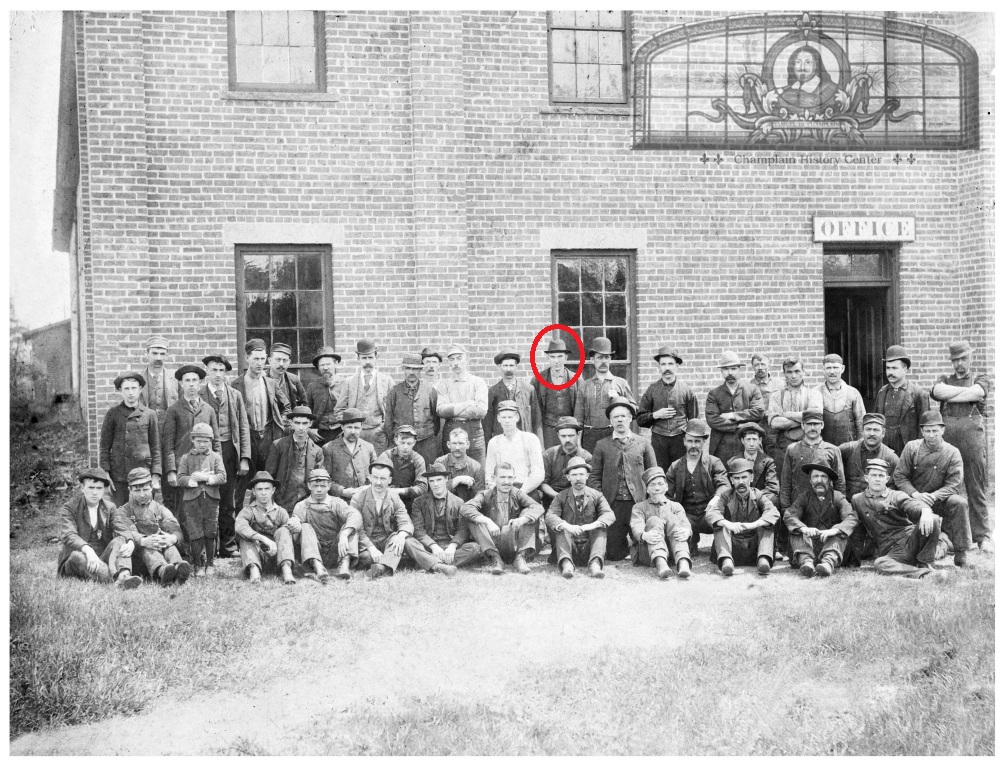
Employees at the Sheridan Iron Works
Source: Samuel de Champlain History Center
The same years that brought both new children and painful losses also marked another transition in Louis’s life: from sailor to ironworker. The exact moment of the shift is lost to history, but by the time the 1892 New York State census taker visited the family, Louis’s occupation had changed: no longer a sailor, but a “moulder,” a skilled craftsman who shaped molten metal into cast forms.24 His new workplace was the Sheridan Iron Works, situated on Elm Street in the heart of Champlain village. By that year, the Sheridan name had only recently been established, though the foundry itself had a longer history in the community.
The origins of the Sheridan Iron Works date to the years before the Civil War when a foundry was constructed on Elm Street after a fire destroyed an earlier facility. Initially, it produced steam engines, boilers, sawmills, iron water wheels, and castings for the Northern Railroad—the industrial backbone of a mid-century small-town economy. In 1880, James Averill Jr. and Sylvester Kellogg purchased the foundry, reorganizing it as the Champlain Foundry and Machine Shop and shifting production toward bookbinding machinery for the graphic arts industry. In 1887, the T.W. & C.B. Sheridan Company of New York City acquired a half-interest, eventually taking full ownership and renaming the operation the Sheridan Iron Works.25
Louis likely joined the company in the late 1880s or early 1890s, as he appears in a group photograph of forty Sheridan employees taken in 1893.26 The image captures a workforce at the height of the foundry’s early growth, with men in work clothes standing alongside others in vests and hats. It also reveals the Franco-American character of the shop floor, with surnames such as Patnode, Lafountain, Senecal, and Lariviere prominently represented. Louis worked among neighbors and fellow townsmen, part of a community whose shared heritage informed both their lives and their labor.
For men like Louis, the foundry was not simply a place of employment but the center of a new working life, one defined by steady wages, daily proximity, and a workforce drawn from the same families and villages. Where the lake had once bound workers together through seasonal rhythms and shared hardship, the iron works reshaped that cohesion into a different form. In this environment, the camaraderie of the waterfront was not lost, but transformed.
The Sheridan Iron Works specialized in bookbinding machinery—the machines that cut, creased, sewed, and covered the books and magazines that Americans consumed in ever-growing quantities. By the early twentieth century, its products were used in printing establishments across the country.27 For Louis, this meant that his daily labor in a small Champlain workshop fed into a much larger industrial system, one that connected his work at the forge and machine floor to the expanding print culture of the nation.
Louis’s career at Sheridan spanned more than four decades, during which his title and responsibilities evolved. The 1892 census records him as a moulder and by 1900 he was listed as “Engineer in Store,” a somewhat ambiguous designation that may have reflected a supervisory or mechanical role within the works. In 1910 and 1920, he was recorded simply as “Engineer” in the iron works and machine shop, respectively—a title suggesting skilled technical work involving the operation and maintenance of machinery. By 1930, in his late seventies, he was listed as a “Laborer” in the iron works, perhaps reflecting a late-career shift to less specialized work, or the imprecision of census reporting.28
For Louis, employment at Sheridan also brought a new rhythm to daily life. The sailor’s year had been dictated by the lake’s seasonal patterns—ice-in and ice-out, the pulse of navigation. Factory life operated differently: the clock, not the weather, governed the workday. Yet local records suggest that for men of Louis’s generation, this transition was eased by the enduring ties of the Franco-American community. The foundry was not an impersonal industrial enterprise, but a familiar environment where coworkers were neighbors and families were known to one another, preserving a sense of continuity even as the nature of work itself changed.
Through all the changes in his working life, one constant remained: the house on North Main Street in Champlain village. The Sanchagrin household appears at that address in census records from 1900 to 1930, rooted in the same place as the decades passed. By 1930, the house was valued at $2,500—a modest sum, yet a sign of the stability a working-class family could achieve through decades of labor. Louis and Agnès had owned it free of mortgage since at least 1910. It stood as a tangible measure of a life built through decades of labor: the sailor’s son who had entered the foundry in his thirties now possessed a home of his own.29
Yet the house on North Main was more than a marker of financial stability—it anchored the Sanchagrins within a close-knit community. In earlier years, Agnès’s younger brother Wilfred lived nearby while working as a boatman, reflecting the lingering ties to the lake.30 By 1910 and into the following decades, their neighbors included families such as the Lafountains, the Blains, and the Patries—many of whom, like Louis, were employed at the Sheridan Iron Works.31 These were not simply neighbors, but coworkers, relatives, and fellow members of Champlain’s Franco-American population. In this setting, the three central threads of Louis’s life—family, work, and community—were not separate spheres, but deeply intertwined within the few blocks surrounding his home.
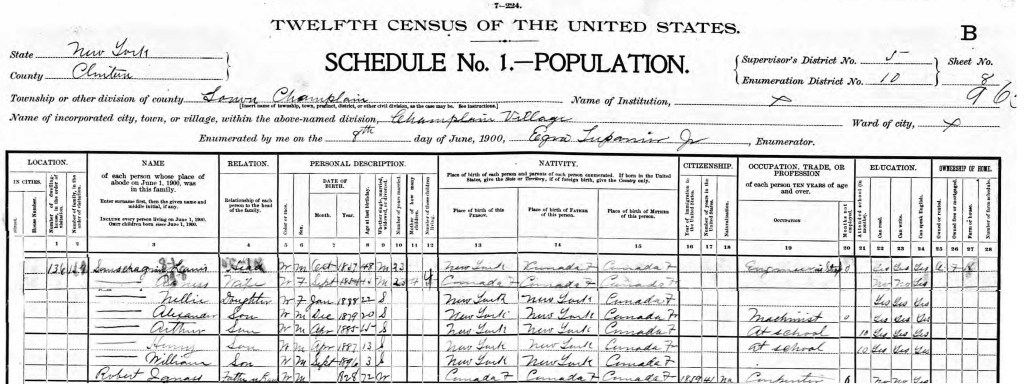
The Sanchagrin family composed of eight people in 1990
Source: 1900 US census, Clinton County, New York, population schedule, Champlain Township.
While the neighbors around the Sanchagrins provided stability, change continued to shape Louis’s life. In 1900, his household numbered ten, including all five of his children who would survive to adulthood—Ellen, Alexander, Arthur, Henry, and Leon—as well as Agnès’s father, Ignace.32 Within five years, that number had fallen to just four, as older children married or moved away, leaving only Henry, employed alongside Louis at the Sheridan works, and Leon at home.33 Loss also marked these years. Louis’s mother had died in 1887, and in 1908 his father passed away at the remarkable age of ninety-three.34 The patriarch who had come from Canada, worked the lake for decades, and sent four sons to war—enduring the losses of that era—was gone.
In the years that followed, the household grew quieter still. By 1910, only the youngest son, Leon, remained at home.35 The house that had been filled ten years earlier now reflected a different stage of life. Ellen had married and moved to Schenectady, and by the time of the First World War, Alexander had followed her there.36 Other members of the extended family left Champlain as well, drawn to industrial opportunities in New England. Solomon, who had survived his wartime wound at Winchester, joined his Civil War veteran brother Henry and sisters Adolphine and Josephine in Nashua, New Hampshire.37 Louis was the lone remaining member of the family he knew as a child who still lived in Champlain—the youngest son of a family shaped by war that had gradually scattered across New York and the Northeast.
Even as the family dispersed across the country, religion offered a steady point of continuity in the lives of Louis and Agnès. Champlain’s Catholic community, centered on St. Mary’s parish, formed the spiritual heart of the village’s Franco-American population. A brief notice in the Plattsburgh Sentinel and Clinton County Farmer offers a glimpse into this aspect of their lives: in July 1904, “Mr. and Mrs. Louis Sanchagrin and Henry Semard took the pilgrimage to St. Anne de Beaupré Tuesday morning.”38 The journey to the basilica of Sainte-Anne-de-Beaupré, near Quebec City—one of North America’s most important Catholic pilgrimage sites—suggests the enduring role of faith within the family and offers one of the few moments in the record where Agnès steps forward as a presence in her own right, not merely a name in a census column. For Franco-American Catholics in border communities like Champlain, such pilgrimages were not only acts of devotion, but also expressions of cultural identity, reaffirming ties to a shared past across the border.
In 1930, the federal census records Louis Sanchagrin still employed as a laborer in the iron works.39 The Great Depression had begun the previous year, and its early effects were already beginning to reach manufacturing communities like Champlain. Yet Louis continued to work. By this time, the household that had once been full of children had grown quieter, as the next generation established lives elsewhere. In the 1920s, his son Henry relocated with his family to Montreal, while his youngest son, Leon, moved west to Denver, Colorado.40 The dispersion of his children reflected broader patterns of migration among working families, but it also meant that Louis and Agnès faced their later years with fewer of their children and grandchildren close at hand. Only son Arthur remained close at hand, living with his wife and children throughout Louis and Agnès’s later life.41 Whether driven by necessity, habit, or the expectation that men of his generation would labor as long as they were able, we cannot know. The image is striking: a man born in 1852, who had sailed Lake Champlain in his youth and labored in the foundry for half a century, still reporting to the Sheridan’s at an age when most men today would have long since retired.
At home, however, the toll of age was becoming increasingly visible. Newspaper notices from these years offer brief but revealing glimpses into the family’s later life. In 1919, Agnès suffered a serious heart attack, from which she slowly recovered.42 By 1931, she had experienced a stroke, while Louis himself was taken to the Champlain Valley Hospital with an infected foot.43 These scattered reports reveal the physical toll of advancing age. Yet they also reveal a family that remained connected: children returned to visit, and news of their comings and goings continued to appear in local papers.44 At the same time, the generation that had defined Louis’s early life was passing. His brother Solomon died in 1925, followed by his brother Henry in 1926 and sister Adolphine in 1929.45
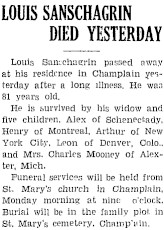
Louis Sanchagrin’s obituary
Source: Plattsburgh Daily Press, Page 5, 22 July 1933
Louis, the last remaining tie to the Sanchagrin family’s Civil War experience, died on July 21, 1933. His passing was noted in a brief obituary that recorded the essential facts of his life. He was described as a lifelong resident of Champlain who died at home after a long illness, and a husband and father survived by children living in places as distant as New York City, Montreal, and Denver. The notice spoke of his funeral at St. Mary’s Church and his burial in the parish cemetery.46 It was a simple accounting—faithful, but spare.
That brevity stands in quiet contrast to the life it represents. Behind those few lines lay decades of labor on the lake and in the foundry, the losses of the Civil War carried home through his family, the deaths of children in an era when such grief was common, and the slow dispersal of a household across a widening geography. It was a life lived not in singular events, but in endurance—in the steady accumulation of work, family, and community over time.
Standing before the stone today, little of this is visible at first glance. The granite headstone in Old Saint Mary’s Cemetery offers only the barest outline: a name, a pair of dates, and the name of his wife. Yet the fragments that remain—census records, enlistment rolls, newspaper notices, and a photograph taken outside a village foundry—allow us to see more clearly what those markers cannot fully express. Louis Sanchagrin’s life was deeply rooted in the place where he lived. Through him, we can trace the transformation of Champlain itself—from a lakeside economy to an industrial village, from a tightly bound family network to one stretched across a continent. If the headstone marks the boundaries of his life, the history surrounding it reveals something more enduring: a life lived fully within the limits and possibilities of its time and place, and a community reflected in one man’s quiet arc of life. One now marked only by a stone on a hillside above the village he never left.
Endnotes
- Find A Grave, “Louis Sanchagrin (1852–1933),” Memorial 99342749, citing Old Saint Mary’s Cemetery, Champlain, Clinton County, New York, accessed April 14, 2026, https://www.findagrave.com/memorial/99342749/louis-sanchagrin. Louis’s first and last name are spelled many different ways across the various historical records; for the purposes of this research, I’ve adopted the naming featured on his gravestone.
- 1850 US census, Clinton County, New York, population schedule, Champlain Township, Louis Soshigran household, dwelling 3015 family 3249, digital image, Ancestry (http://www.ancestry.com: accessed April 14, 2026); citing National Archives Microfilm Publication, Roll M432, Page: 463a. 1860 US census, Clinton County, New York, population schedule, Champlain Township, Lewis Sashagraw household, dwelling 138 family 139, digital image, Ancestry (http://www.ancestry.com: accessed April 14, 2026); citing National Archives Microfilm Publication, Roll M653, Page: 579.
- For more information on the canal boat industry on Lake Champlain, see Russell Bellico, Sails and Steam in the Mountains: A Maritime and Military History of Lake Champlain (Fleischmanns, NY: Purple Mountain Press, 1992), 235-251. For more information on canal boat building in Champlain, see the Samuel de Champlain History Center’s overview: http://www.champlainhistory.org/canal-boat-industry.html.
- New York State Military Museum, 53rd Infantry Regiment Civil War Roster, PDF, accessed April 14, 2026, https://museum.dmna.ny.gov/application/files/7015/5068/0702/53rd_Infantry_CW_Roster.pdf, 630 (entry for David Sawyer).
- New York State Military Museum, 34th Infantry Regiment Civil War Roster, PDF, accessed April 14, 2026, https://museum.dmna.ny.gov/application/files/7115/5059/8288/34th_Infantry_CW_Roster.pdf, 256 (entries for Anthoney Sashagra and Edward Sashagra).
- Anthony Sashagraw, service entry, Town Clerks’ Registers of Men Who Served in the Civil War, ca. 1865–1867, Collection (N-Ar)13774, box 12, roll 8, New York State Archives, Albany; microfilm publication, 37 rolls; digital image, Ancestry (http://www.ancestry.com: accessed April 14, 2026).
- New York State Military Museum, 17th Infantry Regiment Civil War Roster, PDF, accessed April 14, 2026, https://museum.dmna.ny.gov/application/files/2615/5059/3124/17th_Infantry_CW_Roster.pdf, 790, (entry for David Sawyer).
- New York State Military Museum, 153rd Infantry Regiment Civil War Roster, PDF, accessed April 14, 2026, https://museum.dmna.ny.gov/application/files/4915/5310/6521/153rd_Infantry_CW_Roster.pdf, 1055, (entry for Solomon Sachagra).
- “Anthoney Sashagra,” Civil War Muster Roll Abstract, in New York, U.S., Civil War Muster Roll Abstracts, 1861–1900, New York State Archives, Albany; Civil War Muster Roll Abstracts of New York State Volunteers, United States Sharpshooters, and United States Colored Troops, ca. 1861–1900, box 973–974; digital image, Ancestry (http://www.ancestry.com: accessed April 14, 2026).
- David Sawyer, service entry, Town Clerks’ Registers of Men Who Served in the Civil War, ca. 1865–1867, Collection (N-Ar)13774, box 12, roll 8, New York State Archives, Albany; microfilm publication, 37 rolls; digital image, Ancestry (http://www.ancestry.com: accessed April 14, 2026).
- New York State Military Museum, 34th Infantry Regiment Civil War Roster, PDF, accessed April 14, 2026, https://museum.dmna.ny.gov/application/files/7115/5059/8288/34th_Infantry_CW_Roster.pdf, 256 (entry for Edward Sashagra).
- New York State Military Museum, 153rd Infantry Regiment Civil War Roster, PDF, accessed April 14, 2026, https://museum.dmna.ny.gov/application/files/4915/5310/6521/153rd_Infantry_CW_Roster.pdf, 1055, (entry for Solomon Sachagra).
- Henry Sashagraw, service entry, Town Clerks’ Registers of Men Who Served in the Civil War, ca. 1865–1867, Collection (N-Ar)13774, box 12, roll 8, New York State Archives, Albany; microfilm publication, 37 rolls; digital image, Ancestry (http://www.ancestry.com: accessed April 14, 2026).
- 1870 US census, Clinton County, New York, population schedule, Champlain Township, Lewis Sawyer household, dwelling 32 family 34, digital image, Ancestry (http://www.ancestry.com: accessed April 14, 2026); citing National Archives Microfilm Publication, Roll M593_918, Page: 155B.
- For more information on the decline of the canal boat industry in New York, see Lake Champlain Maritime Museum, “Commercial Era (1823–1945),” accessed April 14, 2026, https://www.lcmm.org/explore/lake-champlain-history/commercial-era-1823-1945/.
- Geneanet Community Trees Index (Lehi, UT: Ancestry.com Operations, Inc., 2022), entry for Louis Sanschagrin and Agnès Robert, wedding date October 9, 1876, digital image, Ancestry (http://www.ancestry.com: accessed April 14, 2026).
- 1920 US census, Clinton County, New York, population schedule, Champlain Township, Louis Sanchagrin household, dwelling 188 family 238, digital image, Ancestry (http://www.ancestry.com: accessed April 14, 2026); citing National Archives Microfilm Publication, Roll T625_1094, Page: 10A.
- 1880 US census, Clinton County, New York, population schedule, Champlain Township, Lewis Sansagran household, dwelling 133 family 133, digital image, Ancestry (http://www.ancestry.com: accessed April 14, 2026); citing National Archives Microfilm Publication, Roll 819, Page: 156d.
- 1900 US census, Clinton County, New York, population schedule, Champlain Township, Lewis Sanschagrin household, dwelling 136 family 162, digital image, Ancestry (http://www.ancestry.com: accessed April 14, 2026); citing National Archives Microfilm Publication, Roll 1018, Page: 8.
- 1910 US census, Clinton County, New York, population schedule, Champlain Township, Lewis Sanschagrin household, dwelling 87 family 89, digital image, Ancestry (http://www.ancestry.com: accessed April 14, 2026); citing National Archives Microfilm Publication, Roll T624_932, Page: 5B.
- Find A Grave, “Minna Sanchagrin (1882–1885),” Memorial 99343234, citing Old Saint Mary’s Cemetery, Champlain, Clinton County, New York, accessed April 14, 2026, https://www.findagrave.com/memorial/99343234/minna-sanchagrin.
- “Francis Sanchagrin,” family tree, Ancestry, accessed April 14, 2026.
- See Gretchen Condran and Eileen Crimmins, “Mortality Differentials Between Rural and Urban Areas of States in the Northeastern United States, 1890–1900,” Journal of Historical Geography 6, no. 2 (1980): 179–202 for more information on mortality differences.
- 1892 New York state census, Clinton County, New York, population schedule, Champlain Township, Louis Sanchagrin household, page 9, digital image, Ancestry (http://www.ancestry.com: accessed April 14, 2026).
- Samuel de Champlain History Center, “A History of the T.W. & C.B. Sheridan Co. a.k.a. Sheridan Iron Works,” http://www.champlainhistory.org/sheridan-iron-works.html (accessed April 2026).
- Photograph of Sheridan Iron Works employees, 1893, with identification key, Samuel de Champlain History Center, Champlain, NY.
- Samuel de Champlain History Center, “A History of the T.W. & C.B. Sheridan Co. a.k.a. Sheridan Iron Works,” http://www.champlainhistory.org/sheridan-iron-works.html (accessed 2024).
- 1892 New York state census, Champlain, NY, Louis Sanchagrin household. 1900 U.S. Census, Champlain, NY, Lewis Sanschagrin household. 1910 U.S. Census, Champlain, NY, Lewis Sanschagrin household. 1920 U.S. Census, Champlain, NY, Louis Sanchagrin household.
- 1905 New York state census, Clinton County, New York, population schedule, Champlain Township, Louis Sanchagrin household, page 9, digital image, Ancestry (http://www.ancestry.com: accessed April 14, 2026). 1900 U.S. Census, Champlain, NY, Lewis Sanschagrin household. 1910 U.S. Census, Champlain, NY, Lewis Sanschagrin household. 1920 U.S. Census, Champlain, NY, Louis Sanchagrin household. 1930 US census, Clinton County, New York, population schedule, Champlain Township, Louis Sanchagrin household, dwelling 244 family 278, digital image, Ancestry (http://www.ancestry.com: accessed April 14, 2026); citing National Archives Microfilm Publication, FHL microfilm: 2341151, Page: 10B.
- 1905 New York state census, Clinton County, New York, population schedule, Champlain Township, Wilfred Roberts household, page 9, digital image, Ancestry (http://www.ancestry.com: accessed April 14, 2026).
- 1910 US census, Clinton County, New York, population schedule, Champlain Township, Frank Lafountain household, dwelling 86 family 88, digital image, Ancestry (http://www.ancestry.com: accessed April 14, 2026); citing National Archives Microfilm Publication, Roll T624_932, Page: 5A. 1910 US census, Clinton County, New York, population schedule, Champlain Township, Lewis Blain household, dwelling 89 family 91, digital image, Ancestry (http://www.ancestry.com: accessed April 14, 2026); citing National Archives Microfilm Publication, Roll T624_932, Page: 5B. 1910 US census, Clinton County, New York, population schedule, Champlain Township, Lewis Patrie household, dwelling 91 family 93, digital image, Ancestry (http://www.ancestry.com: accessed April 14, 2026); citing National Archives Microfilm Publication, Roll T624_932, Page: 5B. 1920 US census, Clinton County, New York, population schedule, Champlain Township, Frank Lafountain household, dwelling 189 family 239, digital image, Ancestry (http://www.ancestry.com: accessed April 14, 2026); citing National Archives Microfilm Publication, Roll T625_1094, Page: 10A. 1920 US census, Clinton County, New York, population schedule, Champlain Township, Louis Blain household, dwelling 186 family 236, digital image, Ancestry (http://www.ancestry.com: accessed April 14, 2026); citing National Archives Microfilm Publication, Roll T625_1094, Page: 10A.1920 US census, Clinton County, New York, population schedule, Champlain Township, Louis Patrie household, dwelling 184 family 234, digital image, Ancestry (http://www.ancestry.com: accessed April 14, 2026); citing National Archives Microfilm Publication, Roll T625_1094, Page: 10A.
- 1900 U.S. Census, Champlain, NY, Lewis Sanschagrin household.
- 1905 New York state census, Champlain, NY, Louis Sanchagrin household.
- Find A Grave, “Emily Sanchagrin (1815–1887),” Memorial 95944075, citing Saint Joseph’s Cemetery, Coopersville, Clinton County, New York, accessed April 14, 2026, https://www.findagrave.com/memorial/95944075/emily-sanchagrin. Find A Grave, “Louis Sanchagrin (1810–1908),” Memorial 95944240, citing Saint Joseph’s Cemetery, Coopersville, Clinton County, New York, accessed April 14, 2026, https://www.findagrave.com/memorial/95944240/louis-sanchagrin.
- 1910 U.S. Census, Champlain, NY, Lewis Sanschagrin household.
- 1910 US census, Schenectady County, New York, population schedule, Schenectady City, Charles Mooney household, dwelling 314 family 71, digital image, Ancestry (http://www.ancestry.com: accessed April 14, 2026); citing National Archives Microfilm Publication, Roll T624_1078, Pages: 3B-4A. “U.S., World War I Draft Registration Cards, 1917–1918,” digital image, Ancestry (http://www.ancestry.com: accessed April 14, 2026); entry for Alexander Lewis Sawyer, Schenectady County, New York; citing World War I Selective Service System Draft Registration Cards, 1917–1918, NARA microfilm publication, National Archives and Records Administration, Washington, D.C.
- 1900 US census, Hillsborough County, New Hampshire, population schedule, Nashua Township, Solomon Sawyer household, dwelling 120 family 133, digital image, Ancestry (http://www.ancestry.com: accessed April 14, 2026); citing National Archives Microfilm Publication, Roll 948, Pages: 6. 1900 US census, Hillsborough County, New Hampshire, population schedule, Nashua Township, Henry Sawyer household, dwelling 140 family 159, digital image, Ancestry (http://www.ancestry.com: accessed April 14, 2026); citing National Archives Microfilm Publication, Roll 948, Pages: 8. “Delphine Pelletier,” death record, July 7, 1929, Nashua, New Hampshire, New Hampshire Death Records, 1650–1969, box 1214, New Hampshire Archives and Records Management, Concord; digital image, Ancestry (http://www.ancestry.com: accessed April 14, 2026). 1910 US census, Hillsborough County, New Hampshire, population schedule, Nashua Township, Ashley Pelky household, dwelling 177 family 190, digital image, Ancestry (http://www.ancestry.com: accessed April 14, 2026); citing National Archives Microfilm Publication, Roll 948, Pages: 10A.
- “Champlain,” Plattsburgh Sentinel and Clinton County Farmer, July 15, 1904, p. 8.
- 1930 U.S. Census, Champlain, NY, Louis Sanchagrin household.
- “Louis Sanschagrin Died Yesterday,” Plattsburgh Daily Press, July 22, 1933, 5. 1930 US census, Denver County, Colorado, population schedule, Denver City, Leon Sanschagrin household, dwelling 474 family 515, digital image, Ancestry (http://www.ancestry.com: accessed April 14, 2026); citing National Archives Microfilm Publication, FHL microfilm: 2339970, Page: 26A.
- 1920 US census, Clinton County, New York, population schedule, Champlain Township, Arthur Sanchagrin household, dwelling 12 family 13, digital image, Ancestry (http://www.ancestry.com: accessed April 14, 2026); citing National Archives Microfilm Publication, Roll T625_1094, Page: 1A.
- “Champlain,” Plattsburgh Sentinel, October 3, 1919, 6.
- “Champlain Locals,” The North Countryman, March 19, 1931, 13. “Champlain,” Plattsburgh Sentinel, March 31, 1931, 6.
- “Champlain,” Plattsburgh Sentinel, October 3, 1919, 6. “Champlain,” Chateaugay Record and Franklin County, May 23, 1919, 4.
- Find A Grave, “Solomon Sanchagrin (1843–1925),” Memorial 190221754, citing Saint Francis Xavier Catholic Cemetery, Nashua, Hillsborough County, New Hampshire, accessed April 14, 2026, https://www.findagrave.com/memorial/190221754/solomon-sanchagrin. “Henry Sawyer,” death record, May 18, 1926, Goffstown, New Hampshire, New Hampshire, U.S., Death and Disinterment Records, 1754-1947, New Hampshire Bureau of Vital Records, Concord, New Hampshire; digital image, Ancestry (http://www.ancestry.com: accessed April 14, 2026). “Delphine Pelletier,” death record, July 7, 1929, Nashua, New Hampshire, New Hampshire Death Records, 1650–1969, box 1214, New Hampshire Archives and Records Management, Concord; digital image, Ancestry (http://www.ancestry.com: accessed April 14, 2026).
- “Louis Sanschagrin Died Yesterday,” Plattsburgh Daily Press, July 22, 1933, 5.


