
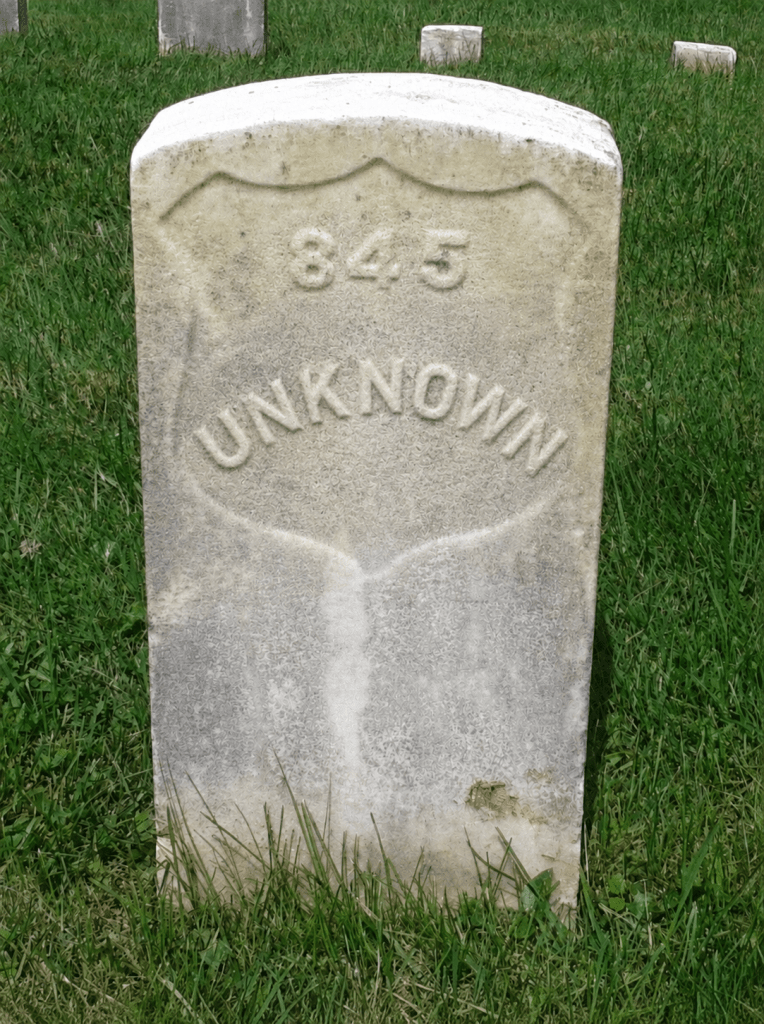
When Duane Hamilton Hurd published History of Clinton and Franklin Counties, New York in 1880, the Civil War was not distant history. Veterans still walked the streets of Champlain. Widows of fallen soldiers remained part of the community. Men who had marched through Virginia and Maryland still carried visible wounds and invisible memories from distant battlefields. The war lived not only in commemorative speeches or celebrations, but in kitchens, churches, family farms, and cemetery plots throughout northern New York.1
Yet when Hurd’s history turned to Champlain’s role in the Civil War, the account was strikingly brief. Under the heading “MILITARY RECORD, 1861–65,” the book simply listed names and sometimes included a regiment, enlistment date, or occasional notes of “killed” or “died.”2 There was no mention of battles, no stories of families who waited at home for letters that sometimes never arrived, and no discussion of the wounded men who returned altered physically and emotionally by war. The experiences of an entire community were compressed into a ledger of military service. And yet, hidden within those columns are extraordinary human stories.
Each name represented a life interrupted. A farmer who left his autumn harvest unfinished. A son who kissed his mother goodbye at a farmhouse door. A husband who promised he would return before the war was over. Some returned, but many others did not. Another group returned home carrying wounds that reshaped both their own futures and the lives of their families.
Examining the first company of soldiers raised in Champlain provides an opportunity to explore that history absent from Hurd’s retelling. Expanding beyond traditional military history creates the possibility to understand what the Civil War meant to the entire community of Champlain. Campaigns, marches, and battles matter, but the war reshaped households, altered economic life, transformed family structures, and left emotional scars that would endure for decades.
To begin telling the story of the Civil War in Champlain, we must first understand the town on the eve of war. In 1860, Champlain was a young and growing border community of over 5,800 people that was overwhelmingly defined by youth. The average resident of Champlain was just 22.5 years old, while the median age was only seventeen. Over half the town was younger than twenty. Children crowded farmhouses and village homes, and large families were common with the average household containing more than six people.3
Champlain in 1860 was also profoundly shaped by migration and border culture. At first glance, the federal census appears to show a largely native-born American community: sixty percent of residents were born in New York. But a deeper examination reveals a far more complex and fluid social landscape. Only 14.4% of Champlain’s population were multigenerational Americans—individuals born in New York to two New York–born parents. Nearly everyone else had either immigrated themselves or were the children of recent immigrants.4
The Canadian presence was especially striking. The census recorded 1,584 Canadian-born residents, but when combined with New York-born children who had at least one Canadian-born parent, people of direct Canadian origin accounted for more than 58% of the town’s entire population. In practical terms, a majority of Champlain’s residents in 1860 were either immigrants from Canada or their first generation children born across the border in the United States.5 For many people living in Champlain, being “American-born” was less an expression of deep ancestral roots than a reflection of geography—simply the place where immigrant families happened to settle and raise children.
The border itself was far more permeable than later generations might imagine. Families crossed regularly for work, trade, marriage, religion, and land opportunities. Cultural identity in northern Clinton County was hybrid and overlapping. French might be spoken at home while English was used in commerce or public life. Catholic and Protestant communities existed alongside one another. Some families had only recently arrived from Québec, while others had already spent a generation adapting to American civic life. In many ways, Champlain in 1860 resembled a frontier borderland community more than a settled interior American town.
Occupation patterns in Champlain in 1860 further illustrate the social and economic divisions within this border community. Canadian-born residents overwhelmingly occupied the ranks of day laborers, with 328 men listed in manual labor positions—far more than any other occupational category among immigrants. Irish immigrants showed a similar pattern, with most likewise concentrated in day labor and other forms of physically demanding work. By contrast, New York-born residents were more heavily represented in farming, commerce, education, and the professions. Native-born residents were far more likely to own or operate farms, work as merchants or tradesmen, or occupy skilled and professional positions within the community. British-born residents occupied a somewhat more mixed economic position, appearing in agriculture, skilled trades, and commerce in greater proportion than Irish or Canadian immigrants.6
These occupational patterns reflected broader realities of mid-nineteenth century immigration and settlement. Recently arrived immigrant families often entered Champlain through wage labor, canal and maritime work, lumbering, or agricultural labor before gradually acquiring property or economic stability. Native-born families, particularly those established in the region longer, were more likely to possess land, businesses, or skilled occupations.7 These demographic and economic patterns were not abstract characteristics of Champlain society. They shaped the very households from which Company D would emerge. The company’s volunteers carried with them the influences of immigration, family circumstance, occupation, and economic status, bringing the full complexity of their community into military service.
When the first soldiers enlisted in 1861, those economic differences marched into military service alongside the men themselves. Farmers’ sons stood beside laborers, immigrant workers beside clerks and tradesmen, all creating a company that mirrored both the diversity and inequality of Champlain society on the eve of the Civil War. The question, however, was how this diverse borderland community would respond when national events demanded action.
The outbreak of the Civil War in April 1861 transformed the national crisis into a local one almost immediately in Champlain. Following the Confederate attack on Fort Sumter in April 1861, communities across the North began organizing volunteer companies in response to President Abraham Lincoln’s call for troops. In Champlain, some of the earliest volunteers were John Coonan and brothers Royal and George Corbin, who enlisted in the 16th New York Infantry in May 1861. Royal was commissioned a first lieutenant, and the regiment soon departed for service with the Union Army.8 Although the 16th New York was held largely in reserve during the First Battle of Bull Run in July 1861, their experience underscored a reality that many Americans were only beginning to understand: the war would neither be brief nor romantic.
The larger story of Champlain’s Civil War experience would emerge not through scattered enlistments in distant regiments, however, but through the formation of a company raised directly from the community itself as volunteer companies were often organized locally. A respected community member—frequently a lawyer, businessman, militia officer, or civic leader—would obtain authority to recruit men for service. Recruiting meetings were held in town halls, public squares, hotels, and churches. Speeches invoked patriotism, duty, local honor, and loyalty to the Union. Once enough men enlisted, the company would elect its own officers before being formally mustered into state and federal service. The process was deeply democratic and intensely local and, by the middle of June 1861, had resulted in the formation of just such a company in Champlain. Those men became Company D of the 34th New York Infantry, the only men from Clinton County in a regiment composed largely of men from Herkimer County.
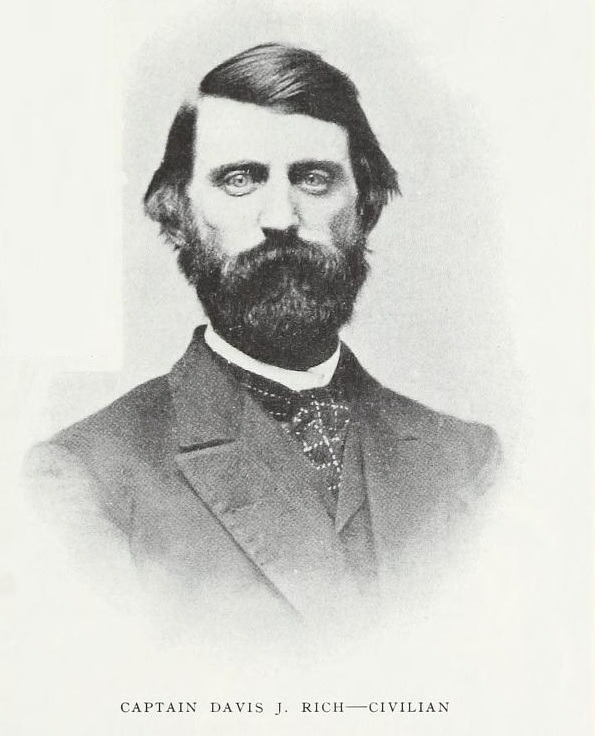
Captain Davis Rich–Company D’s first captain
Source: Louis N. Chapin, A Brief History of the Thirty-Fourth Regiment, N.Y.S.V., page 55
That first company of men from Champlain emerged directly from the social fabric of the town and surrounding countryside. The men elected local lawyer Davis J. Rich as captain, John O. Scott as first lieutenant, and Brinckerhoff Noadiah Miner as second lieutenant.9 These were not distant professional soldiers imposed upon the company by the federal government. They were men known personally to the volunteers—neighbors, employers, relatives, and respected figures within the community itself. Miner was the great grandson of Pliny Moore, a lieutenant under George Clinton during the Revolution, and one of the founders of Champlain.10
The men who answered that call were strikingly young, even by the standards of a town defined by youth. Of the soldiers who could be matched to the 1860 census, nearly forty-three percent were under eighteen at the time of enlistment, meaning a substantial portion of Company D marched to war as teenagers. A handful of older men — several in their forties and fifties — pulled the mean age up to 24.8, but the median age of 21 told a different story.11 These were boys from farms and village households, most of them still living under their parents’ roofs when the war began. They did not leave behind isolated lives; they departed from densely interconnected family networks that depended upon their labor and presence.
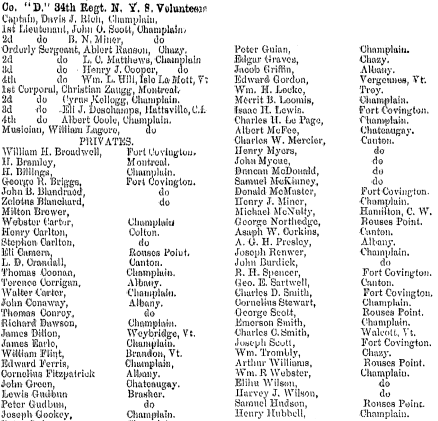
The initial muster list published when Company D left town in August 1861
Source: “Co. ‘D.’ 34th Regt. N.Y.S. Volunteers,” Plattsburgh Republican, August 24, 1861, 2, col. 6.
Although Company D became closely identified with Champlain, the company also reflected the broader regional world of the northern Champlain Valley and the borderlands stretching into Vermont and Canada. Of the seventy-two men whose hometowns were recorded on the original muster list published in the local paper, thirty came from Champlain, while others arrived from nearby communities such as Canton, Chazy, Chateaugay, Fort Covington, and Massena. Still others came from across the wider northern landscape—from Vermont towns like Brandon, Vergennes, Weybridge, and Isle La Motte, and even from Montréal and Canada West.12 The company therefore embodied both local intimacy and regional mobility, drawing together farm boys, laborers, immigrants, and young tradesmen whose lives had already been shaped by the movement of people across borders and waterways.
Yet within that broader regional mix, the company still retained the closeness of a neighborhood militia. Brothers enlisted beside brothers. Among the Champlain men were Wallace and Webster Carter, one example of the family bonds woven throughout the company.13 Charles LePage, a fifty-two year old cabinet maker, and Peter Guyon, a thirty-seven year old shoemaker, represented another connection–their two immigrant families shared a single dwelling in town.14 The same patterns repeated across the roster: men who had grown up together, attended the same churches, worked neighboring farms, or traveled the same roads now prepared to march and fight side-by-side. When Company D entered the war, Champlain was not simply sending individuals into battle; it was sending interconnected pieces of the community itself. That closeness created powerful bonds within the company, but it also magnified the consequences of battle. When men eventually experienced combat, losses radiated outward through communities in concentrated form. A single engagement might wound or kill multiple men from the same extended family or neighborhood. News from the front did not arrive as abstract casualty totals; it arrived as the loss of familiar faces known throughout the town.
The muster roll quietly reveals the remarkable diversity of the community that entered the war together. Alongside Anglo-American names appear French-Canadian and immigrant surnames such as LePage, Lajoie, Gadbois, Gokey, Corrigan, and Fitzpatrick.15 Company D reflected the borderland character of northern New York—a region shaped by migration, Catholic and Protestant traditions, and enduring economic and family ties stretching northward into Québec. Nearly thirty-nine percent of the men were either Canadian-born themselves or came from households headed by Canadian immigrants, a proportion that mirrored Champlain’s broader population. Indeed, by 1860 only a minority of the town’s residents could be considered multigenerational Americans. Most families had arrived recently from Canada, Ireland, or elsewhere in Europe, or were the children of those immigrants.16 For many soldiers in Company D, their connection to the United States was relatively new. Yet when the company formed in the summer of 1861, those distinctions mattered less than the shared commitment that brought them together. Immigrant and native-born, Catholic and Protestant, laborer and tradesman, teenager and middle-aged family man marched side by side toward a war whose scale and consequences none of them could fully comprehend.
Despite their varied backgrounds and stories, few of the men who enlisted in Company D could yet imagine the scale of violence awaiting them. Like many Northern volunteers, they likely believed they were joining a short war fought for Union and national preservation. But by forming the company, Champlain had done something profound: the town had effectively marched itself into the Civil War.
As the soldiers marched off to war, they left behind families that had to cope with suddenly changed circumstances. The families from which Company D emerged reveal how vulnerable many Champlain households were on the eve of war. Among thirty identified soldier households, the average family contained nearly seven people, substantially larger than the town average. Most were headed by immigrants or the children of immigrants, and many depended heavily upon the labor of a single adult male.17 Three households were already headed by widows before the first shots were fired. Frances Hubbell lived with her five sons.18 Mary Rogers, just a few houses away from the Hubbell family, was supporting nine children.19 Harriet Cameron, a Canadian-born widow, was raising six children with no recorded property.20 Such families lived close to the economic margin. When sons and husbands enlisted, they carried not only muskets but also the labor upon which their households depended. Military service therefore imposed immediate hardships long before casualty lists began arriving from Virginia and Maryland.
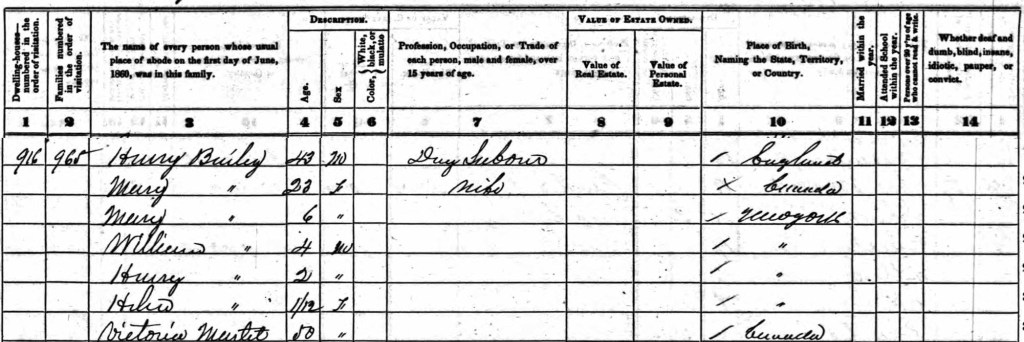
The Bailey family in 1860
Source: 1860 US census, Clinton County, New York, population schedule, Champlain Township.
The Bailey family further illustrates the vulnerability of many Company D households. In 1860, Henry Bailey lived in Rouses Point with his wife Mary, four young children all under the age of seven, and Mary’s aging mother.21 Like many families in the Champlain area, the household depended heavily upon the labor and earnings of a single adult male and possessed few economic buffers against hardship. Local records show that the family received community assistance during Henry’s military service, evidence that they struggled to make ends meet in his absence.22 The Baileys were not alone. The families of Peter Guyon and Charles LePage also received support while their husbands and fathers served in the army.23 The sums involved were modest, but their significance was not. They reveal how little economic cushion many Champlain families possessed and how quickly the loss of a wage earner could create hardship. For these households, military service imposed burdens long before casualty lists arrived from the front. The enlistment of a husband or son did not simply remove a soldier from the community; it often removed a family’s primary means of support, leaving wives, children, and aging parents to navigate an uncertain future.
A closer examination of the thirty households from which Company D’s soldiers came provides additional insight into the vulnerability and the complexity of those families. The households were notably larger than the Champlain average, with a mean of 6.9 persons compared to the town-wide figure of 5.77, and a median of seven.24 Three households exceeded ten people — the Sanchagrin canal-boat family, the Rogers household, and the large Gokey carpenter household, which included a boarder.25 Economically, the picture was more varied than the word “vulnerable” alone can capture. Half of the thirty households held some recorded real estate in 1860, a rate somewhat higher than the town-wide figure of approximately thirty-nine percent, suggesting that soldier families were not uniformly the poorest in Champlain. But the distribution within the group was sharply skewed. A small number of relatively prosperous households — including that of company captain Davis J. Rich, a lawyer, and two merchants — raised the averages considerably, while many others held little or nothing.26 Among the thirty household heads, seventy percent had been born outside New York State, primarily in Canada, England, Ireland, and Vermont. They had come to Champlain as part of the same migration currents that defined the town, and they now faced the prospect of losing the working-age sons and husbands upon whom their households depended.
The regiment departed for Washington on July 3, 1861, spending its first months in garrison duty and training at Kalorama Heights before moving into Maryland. They first encountered a rigorous routine of training and garrison duty. By winter, the regiment established Camp McClellan near Poolesville along the upper Potomac, drilling, walking picket lines, and guarding against Confederate activity along the river. In its first nine months of service, the regiment suffered only two men killed and one wounded — none of them from Champlain. The regiment was accumulating field experience without yet confronting the full violence of large-scale battle. In March 1862, the regiment was folded into Major General Edwin Sumner’s II Corps, assigned to Major General John Sedgwick’s division, and moved back to Washington to board boats for the spring Peninsula Campaign.27 By the time they set out for Virginia, the men of Company D were soldiers in practice if not yet in the fullest sense of the word.

Pliny Monette’s death recorded in the register of volunteer deaths
Source: The National Archives Registers of Deaths of Volunteers, Compiled 1861-1865
Long before they ever faced a Confederate line of battle, the men of Company D met the Civil War’s most lethal adversary: infectious disease. In March 1862, Pliny Monette became Champlain’s first operational loss of the war, succumbing to typhoid fever.28 The overcrowded, poorly sanitized conditions of volunteer camps made them breeding grounds for illness, and rural boys from the North Country often possessed no natural immunity to camp pathogens. Across the entire war, disease would claim two out of every three military lives. The Monette family felt this grim math acutely; Pliny’s brother George also enlisted, only to return home so broken by camp illness that he died shortly after and was buried in Perry’s Mills.29
When combat finally arrived, it was a baptism of fire. During George McClellan’s Peninsula Campaign in May 1862, Sedgwick’s entire division, including the 34th, was ordered to rush across the rain-swollen, unstable Grapevine Bridge over the Chickahominy River to save a crumbling Union line at Fair Oaks.30 The ensuing clash was a horrific introduction to industrial warfare.31 The 34th New York suffered nearly one hundred casualties that day, with Company D losing two men killed and four wounded. The wounded included Champlain natives Merritt Loomis, Joseph Reneur, John Scott, and William Webster.32 The trauma only intensified as the summer heat rolled in and the Union Army fought the Seven Days battles where Wolfred Mooers suffered a gunshot wound to the right shoulder at White Oak Swamp.33
The specter of captivity as well had begun thinning the ranks in concentrated and terrible ways. Albert Cook, George Dodds, and Cyrus Kellogg were captured and sent to suffer in the notorious cells of Libby Prison in Richmond; Wilford Mooers was sent to a different Confederate facility.34 Merritt Loomis, already carrying wounds from Fair Oaks, endured the worst fate of all, as his captivity ended not in exchange or release but in death, far from Champlain, in a prison camp in Texas.35 These men had not been killed in battle. They had simply disappeared into the Confederate prison system, leaving families at home in a particular form of uncertainty: not the sharp grief of a known death, but the prolonged and corrosive dread of not knowing. By the time the Maryland Campaign opened that September, the survivors of Company D were hardened, battle-tested veterans, but their numbers had been significantly reduced.
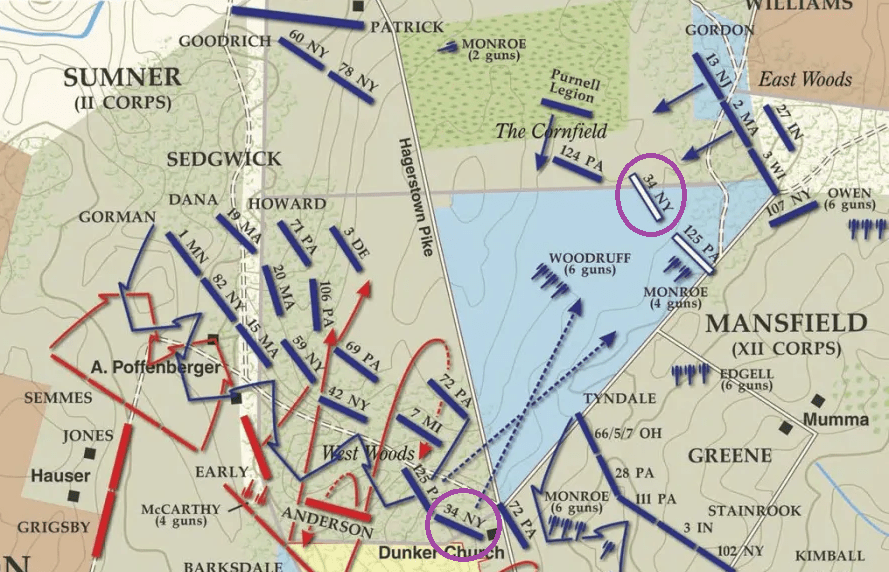
The portion of the battle where the 34th New York Infantry fought at Antietam on 9/17/1862
Source: American Battlefield Trust
At approximately 7:30 a.m. on September 17, 1862, the 34th New York left its camp near Keedysville and advanced toward the fighting already raging north of Sharpsburg. Assigned to Brigadier General Willis Gorman’s brigade, the regiment crossed Antietam Creek and moved at a double-quick through the carnage of the East Woods from the early fighting of the day before emerging into the open ground east of the Hagerstown Pike. Maintaining the rapid advance, the regiment crossed the pike and entered the West Woods near the Dunker Church around 9 a.m., where Colonel James A. Suiter soon spotted Confederate forces concealed beyond a ridge. “I immediately ordered my command to fire,” Suiter later reported, “which they did in gallant order.”36 Within moments, however, the regiment found itself in a precarious position. Separated from much of its brigade and “entirely unsupported by infantry or artillery” on its left and rear, the 34th became the exposed flank of Sedgwick’s advancing division.37 As Confederate forces maneuvered around the regiment’s left flank, Suiter realized his command was in danger of being surrounded. The enemy, he wrote, “poured a tremendous fire of musketry and artillery upon me.”38 When Major General Edwin Sumner’s attack collapsed under heavy Confederate counterattacks, General Sedgwick personally ordered the regiment to withdraw. The 34th retired in good order and reformed behind the battlefield in support of a battery that continued to take aim at the Confederate forces. The official regimental history described the scene: “The field was thickly strewn with dead bodies, which soon swelled to enormous proportions” and “Surely, the demon of death must have been satiated.”39
When the firing finally stopped, the cost to the regiment was devastating: out of 311 men who had stepped into the West Woods, 46 were dead or mortally wounded, 98 were bleeding, and 10 were missing. Back home, the news reverberated through the community. The loss was heavy and deeply personal. Henry Bailey, Patrick Coonan, Dennis Hayes, Henry Hubbell, and Antoine Sanchagrin of Champlain all lay dead or mortally wounded on the field, alongside their comrades Henry Bramley of Gouverneur, Lewis Gadban of Massena, Peter Jolly of Chazy, and John Mycue of Canton.40 Others, like Webster Carter, Jerome Carto, George Northedge, and George Scott of Champlain, Zelotus Blanchard of Fort Covington, and John Green of Chateguay, carried the physical scars of wounds away from the field, while Isaac Lewis was captured by the enemy.41
For the nation, the battle carried consequences that extended far beyond the fields of Maryland. That single day of battle saw more than twenty-two thousand Americans killed, wounded, or missing — the bloodiest day in American history. The strategic outcome, though costly and incomplete, was enough to push Confederate forces back across the Potomac and deny Robert E. Lee the decisive victory on Northern soil he had sought. The Union’s failure to pursue Lee’s retreating army would ultimately cost George McClellan his command. But the battle’s most far-reaching national consequence was political. The outcome gave President Abraham Lincoln the leverage he needed to issue the preliminary Emancipation Proclamation, transforming the war’s stated purpose and altering the calculations of European powers considering intervention on the Confederacy’s behalf. For the people of Champlain, none of this national transformation arrived without a price. The battle that gave Lincoln his proclamation and reshaped the war’s meaning had also, in the space of a single morning, taken sons and husbands from a cluster of border-country households that would spend the next several decades absorbing the loss.
As the year drew to a close, the war continued to restructure the military service of Champlain’s men. The two-year term for many of the original 34th NY Infantry volunteers was drawing near its end, leading to transfers for further service. In the months following Antietam, several Company D men transferred to the Regular Army or to the cavalry service, trading infantry life for a different frontier of war. Joseph Bradley, Peter Gadban, and George Dodds all transferred to the United States Cavalry or Regular Army on November 23, 1862.42 By the time the snow began to fall, signaling the close of 1862, Champlain was sending more recruits to the front while counting the loss of those who would never, their fates sealed in the mud of the Chickahominy and on the dusty pike at Antietam. The year began with quiet losses from disease and ended with the grim realization that war would remain a defining part of their small community’s history.
The 34th New York would serve out the remainder of its two-year enlistment, enduring the hardships of Fredericksburg and Salem Church before finally heading home in June 1863.43 When the survivors stepped off the train in Champlain on July 15, they were greeted by a celebratory crowd. Local lawyer James Averill welcomed the returning veterans of Company D with words that captured both the community’s pride and its grief:
“This assembly of your neighbors and fellow citizens—this crowd of old men and maidens, young men and children, with music and with song, with prayers and benedictions, with words of joyous welcome and tears of bitter regret have met to do you honor—to welcome your return from fields of carnage and slaughter—to express, with meet words, the gratitude we owe, and to speak those words of encouragement and express that heart felt sympathy, which, as a community whose honor and interests you have so bravely and earnestly upheld, is demanded at our hands. Looking upon you, brave men, the first who from among us, at the sacred call of your country, voluntarily, without conscription or compulsion of any kind, stepped forward and enrolled your names and hazarded your lives—as the first who left your homes, your wives, your parents, your children—as the first to separate those ties which circle round the family fireside, and go forth to battle manfully for the right—looking upon you, brave men, as the first offering of blood laid upon the altar of our country—looking, with just pride upon you, members of Company D., who have returned from scenes of warfare more bloody and more fierce than history has before recorded—returned without a spot or blemish upon your character for courage, and patience, and honorable warfare, we tender you, brave men, a thrice hearty welcome.”
Averill then reminded the veterans that their sacrifices had not been forgotten:
“Think not, soldiers, that your absence from us for two years, has been unheeded… think not that the wounds of a Scott, a McDonald, a Moore, a Zougg, a Carto, a Hudson, a Carter, a Hill, a Rainer, a Loomis, a Barcelo, a Lepage and a Northedge—when who bear these wounds in our presence to day—think not the imprisonment of a Miner, a Kellogg, and a Cook, think not these have failed to receive honorable mention with us.
Think not, soldiers, that the falling, bravely but willingly in the cold embrace of death, of a Ransom, a Bramley, a Brewer, a Carleton, a Bailey, a Hayes, a Coonan, a Gadbaw, a Hubbell, a McCue, a Jollie, and a Sahshegra, all members of your company, remains unrecorded in our hearts.”
Most revealing was Averill’s appeal that the community continue to care for the families left behind:
“Let us by our kindly acts and greetings, by our readiness at all times to lend material aid and comfort … by a tender care for the widows and fatherless, whose dear ones have laid down their lives for us and for our cause, and whose bones lie bleaching upon the enemy’s soil, without a monument to mark their resting place—prove the fathomless depths of our sincerity.”44
Averill’s speech reveals how Champlain understood the war after Antietam. He devoted nearly as much attention to the dead, wounded, prisoners, widows, and children as he did to military achievements. His repeated calls to care for returning soldiers and the families of the fallen suggest that residents already recognized the long-term burdens the war had imposed on the community. The speech was not merely a celebration. It was also an acknowledgment of a debt that could never be fully repaid.
A celebratory dinner at the Champlain House followed the speeches.45 But the town they returned to was fundamentally changed. Because Company D’s losses were so tightly concentrated on specific streets and within interconnected families, the normal systems of community support were broken; the very neighbors who would traditionally help a family in distress were grieving or financially ruined themselves. For decades, the families of Champlain would quietly absorb the socio-economic wreckage of that single, terrible morning in the West Woods, bearing the invisible, generational scars of the fields of carnage.
But the losses suffered by Company D at Antietam did not end when the firing ceased in the West Woods. Every casualty represented a family suddenly forced to confront a new reality. Widows, parents, siblings, and children would spend years—and in some cases decades—living with the consequences of that September morning. The battle’s consequences were ultimately felt less in military reports than around family firesides, where widows struggled to support children, parents mourned lost sons, and survivors attempted to rebuild lives altered by war. The true impact of Antietam in Champlain can be measured not only by the names recorded on casualty lists but by the lives that unfolded afterward.
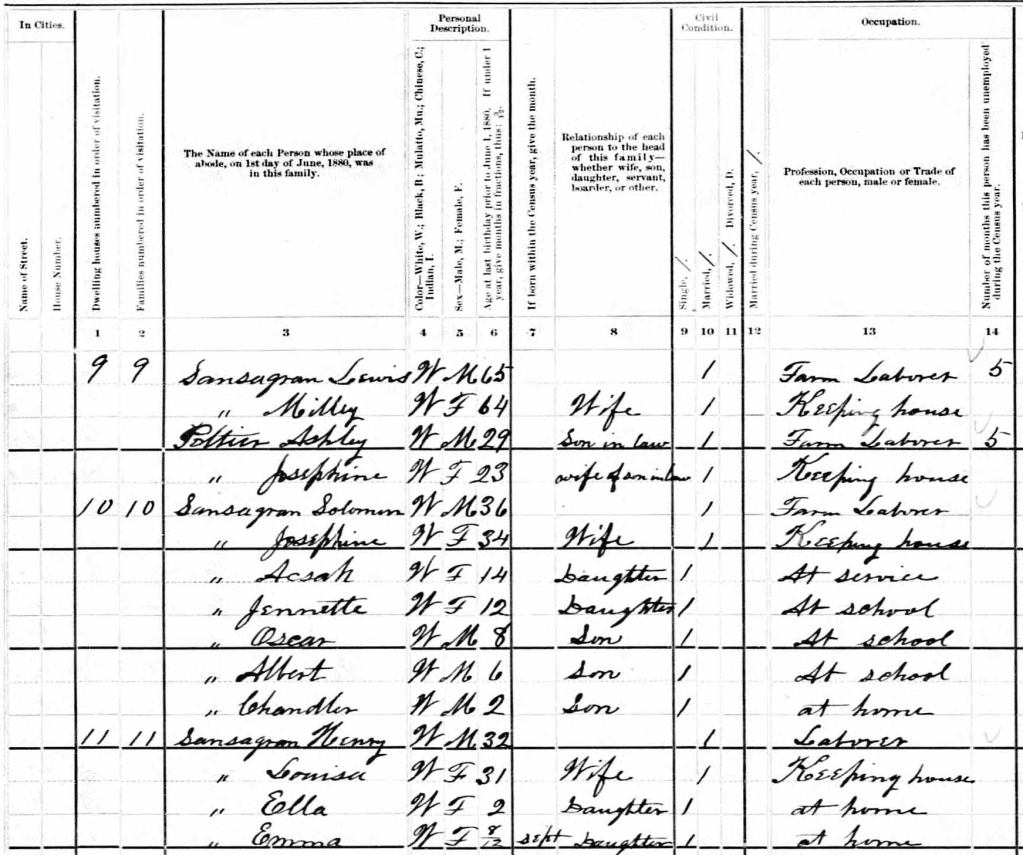
The Sanchagrin family in 1880 working as laborers–the two sons who survived the Civil War lived next door to their parents
Source: 1880 US census, Clinton County, New York, population schedule, Champlain Township.
Few families better illustrate the long reach of Antietam than the Sanchagrins. Louis and Emilie Sanchagrin were French-Canadian immigrants who had built a life in the Champlain area through the canal boat trade and were raising a large family when the Civil War erupted. Four of their sons—Antoine, Solomon, David, and Henry—entered military service.46 The family paid dearly for that commitment. Antoine was killed at Antietam, and David returned home suffering from consumption to die in 1862.47 Within a short span of time, the losses struck a household that depended heavily upon the labor of its children and was already navigating the uncertainties of immigrant life in a borderland community.
The years that followed brought economic dislocation on top of grief. As railroads expanded and canal traffic declined, the economic world upon which Louis had built his livelihood steadily disappeared.48 Family members adapted by turning to farming, day labor, and eventually industrial employment. Some of the surviving children left Champlain altogether, seeking opportunity in the mills of New Hampshire.49 In 1891, nearly three decades after Antietam, the aging Louis Sanchagrin appealed to the federal pension system seeking support based on the death of his son Antoine.50 The application was more than a bureaucratic exercise. It represented a father still living with the consequences of a battle fought twenty-nine years earlier. The story of the Sanchagrins reveals how battlefield casualties could combine with broader economic change to reshape the fortunes of an immigrant family across generations.
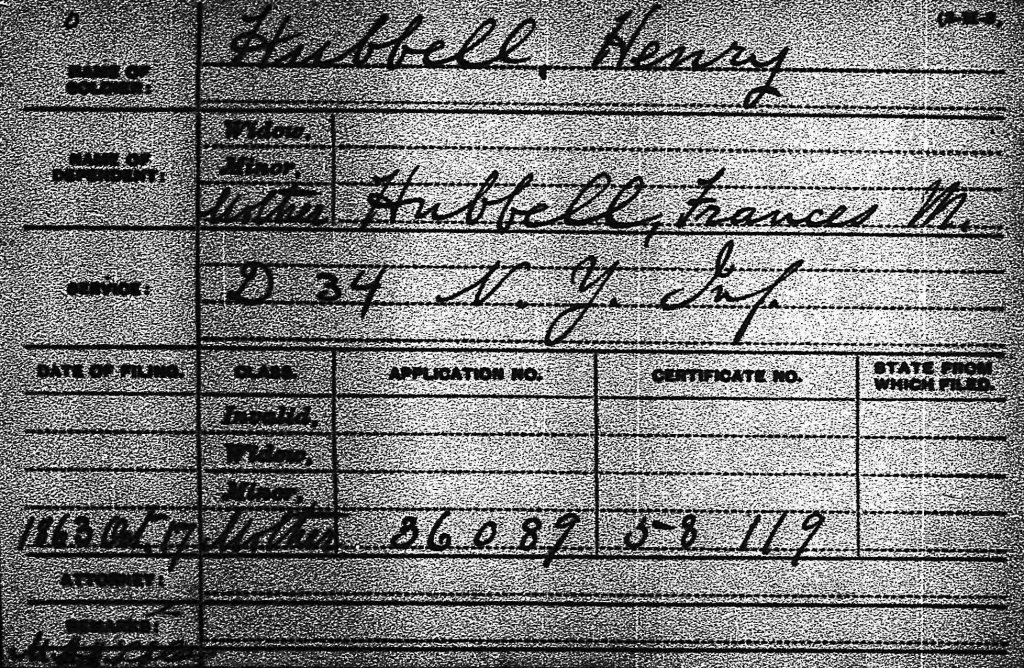
Frances Hubbell’s 1863 pension application tied to Henry’s service and death at Antietam
Source: The National Archives Civil War Pension Index
The experience of the Hubbell family reveals a different form of wartime hardship. Frances Hubbell was already a widow when the Civil War began.51 Four of her sons—Charles, Henry, James, and Alexander—entered military service. Henry never returned from Antietam. James was wounded at Cedar Creek, and Alexander was wounded at Lookout Mountain.52 Even after the war concluded, tragedy continued. James died from disease while returning home, and Charles died within a decade of the conflict’s end.53 By her later years, Frances depended largely upon her surviving son Alexander, eventually leaving Champlain when he relocated to Iowa. Her successful application for a pension in 1863 underscores the precarious economic position many wartime families occupied.54 The death of a single son represented not merely emotional grief but the loss of a critical source of future support.
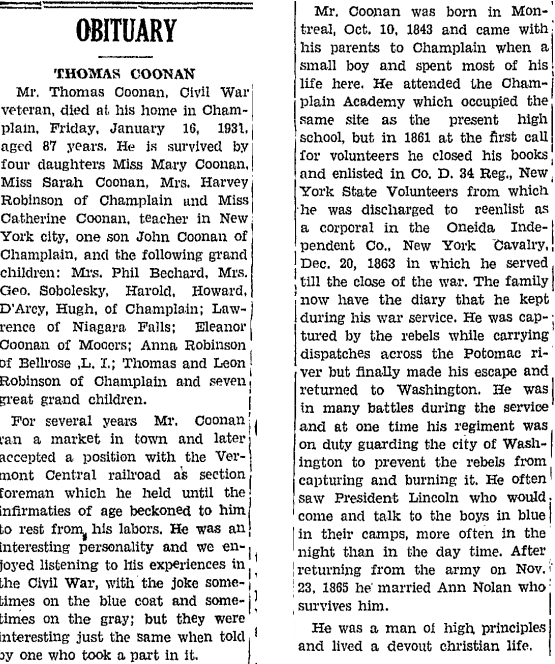
Thomas Corcoran’s obituary from 1931
Source: “Obituary: Thomas Coonan,” Plattsburgh Daily Press, January 23, 1931, 5, col. 3.
The Coonan family likewise experienced how military service could ripple through an entire household. Irish immigrants John and Ellen Coonan saw all three of their sons volunteer for the Union cause. Thomas was discharged because of disability before the war was over.55 In the same year that Patrick was killed at Antietam, family patriarch John also died.56 The Battle of Salem Church in 1863 saw John Jr. wounded and captured.57 By the conflict’s end, every member of the family had experienced loss, illness, disability, or captivity. Yet the surviving members persevered. Thomas eventually returned to Champlain, spending much of the remainder of his life caring for his widowed mother and extended family.58 The story of the Coonans illustrates both the enormous burden borne by immigrant families and the resilience required to rebuild lives after repeated tragedy.
Not every casualty left behind a family whose struggles can be reconstructed through pension applications, census records, and newspaper accounts. The story of Dennis Hayes reminds us that some of Antietam’s losses were so complete that they nearly vanished from the historical record altogether. Hayes was an Irish immigrant living in Champlain in 1860, working as a laborer and boarding at the inn operated by Dedousis Holcomb.59 Unlike many of the men in Company D, he appears to have had no household of his own in the community. There was no wife waiting at home, no children recorded in the census, and no property that tied him to a particular place. Yet he was no less a part of Champlain’s wartime experience. He enlisted without a bounty and served through every engagement of the 34th New York from October 1861 until September 17, 1862, when he was killed in the West Woods at Antietam.60
What makes Hayes’s story especially poignant is how little trace he left behind. There is no known pension file, no surviving correspondence, and no detailed local biography. Whether relatives in Ireland ever learned precisely what became of him remains unknown. Like many Irish immigrants of his generation, Hayes had crossed the Atlantic seeking opportunity before settling in Champlain. Instead, he disappeared into a casualty list and an unmarked grave hundreds of miles from the community he had briefly called home. The families of the Sanchagrins, Hubbells, and Coonans left paper trails of grief because there were survivors to generate those records. Hayes left almost nothing. In that silence, he represents a different but equally important consequence of Antietam: lives cut short so completely that only fragments remain. Recovering even those fragments restores a measure of humanity to a man who otherwise risks becoming only another forgotten name in a regimental roster.
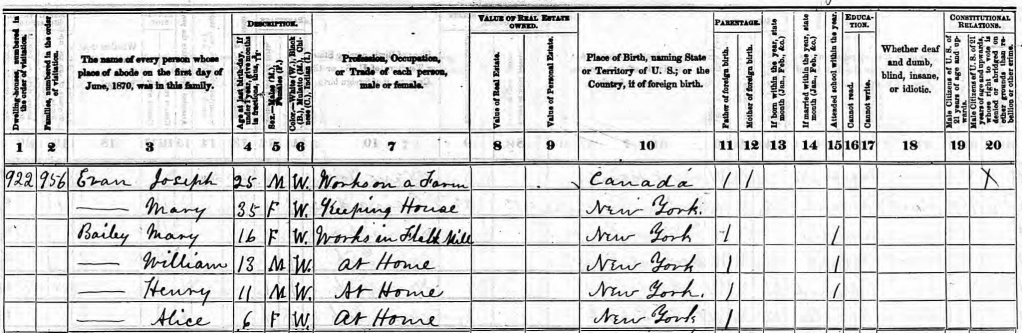
The Bailey family in 1870 after Mary remarried and as younger Mary works in a mill at age 16
Source: 1870 US census, Clinton County, New York, population schedule, Champlain Township.
The experience of the Bailey family demonstrates how a battlefield death could reshape an ordinary household for generations. When Henry Bailey was killed at Antietam, he left behind his wife Mary, four young children, and Mary’s elderly dependent mother.61 The loss removed the family’s primary provider at a moment when the children were still too young to contribute meaningfully to the household economy. In the years that followed, the family adapted as best it could. By 1870, Mary had remarried, a decision that likely reflected both personal and economic necessity. Her eldest daughter had already entered the workforce, laboring in a mill while still a teenager.62 By 1880, Mary was receiving a widow’s pension based upon Henry’s service, but the assistance came years after the family’s greatest period of uncertainty.63 Eventually the family left the Champlain region altogether, relocating to Massachusetts.64 Antietam did not simply take Henry Bailey’s life; it altered the trajectory of an entire family. The decisions to remarry, send children into wage labor, seek federal assistance, and ultimately leave the community were all part of the long shadow cast by a single morning in the West Woods.
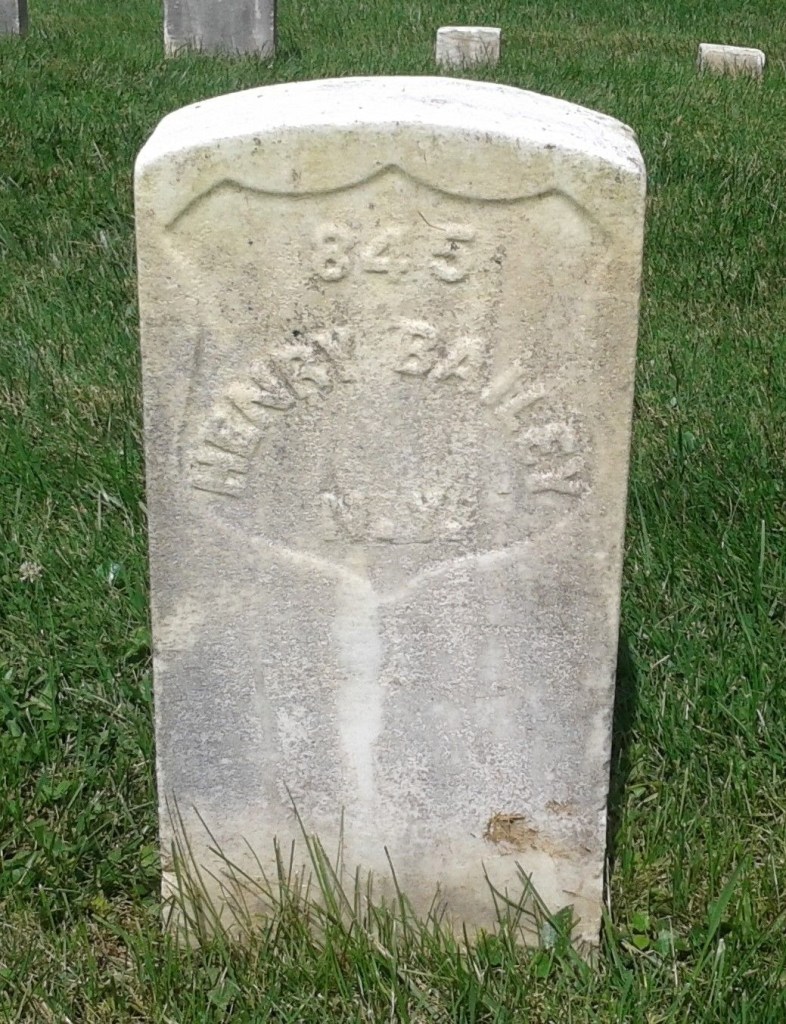
The grave of Henry Bailey in Antietam National Cemetery–the lone identified grave for a Company D Champlain resident
Source: FindAGrave
The consequences of Antietam extended beyond the lives of survivors. Even in death, the fate of Champlain’s soldiers reflected the chaos and violence of the battle. Henry Bailey was the only Champlain casualty from Company D identified through the cemetery’s burial records.65 The other four men — Antoine Sanchagrin, Henry Hubbell, Patrick Coonan, and Dennis Hayes — were never identified and lie today in unmarked graves in the battlefield cemetery.66 Henry Hubbell’s fate is perhaps the starkest illustration of the battle’s chaos. His brother Alexander served with the 60th New York Infantry, a different regiment that fought in the same West Woods on the same morning — meaning two brothers from Champlain were simultaneously in the middle of one of the war’s most violent engagements. Alexander survived. Henry did not, and his body was never identified. That a man’s brother could be fighting mere yards away in the same woods and still fail to secure him a marked grave speaks more plainly than any casualty statistic about the scale of carnage that morning.
These families from Champlain were not unusual exceptions. Rather, they represented the broader experience of Champlain itself. Across the community, households that had once relied upon young sons and fathers for labor, income, and stability suddenly found themselves adapting to absence. Some received pensions after years of effort. Others depended upon relatives, neighbors, or their own determination to survive. The casualties of Company D therefore cannot be measured solely in the men who died or suffered wounds. Their losses reshaped the lives of dozens of family members whose names never appeared in military records but whose futures were permanently altered by the battle.
What made Antietam especially devastating for Champlain was the concentration of loss. Modern casualty statistics can obscure a simple reality: Company D was not a collection of strangers. It was a network of brothers, cousins, neighbors, co-workers, and fellow parishioners. The men who fell in the West Woods often lived within walking distance of one another before the war. Their families attended the same churches, traded with the same merchants, and relied upon one another during times of hardship.
As a result, Antietam struck multiple layers of the community simultaneously. The very neighbors who might normally have assisted a grieving family were often grieving themselves. Antietam therefore weakened the same networks of mutual support upon which families relied during times of hardship. Economic burdens, emotional trauma, and the loss of working-age men accumulated in the same social networks rather than being dispersed across a wider population. Champlain’s experience therefore differed from abstract national narratives of victory or defeat. The battle became a concentrated community trauma whose effects lingered long after the dead were buried and the survivors returned home.
Given the scale of loss suffered by such a small community, the absence of Company D from Hurd’s history is striking. The stories of Champlain’s families may help explain why the experiences of Company D received no mention in Hurd’s history. For many households, Antietam was not an isolated tragedy but one chapter in a much longer story of wartime loss. The Sanchagrins and Hubbells lost multiple family members. The Coonans endured death, wounding, disability, and captivity. In households struggling simply to survive, remembrance often took a back seat to immediate concerns. Many families occupied a precarious economic position before the war and faced the pressing realities of supporting widows, caring for aging parents, and raising children in the absence of husbands and sons. For these families, the demands of the present frequently outweighed reflection upon the past.
The dispersal of Champlain’s wartime families may have been as important to forgetting as the passage of time itself. By the time the 1890 census takers made their rounds, only four veterans from Company D still resided in the town: Albert Cook, Charles Deal, Wolfred Mooers, and George Scott (one of the soldiers wounded at Antietam).67 Many of the families that had once served as living reminders of the battle had headed west in search of land or moved to industrial cities seeking employment. As veterans died and their children established lives elsewhere, fewer people remained to tell the stories of Company D and the sacrifices made in the West Woods. The fading of memory can even be traced in the historical record itself. When Thomas Coonan died in 1931, newspaper accounts made no mention of the brother he had lost at Antietam nearly seventy years earlier.68 The long war, the demands of daily life, and the gradual disappearance of the families most directly affected allowed the carnage of Antietam to slowly slip from collective memory.
Yet forgetting was never complete.
Despite the absence of Company D and their experiences at the Battle of Antietam from Hurd’s history, their legacy endures. The monument erected by veterans of the 34th New York near the Dunker Church in 1902 still stands as a reminder of their sacrifice.69 Yet the most enduring legacy of Antietam was not built of granite or bronze. It existed in the altered lives of the families who spent decades coping with the absence of sons, husbands, fathers, and brothers. For Champlain, the Battle of Antietam was not a single day in September 1862. It was a generational event that continued to shape lives for decades afterward around family firesides, farm kitchens, village streets, and cemetery plots.
Endnotes
- A portion of this research was achieved via a Lake Champlain Basin Program grant as part of The Champlain Valley National Heritage Partnership (CVNHP).
- D. Hamilton Hurd, History of Clinton and Franklin Counties, New York: With Illustrations and Biographical Sketches of Its Prominent Men and Pioneers (Philadelphia: J. W. Lewis & Co., 1880), 274–75.
- Author’s compilation and statistical analysis of the 1860 U.S. Census, Town of Champlain, Clinton County, New York, population schedules, National Archives microfilm publication M653, Seventh Census of the United States, 1860.
- Ibid.
- Ibid.
- Ibid.
- Ibid.
- John Coonan, Champlain Town Clerks’ Registers of Men Who Served in the Civil War, ca. 1861–1865, Collection (N-Ar)13774, Box 12, Roll 8, New York State Archives, Albany. Royal Corbin, Champlain Town Clerks’ Registers of Men Who Served in the Civil War, ca. 1861–1865, Collection (N-Ar)13774, Box 12, Roll 8, New York State Archives, Albany. George Corbin, Champlain Town Clerks’ Registers of Men Who Served in the Civil War, ca. 1861–1865, Collection (N-Ar)13774, Box 12, Roll 8, New York State Archives, Albany.
- 1860 US census, Clinton County, New York, population schedule, Champlain Township, Elisabeth Allason household, dwelling 767 family 804, digital image, Ancestry.com (accessed June 21, 2026); citing National Archives Microfilm Publication M653, page 678. New York State Adjutant General’s Office, Muster Roll of the Thirty-Fourth Regiment, New York State Volunteers, New York State Military Museum and Veterans Research Center, accessed June 21, 2026, https://museum.dmna.ny.gov/application/files/9115/5059/8259/34thInf_NYSV_MusterRoll.pdf, 770-71.
- Find A Grave, “Brinkerhoff Nodiah Miner (1835–1871),” Memorial 74409266, citing Oakwood Cemetery Syracuse, Onondaga County, New York, accessed June 21, 2026, https://www.findagrave.com/memorial/74409266/brinkerhoff-nodiah-miner.
- Author’s compilation and statistical analysis of the 1860 U.S. Census, Town of Champlain, Clinton County, New York, population schedules, National Archives microfilm publication M653, Seventh Census of the United States, 1860.
- “Co. ‘D.’ 34th Regt. N.Y.S. Volunteers,” Plattsburgh Republican, August 24, 1861, 2, col. 6.
- 1860 US census, Clinton County, New York, population schedule, Champlain Township, Ira Carter household, dwelling 797 family 840, digital image, Ancestry.com (accessed June 21, 2026); citing National Archives Microfilm Publication M653, page 686.
- 1860 US census, Clinton County, New York, population schedule, Champlain Township, Charles Lapage household, dwelling 813 family 856, digital image, Ancestry.com (accessed June 21, 2026); citing National Archives Microfilm Publication M653, page 685.
- “Co. ‘D.’ 34th Regt. N.Y.S. Volunteers.”
- Author’s compilation and statistical analysis of the 1860 U.S. Census, Town of Champlain, Clinton County, New York, population schedules, National Archives microfilm publication M653, Seventh Census of the United States, 1860.
- Author’s compilation and statistical analysis of the 1860 U.S. Census, Town of Champlain, Clinton County, New York, population schedules, National Archives microfilm publication M653, Seventh Census of the United States, 1860.
- 1860 US census, Clinton County, New York, population schedule, Champlain Township, Frances Hubbell household, dwelling 313 family 319, digital image, Ancestry.com (accessed June 21, 2026); citing National Archives Microfilm Publication M653, page 608.
- 1860 US census, Clinton County, New York, population schedule, Champlain Township, Mary L Rogers household, dwelling 315 family 321, digital image, Ancestry.com (accessed June 21, 2026); citing National Archives Microfilm Publication M653, page 609.
- 1860 US census, Clinton County, New York, population schedule, Champlain Township, Harriet Camera household, dwelling 500 family 508, digital image, Ancestry.com (accessed June 21, 2026); citing National Archives Microfilm Publication M653, page 633.
- 1860 US census, Clinton County, New York, population schedule, Champlain Township, Henry Bailey household, dwelling 916 family 965, digital image, Ancestry.com (accessed June 21, 2026); citing National Archives Microfilm Publication M653, page 702.
- Henry Bailey, Champlain Town Clerks’ Registers of Men Who Served in the Civil War, ca. 1861–1865, Collection (N-Ar)13774, Box 12, Roll 8, New York State Archives, Albany. The Bailey family received $2.50 for five weeks.
- Charles Lapage, Champlain Town Clerks’ Registers of Men Who Served in the Civil War, ca. 1861–1865, Collection (N-Ar)13774, Box 12, Roll 8, New York State Archives, Albany. Peter Gyon, Champlain Town Clerks’ Registers of Men Who Served in the Civil War, ca. 1861–1865, Collection (N-Ar)13774, Box 12, Roll 8, New York State Archives, Albany. The Guyon family received $1 for 20 weeks, and the LePage family received $1 for 24 weeks.
- Author’s compilation and statistical analysis of the 1860 U.S. Census, Town of Champlain, Clinton County, New York, population schedules, National Archives microfilm publication M653, Seventh Census of the United States, 1860.
- 1860 US census, Clinton County, New York, population schedule, Champlain Township, Lewis Sashagraw household, dwelling 138 family 139, digital image, Ancestry.com (accessed June 21, 2026); citing National Archives Microfilm Publication, Roll M653, Page: 579. 1860 US census, Clinton County, New York, population schedule, Champlain Township, Mary L Rogers household, dwelling 315 family 321, digital image, Ancestry.com (accessed June 21, 2026); citing National Archives Microfilm Publication M653, page 609. 1860 US census, Clinton County, New York, population schedule, Champlain Township, Gilbert Goka household, dwelling 279 family 282, digital image, Ancestry.com (accessed June 21, 2026); citing National Archives Microfilm Publication M653, page 603.
- 1860 US census, Clinton County, New York, population schedule, Champlain Township, Elisabeth Allason household, dwelling 767 family 804, digital image, Ancestry.com (accessed June 21, 2026); citing National Archives Microfilm Publication M653, page 678. 1860 US census, Clinton County, New York, population schedule, Champlain Township, Mary Russell household, dwelling 557 family 576, digital image, Ancestry.com (accessed June 21, 2026); citing National Archives Microfilm Publication M653, page 646. 1860 US census, Clinton County, New York, population schedule, Champlain Township, Ezra Cooper household, dwelling 6 family 6, digital image, Ancestry.com (accessed June 21, 2026); citing National Archives Microfilm Publication M653, page 559.
- The Union Army: A History of Military Affairs in the Loyal States, 1861–65; Records of the Regiments in the Union Army; Cyclopedia of Battles; Memoirs of Commanders and Soldiers, vol. 2 (Madison, WI: Federal Publishing Company, 1908), 73–74.
- Pliny Monette, Champlain Town Clerks’ Registers of Men Who Served in the Civil War, ca. 1861–1865, Collection (N-Ar)13774, Box 12, Roll 8, New York State Archives, Albany.
- New York State Archives, New York, Registers of Officers and Enlisted Men Mustered into Federal Service, 1861–1865, ser. A0389, vol. 6, p. 161, service record of George W. Monette, digital image, Ancestry.com (accessed June 21, 2026).
- For a general history of the Battle of Fair Oaks, see Stephen W. Sears, To the Gates of Richmond: The Peninsula Campaign (New York: Ticknor & Fields, 1992).
- Louis N. Chapin, A Brief History of the Thirty-Fourth Regiment, N.Y.S.V., Embracing a Complete Roster of All Officers and Men and a Full Account of the Dedication of the Monument on the Battlefield of Antietam, September 17, 1902 (New York, 1903), 41-47.
- Merritt Loomis, Champlain Town Clerks’ Registers of Men Who Served in the Civil War, ca. 1861–1865, Collection (N-Ar)13774, Box 12, Roll 8, New York State Archives, Albany. John Ogden Scott, Champlain Town Clerks’ Registers of Men Who Served in the Civil War, ca. 1861–1865, Collection (N-Ar)13774, Box 12, Roll 8, New York State Archives, Albany. William Webster, Champlain Town Clerks’ Registers of Men Who Served in the Civil War, ca. 1861–1865, Collection (N-Ar)13774, Box 12, Roll 8, New York State Archives, Albany. New York State Adjutant General’s Office, 34th Infantry Regiment Civil War Roster, New York State Military Museum and Veterans Research Center, accessed June 21, 2026, https://museum.dmna.ny.gov/application/files/7115/5059/8288/34th_Infantry_CW_Roster.pdf, 225, 250, 277.
- Wolford Nelson Mooers, Champlain Town Clerks’ Registers of Men Who Served in the Civil War, ca. 1861–1865, Collection (N-Ar)13774, Box 12, Roll 8, New York State Archives, Albany.
- Albert Cook, Champlain Town Clerks’ Registers of Men Who Served in the Civil War, ca. 1861–1865, Collection (N-Ar)13774, Box 12, Roll 8, New York State Archives, Albany. George Dodds, Champlain Town Clerks’ Registers of Men Who Served in the Civil War, ca. 1861–1865, Collection (N-Ar)13774, Box 12, Roll 8, New York State Archives, Albany. Cyrus Kellogg, Champlain Town Clerks’ Registers of Men Who Served in the Civil War, ca. 1861–1865, Collection (N-Ar)13774, Box 12, Roll 8, New York State Archives, Albany. Wolford Nelson Mooers, Champlain Town Clerks’ Registers of Men Who Served in the Civil War, ca. 1861–1865, Collection (N-Ar)13774, Box 12, Roll 8, New York State Archives, Albany.
- Merritt Loomis, Champlain Town Clerks’ Registers of Men Who Served in the Civil War, ca. 1861–1865, Collection (N-Ar)13774, Box 12, Roll 8, New York State Archives, Albany.
- Louis N. Chapin, A Brief History of the Thirty-Fourth Regiment, N.Y.S.V., Embracing a Complete Roster of All Officers and Men and a Full Account of the Dedication of the Monument on the Battlefield of Antietam, September 17, 1902 (New York, 1903), 62.
- Ibid.
- Ibid.
- Ibid., 64.
- Ibid., 65.
- Ibid., 65-66.
- New York State Archives, Albany. New York State Adjutant General’s Office, 34th Infantry Regiment Civil War Roster, New York State Military Museum and Veterans Research Center, accessed June 21, 2026, https://museum.dmna.ny.gov/application/files/7115/5059/8288/34th_Infantry_CW_Roster.pdf, 163, 185, 196.
- Chapin, 79-84, 92-93.
- “Reception of Co. D, 34th N.Y. Volunteers at Champlain,” Plattsburgh Republican, July 25, 1863, 2, cols. 4–5.
- Ibid.
- 1860 US census, Clinton County, New York, population schedule, Champlain Township, Lewis Sashagraw household, dwelling 138 family 139, digital image, Ancestry.com (accessed June 21, 2026); citing National Archives Microfilm Publication, Roll M653, Page: 579.
- Anthony Sasahgra, Champlain Town Clerks’ Registers of Men Who Served in the Civil War, ca. 1861–1865, Collection (N-Ar)13774, Box 12, Roll 8, New York State Archives, Albany. David Sawyer, Champlain Town Clerks’ Registers of Men Who Served in the Civil War, ca. 1861–1865, Collection (N-Ar)13774, Box 12, Roll 8, New York State Archives, Albany. Solomon Sasahgra, Champlain Town Clerks’ Registers of Men Who Served in the Civil War, ca. 1861–1865, Collection (N-Ar)13774, Box 12, Roll 8, New York State Archives, Albany. Henry Sasahgra, Champlain Town Clerks’ Registers of Men Who Served in the Civil War, ca. 1861–1865, Collection (N-Ar)13774, Box 12, Roll 8, New York State Archives, Albany.
- Lake Champlain Maritime Museum, “Commercial Era (1823–1945),” accessed June 22, 2026, https://www.lcmm.org/explore/lake-champlain-history/commercial-era-1823-1945/. The museum notes that expanding railroad networks throughout the Champlain Valley increasingly captured freight traffic that had previously supported lake shipping and canal boats, contributing to the decline of commercial boatbuilding during the late nineteenth century.
- 1900 US census, Hillsborough County, New Hampshire, population schedule, Nashua Township, Solomon Sawyer household, dwelling 120 family 133, digital image, Ancestry.com (accessed June 21, 2026); citing National Archives Microfilm Publication, Roll 948, Page: 6. 1900 US census, Hillsborough County, New Hampshire, population schedule, Nashua Township, Henry Sawyer household, dwelling 140 family 159, digital image, Ancestry.com (accessed June 21, 2026); citing National Archives Microfilm Publication, Roll 948, Page: 8. 1910 US census, Hillsborough County, New Hampshire, population schedule, Nashua Township, Ashley Pelky household, dwelling 177 family 190, digital image, Ancestry.com (accessed June 21, 2026); citing National Archives Microfilm Publication, Roll 948, Page: 10A.
- U.S. Pension Application for Anthony Sashagrah, father Lewis Sashagrah, filed December 16, 1889, Application No. 410.997, Certificate No. 354.808, New York; U.S., Civil War Pension Index: General Index to Pension Files, 1861–1934; Records of the Department of Veterans Affairs, 1773–2007, Record Group 15; National Archives, Washington, D.C., digital image, Ancestry.com (accessed June 21, 2026).
- 1860 US census, Clinton County, New York, population schedule, Champlain Township, Frances Hubbell household, dwelling 313 family 319, digital image, Ancestry.com (accessed June 21, 2026); citing National Archives Microfilm Publication M653, page 608.
- Charles Hubbell, Champlain Town Clerks’ Registers of Men Who Served in the Civil War, ca. 1861–1865, Collection (N-Ar)13774, Box 12, Roll 8, New York State Archives, Albany. Henry Hubbell, Champlain Town Clerks’ Registers of Men Who Served in the Civil War, ca. 1861–1865, Collection (N-Ar)13774, Box 12, Roll 8, New York State Archives, Albany. James Hubbell, Champlain Town Clerks’ Registers of Men Who Served in the Civil War, ca. 1861–1865, Collection (N-Ar)13774, Box 12, Roll 8, New York State Archives, Albany. Alexander Hubbell, Champlain Town Clerks’ Registers of Men Who Served in the Civil War, ca. 1861–1865, Collection (N-Ar)13774, Box 12, Roll 8, New York State Archives, Albany.
- James Hubbell, Champlain Town Clerks’ Registers of Men Who Served in the Civil War, ca. 1861–1865, Collection (N-Ar)13774, Box 12, Roll 8, New York State Archives, Albany. Find A Grave, “Charles Hubbell (1838–1875),” Memorial 142902555, citing Glenwood Cemetery, Champlain, Clinton County, New York, accessed June 21, 2026, https://www.findagrave.com/memorial/142902555/charles-f-hubbell.
- U.S. Pension Application for Henry Hubbell, mother Frances Hubbell, filed October 17, 1863, Application No. 36089, Certificate No. 58119, New York; U.S., Civil War Pension Index: General Index to Pension Files, 1861–1934; Records of the Department of Veterans Affairs, 1773–2007, Record Group 15; National Archives, Washington, D.C., digital image, Ancestry.com (accessed June 21, 2026).
- Thomas Coonan, Champlain Town Clerks’ Registers of Men Who Served in the Civil War, ca. 1861–1865, Collection (N-Ar)13774, Box 12, Roll 8, New York State Archives, Albany.
- Find A Grave, “John Coonan (1812–1862),” Memorial 96627165, citing Old Saint Mary’s Cemetery, Champlain, Clinton County, New York, accessed June 21, 2026, https://www.findagrave.com/memorial/96627165/john-coonan.
- John Coonan, Champlain Town Clerks’ Registers of Men Who Served in the Civil War, ca. 1861–1865, Collection (N-Ar)13774, Box 12, Roll 8, New York State Archives, Albany.
- “Obituary: Thomas Coonan,” Plattsburgh Daily Press, January 23, 1931, 5, col. 3.
- 1860 US census, Clinton County, New York, population schedule, Champlain Township, Diodorus S. Holcomb household, dwelling 902 family 951, digital image, Ancestry.com (accessed June 21, 2026); citing National Archives Microfilm Publication M653, page 700.
- Dennis Hayes, Champlain Town Clerks’ Registers of Men Who Served in the Civil War, ca. 1861–1865, Collection (N-Ar)13774, Box 12, Roll 8, New York State Archives, Albany.
- 1860 US census, Clinton County, New York, population schedule, Champlain Township, Henry Bailey household, dwelling 916 family 965, digital image, Ancestry.com (accessed June 21, 2026); citing National Archives Microfilm Publication M653, page 702.
- 1870 US census, Clinton County, New York, population schedule, Champlain Township, Joseph Evan household, dwelling 922 family 956, digital image, Ancestry.com (accessed June 21, 2026); citing National Archives Microfilm Publication M593_918, page 212B.
- U.S. Pension Application for Henry Bailey, wife Caleste Evert, filed April 16, 1879, Application No. 244017, Certificate No. 186616, New York; U.S., Civil War Pension Index: General Index to Pension Files, 1861–1934; Records of the Department of Veterans Affairs, 1773–2007, Record Group 15; National Archives, Washington, D.C., digital image, Ancestry.com (accessed June 21, 2026).
- 1900 US census, Hampden County, Massachusetts, population schedule, Springfield Township, Henry Martin household, house number 38 house order 130 family 221, digital image, Ancestry.com (accessed June 21, 2026); citing National Archives Microfilm Publication Roll 652, page 9. 1900 US census, Hampden County, Massachusetts, population schedule, Ludlow Township, Henry Bailey household, house order 9 family 10, digital image, Ancestry.com (accessed June 21, 2026); citing National Archives Microfilm Publication Roll 651, page 193A.
- Find A Grave, “Henry Bailey (Unknown–1862),” Memorial 39223621, citing Antietam National Cemetery Sharpsburg, Washington County, Maryland, accessed June 21, 2026, https://www.findagrave.com/memorial/39223621/henry-bailey. National Park Service, “Antietam National Cemetery Burial Records Search,” Antietam National Battlefield, accessed June 22, 2026, https://www.nps.gov/anti/learn/historyculture/antietam-national-cemetery.htm. Searches for Company D soldiers identified only Bailey and Chazy’s Peter Jolly.
- The National Park Service reports that approximately 38% of the Union soldiers buried in Antietam National Cemetery lie in identified graves. National Park Service, “Antietam National Cemetery,” Antietam National Battlefield, accessed June 22, 2026, https://www.nps.gov/anti/learn/historyculture/antietam-national-cemetery.htm.
- U.S. Census Office, Special Schedules of the Eleventh Census (1890), Enumerating Union Veterans and Widows of Union Veterans of the Civil War, Champlain, Clinton County, New York, Supervisor’s District 7, Enumeration Districts 11–12, entries for Charles Deal (p. 1, line 7), Albert Cook (p. 2, line 15), Wolfred Mooers (p. 1, line 1), and George Scott (p. 2, line 13); National Archives microfilm publication M123, Records of the Department of Veterans Affairs, Record Group 15; digital image, Ancestry.com (accessed June 21, 2026).
- “Obituary: Thomas Coonan,” Plattsburgh Daily Press, January 23, 1931, 5, col. 3.
- National Park Service, “34th New York Infantry Monument,” Antietam National Battlefield, last modified January 17, 2020, accessed June 21, 2026.

 Cemetery Tales