Randy’s Tale

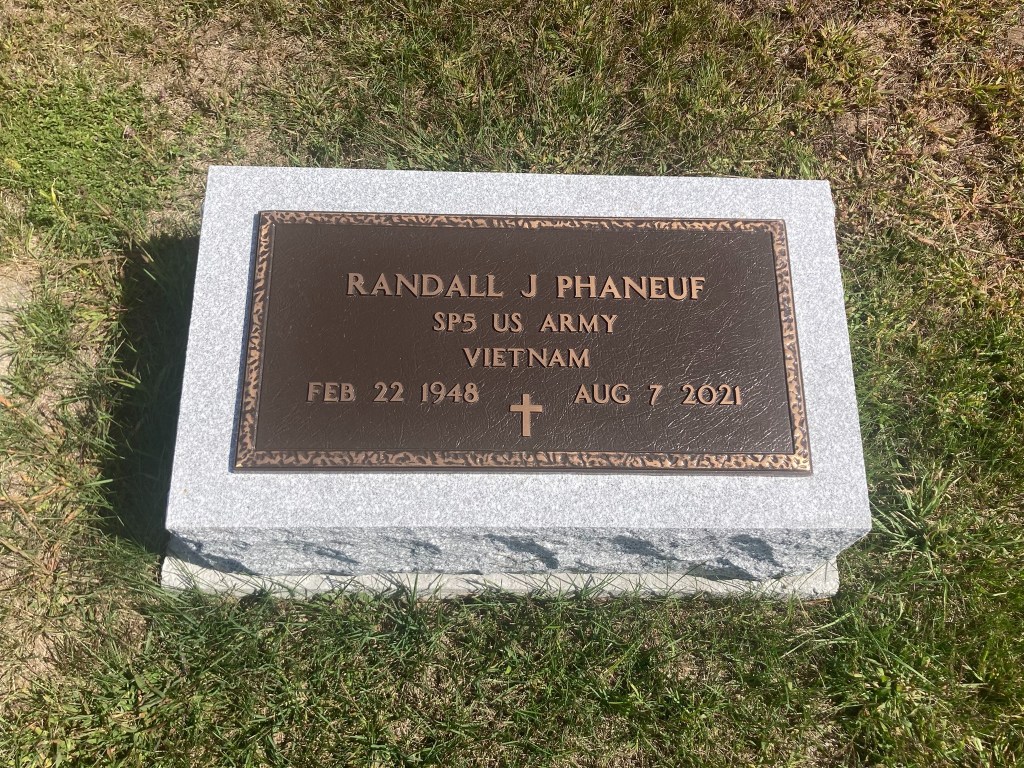
Randall Phaneuf’s grave in Saint Ann’s Cemetery, Mooers Forks, NY

Source: author’s personal collection

In Saint Ann’s Cemetery in Mooers Forks, New York, a modest grave marker bears the name Randall J. Phaneuf—known to those who loved him simply as Randy. Outside of the date of his birth and the date of his death, it records that Randy was a SP5 in the United States Army, a veteran of Vietnam.1 The stone offers only a fragment of a life shaped by a distant war and a quiet return home, leaving unspoken the fears, routines, and moments of reflection that defined his service. Yet Randy can still speak for himself through the letters he sent to his uncle and the photographs he took during his service. By recovering his voice, we can shed light on the wartime experience of Americans who served in Vietnam and how those experiences forever altered the lives of a generation.
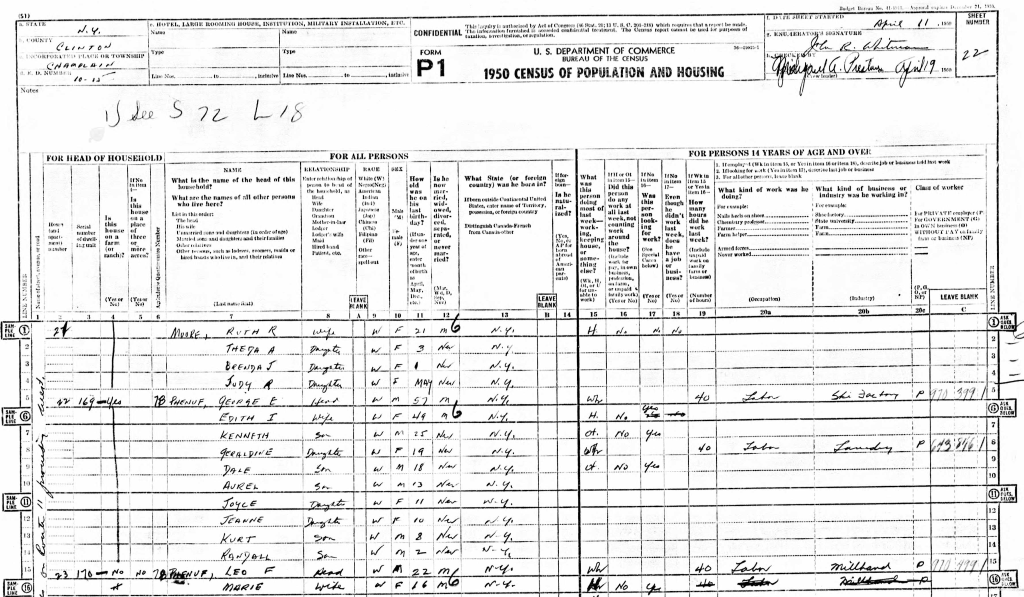
The multi-generational Phaneuf household in 1950, including two-year-old Randy

Source: 1950 US census, Clinton County, New York, population schedule, Champlain Township.

Randy was born on February 22, 1948, into a close-knit extended family that shaped daily life in rural upstate New York. He spent his early childhood in a crowded, multigenerational household in the hamlet of Perry’s Mills in Champlain, where he lived with his mother, Geraldine; his maternal grandparents, George and Edith Phaneuf; and several of his mother’s siblings—an arrangement common in postwar rural America.2 Among them was his uncle Kenneth, a World War II veteran who had served in Italy and was then in his mid-twenties, only a few years removed from his own war.3 The family home on Mill Street was defined by long days of shared labor and strong family bonds, a place where everyone contributed to the work of maintaining the household. While his mother worked full-time at the local laundry and his grandfather at a nearby ski factory, Randy’s days were largely spent alongside a different uncle, Kurt, just six years his senior, whose presence during these formative years would later make him the natural recipient of the letters Randy sent home from Vietnam. 

Life on Mill Street unfolded within a narrow physical space but a wide web of obligation and connection. The dead-end road itself terminated at the Kaufman lumber and saw mill just across from the Phaneuf home, and its presence shaped the cadence of everyday life. The mill was not simply nearby; it was part of the family. In 1950, Randy’s uncle Leo worked there, as did other uncles over the years, alongside his grandfather.4 The sounds of sawing and loading were part of the background of Randy’s childhood, and the work done there sustained the multigenerational household on Mill Street. Even as a boy, Randy was drawn into this economy of shared labor. He occasionally helped his grandfather with small tasks—stacking shingles for packing at the mill, running errands, or lending a hand where he could—absorbing early lessons about responsibility and contribution.

Work also extended beyond the mill and into the soil. A large garden was planted each year to feed the family, and the grandchildren were expected to help. Under the steady direction of his grandmother Edith, Randy learned to plant, weed, and harvest, and by autumn he participated in the seasonal ritual of canning, when the year’s labor was preserved for the winter ahead.
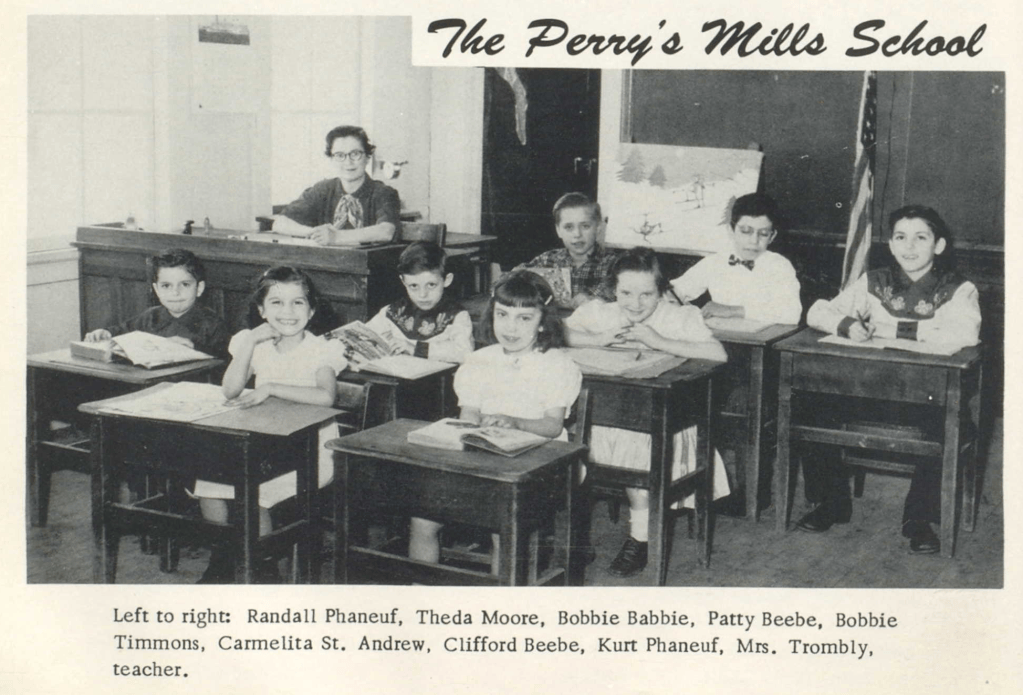
Randy and the rest of the students at the one-room schoolhouse in Perry’s Mills, circa 1954

Source: Ancestry.com

School added another rhythm to Randy’s early life, one that carried him beyond Mill Street while remaining firmly rooted in the same community. He began his education at the one-room schoolhouse in Perry’s Mills, a setting that mirrored the interwoven nature of family and daily life. A photograph from 1954 shows six-year-old Randy seated among just seven other children under the care of Mrs. Trombley, the sole teacher responsible for students ranging widely in age. Among the older children was his uncle Kurt, then twelve, reinforcing the closeness of kinship that defined Randy’s world.5 In this shared classroom, younger students learned by listening to lessons meant for older ones, while older children absorbed responsibility by assisting the younger. School was not a separate sphere but an extension of the same communal structure that governed work and home life.
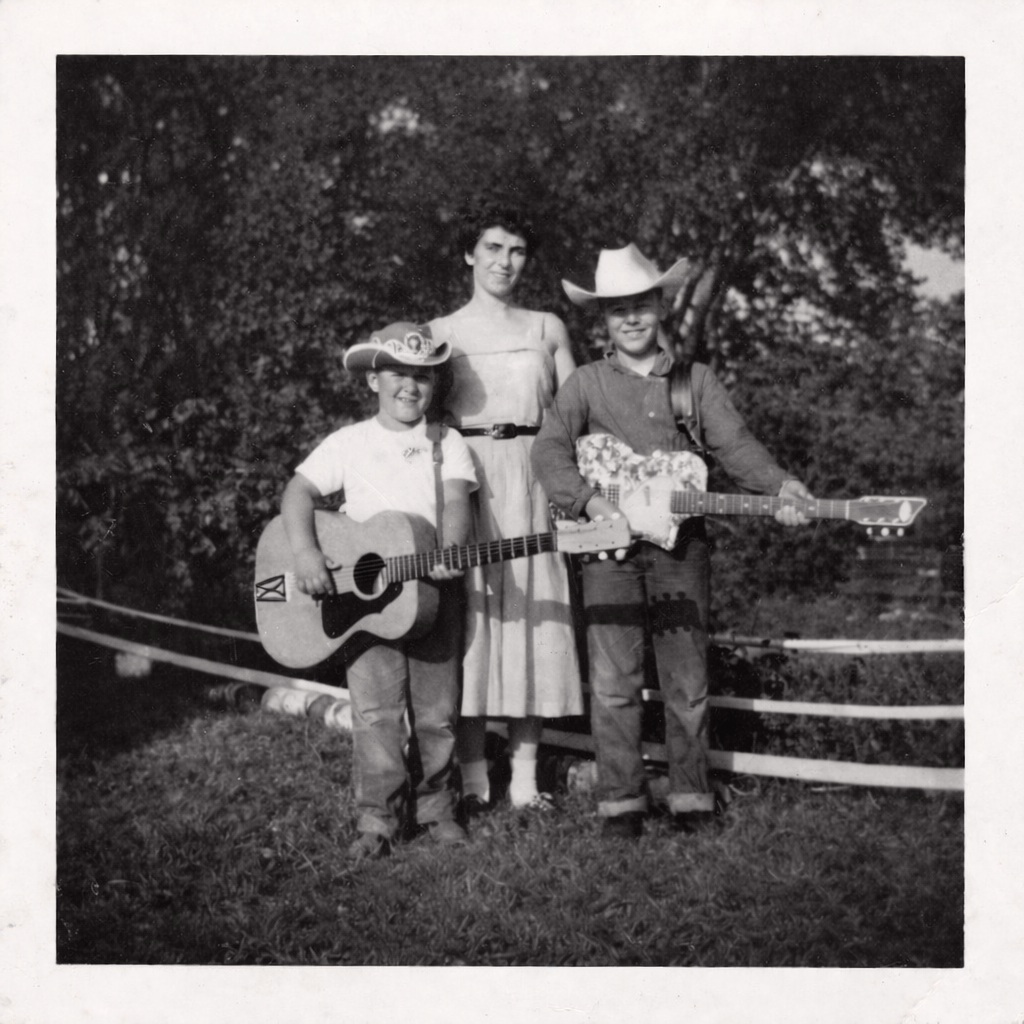
Randy with his younger brother Donnie and mother Geraldina circa 1958

Source: author’s personal collection

Yet Mill Street was not defined solely by labor and routine. There was also room for joy, and it often took shape inside the Phaneuf home itself. At various times, furniture was pushed aside, the main floor cleared, and relatives and neighbors gathered for evenings of music and dancing. These informal dance parties offered a release from the demands of mill work, gardening, and school, transforming the house into a space of shared celebration. Music filled the room, feet moved across worn floors, and bonds of kinship and community were reinforced through collective pleasure. For Randy, these gatherings provided balance to the responsibilities of childhood and planted a love of music that would endure throughout his life. Together, work, school, and play formed a steady rhythm on Mill Street—one that shaped Randy’s understanding of duty, belonging, and resilience long before he would encounter a world far removed from this dead-end road in northern New York.

As the 1950s gave way to the early 1960s, the family world that had shaped Randy’s childhood began to expand rather than disappear. After his early years in the multigenerational household on Mill Street, Randy moved with his mother into a home with her husband, Frank Parker — a decorated veteran of the U.S. Army’s 101st Airborne Division, the “Screaming Eagles,” who had served in World War II.6 While this marked a shift toward life within a nuclear family, it did not sever the ties that had defined his upbringing. His grandparents and extended family continued to live nearby, and Mill Street remained a constant presence in his daily life. During these same years, Randy’s family grew with the arrival of three younger brothers—Donnie, Frank Jr., and Dave—gradually reshaping his role within the household while reinforcing the importance of family responsibility and connection. It also meant that a veteran’s service was no longer a distant or abstract thing in Randy’s world, but a fact of daily life under his own roof, years before he volunteered for his own.
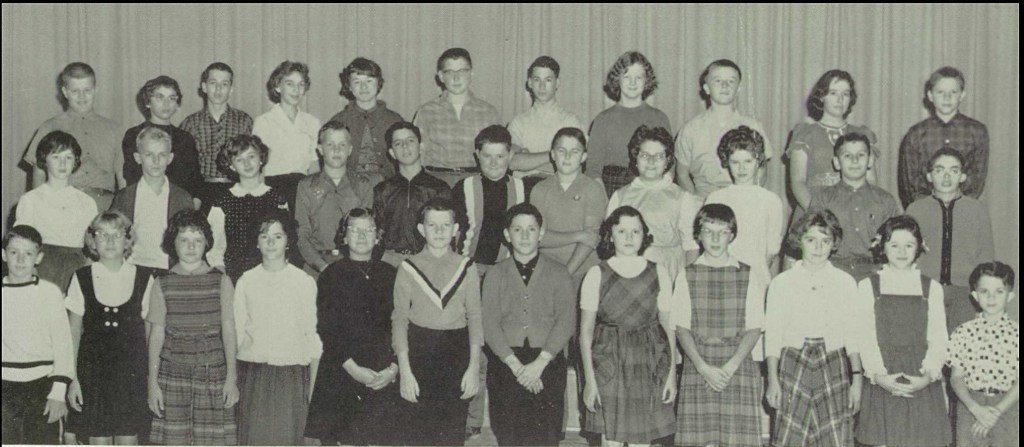
Randy in 7th grade at Champlain Central, circa 1963–fifth from the left in the middle row

Source: Ancestry.com

Randy’s schooling followed a similar pattern of change tempered by continuity. He left the one-room schoolhouse of Perry’s Mills to attend Champlain Elementary and later Champlain Central High School, entering a consolidated system with larger classrooms, more formal routines, and clearer divisions by age.

Outside the school day, however, life retained its familiar rural rhythm. Randy and Donnie, closest in age, spent much of their time together fishing local waters, hunting in nearby woods, and playing sports such as baseball. Work also remained part of everyday life. Both boys continued to help at the mill and to lend a hand at their grandparents’ home on Mill Street, where time in the garden and shared labor with extended family reinforced the same values of cooperation and responsibility that had shaped Randy’s earliest years.

By November 1966, the steady rhythms of family, work, and school that had defined Randy’s life gave way to a decisive rupture. Rather than being drafted, he volunteered for three years of service with the Army, a choice that marked his first sustained separation from the family and community that had long anchored him. Upon enlistment, he was sent to basic training at Fort Dix, New Jersey, a sprawling installation that processed thousands of young men bound for Vietnam.7 There, the familiar cadences of rural life were replaced by pre-dawn wake-ups, rigid schedules, and relentless discipline. Weeks of physical conditioning, weapons training, and drill were designed to strip away civilian habits and impose uniformity, endurance, and obedience under constant pressure to perform.
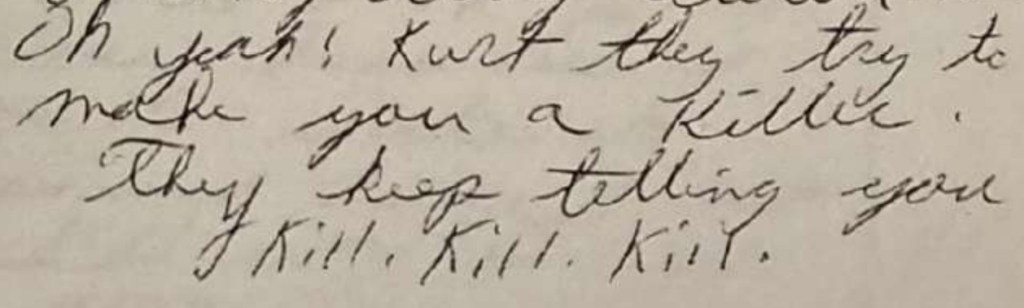
A portion of Randy’s January 1967 letter to his uncle

Source: author’s personal collection

Randy’s earliest letters from Fort Dix capture the shock of this transition with striking immediacy. Writing to his uncle in hurried, uneven handwriting that reflected both the cold and his nervous energy, he described his first encounters with military life in blunt, physical terms. “It’s colder than a bitch down hear,”8 he wrote, before turning to the practical details of induction: learning to handle the M-14 rifle, a “pretty big” weapon that could fire “automatic, semiautomatic,” and memorizing his service number, rifle serial number, name, and rank. Recently inducted, the young mechanic from upstate New York was already becoming aware that basic training demanded more than technical competence. “Kurt,” he added, “they try to make you a killer. They keep telling you Kill. Kill. Kill.”9

The physical and psychological disorientation Randy described was reinforced through deliberately stressful training exercises. In one account, he recalled a gas chamber drill that left him temporarily blinded and injured: “I got some tear gas in my eye and I couldn’t see. I ran in to a wall. It nearly knocked me out. It make you eyes burn like fire.”10 Such episodes underscore the extent to which basic training subjected recruits to deliberately stressful conditions designed to test their physical and psychological endurance.
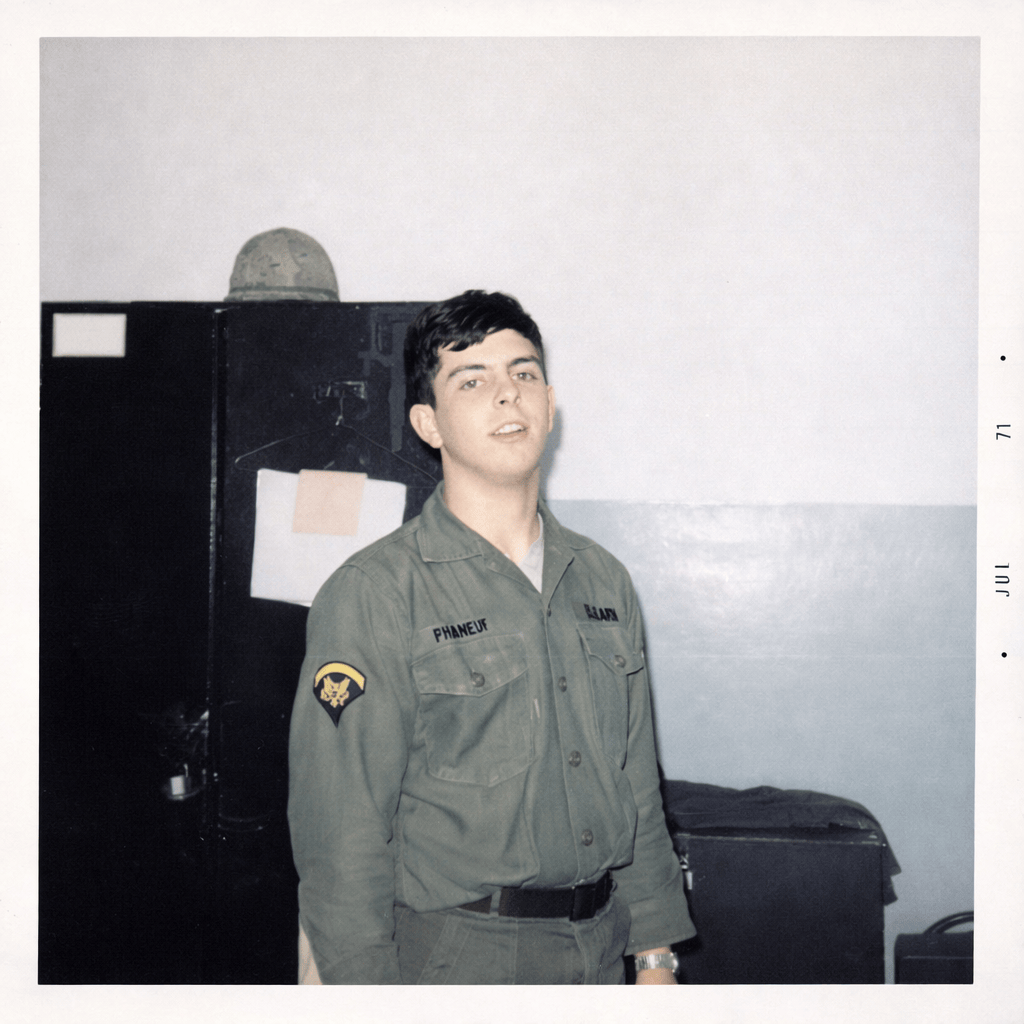
Randy during his early service

Source: author’s personal collection

Within this environment, Randy’s repeated assertions of confidence read as both bravado and self-persuasion. “I’m not afraid of any body down here,” he insisted, even as he acknowledged the Army’s efforts to harden him psychologically. In that same letter, he notes, “They just think there tough but if one every grab me I kick him.”11 These statements reveal a young man negotiating the demands of military masculinity—projecting toughness in a setting that discouraged vulnerability even as his letters reveal growing uncertainty about what lay ahead. From the outset, military service demanded not only physical endurance, but the sustained suppression of emotion, a pattern that would recur throughout his wartime correspondence.

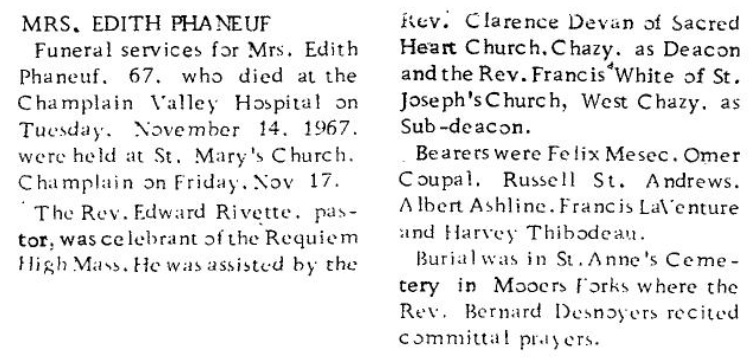
It was during this period of intense transformation that Randy experienced a loss that underscored the growing distance—both physical and emotional—separating him from home. On November 14, 1967, his grandmother Edith, to whom he was deeply attached and who had played a central role in his upbringing on Mill Street, passed away.12 Unable to get leave to attend her wake or funeral, he was forced to grieve from afar for the first time in his life. Although his grandfather George continued to live nearby, anchoring the family’s long presence in the Perry’s Mills area, Edith’s death marked the end of a formative chapter for Randy. The convergence of these two events—his initiation into military life and the loss of a guiding family figure—foreshadowed the isolation and emotional strain he would confront as his service carried him far beyond northern New York and into the war in Vietnam.

After completing basic training at Fort Dix in early 1967, Randy was assigned to an Army base in Aschaffenburg, Germany.13 For the young man from Perry’s Mills, this posting marked his first sustained encounter with the wider world beyond northern New York, where he was a soldier suspended between two worlds—drawn to the novelty of travel and foreign places, yet increasingly aware of how deeply his sense of self remained rooted in home.
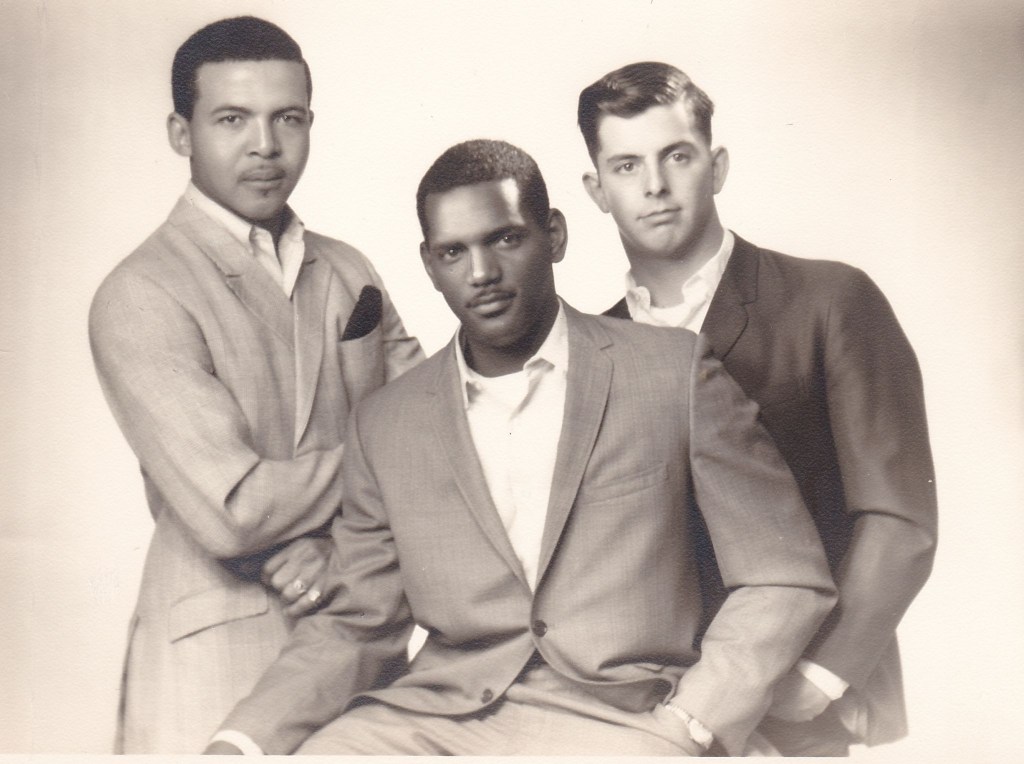
Randy and two of his fellow GIs in Europe circa 1968

Source: author’s personal collection

Stationed in Aschaffenburg—a Bavarian city Randy noted in his letters as having “about 57,000 people”—he encountered a world far larger than Perry’s Mills, yet one still deeply shaped by the aftermath of World War II and the Cold War.14 He took numerous photos on the streets of Aschaffenburg and visited local parks to capture additional images. He wrote of traveling to nearby cities such as Frankfurt, going to Austria on leave, and seeing the Alps for the first time—experiences far removed from the dead-end street and mill town rhythms of his childhood. “I went to Garmisch and Austria,” he told his uncle Kurt after one period of leave. “I went to the Alps. They huge. It was pertty nice.”15 These moments of wonder reflect a common feature of overseas service during the Vietnam era. Historians have noted that for many young American soldiers, postings in Europe offered their first exposure to international travel, producing a complicated mix of fascination, freedom, and dislocation.16 Randy’s letters capture that tension vividly: excitement at what he was seeing, paired with an awareness that this world, however impressive, was not his own.

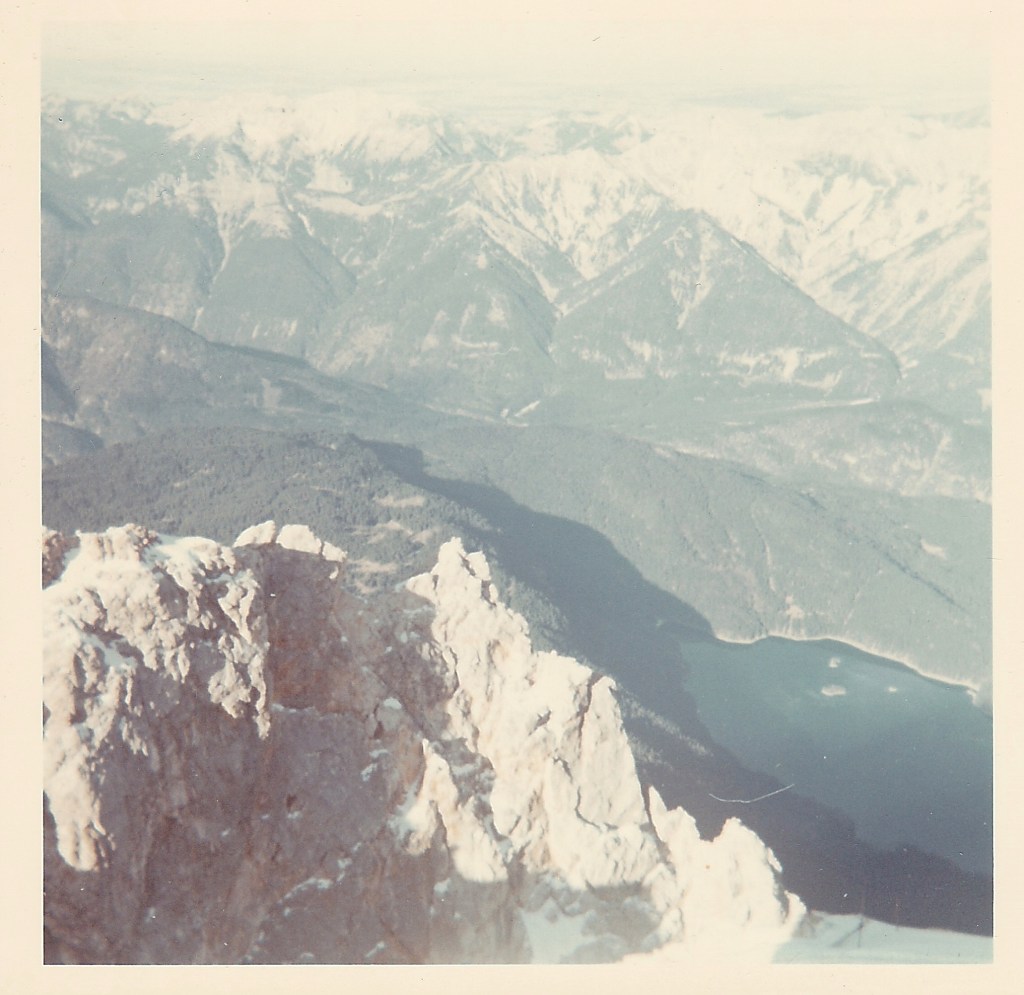
Two views of the Alps captured by Randy during his time in Germany

Source: author’s personal collection

Despite the opportunities for travel and diversion, Randy’s correspondence repeatedly circled back to home. He asked often for news of relatives. He imagined future hunting trips, buying his first car, and drinking a beer with friends and family. Germany, for all its novelty, never displaced home in his imagination. “Just wish you were over here to see Germany,” he wrote to Kurt, before adding bluntly, “but I’ll tell you there’s no place like home. I’d eat some shit if they would let me go back home.”17

His longing was concrete and insistent rather than abstract as he carefully counted the days until he could resume the life he had left behind. “I got about 642 days left,” he wrote in January.18 Then “20 month left” when he wrote the following month.19 By December he was looking forward to being home in “about ten months.”20 Randy’s steady attention to family news, local personalities, and the rhythms of Perry’s Mills was more than nostalgia—rehearsing his post-war life in such detail was how he preserved his civilian identity under military routine. By marking time so precisely, he rendered his separation survivable, bounded by an anticipated return to normalcy—a fragile sense of temporal control that would soon be shattered when his long wait in Germany gave way to sudden orders for Vietnam.21

Music emerged as one of the most powerful ways Randy sustained his connection to home and made his service in Germany more tenable. Throughout his time in Germany, his letters are saturated with references to albums, radio programs, and musicians. He listened constantly—Buck Owens, Faron Young, Jim Reeves, June Carter and Johnny Cash, Melba Montgomery, Lee Hazlewood, Wes Montgomery—and he paid close attention to Armed Forces and local radio broadcasts. “Every Saturday night they have the Grand Ole Opry on the radio,” he wrote, marveling that even overseas, familiar sounds reached him.22 Country music, in particular, carried emotional weight. When a song came on that reminded him of home, he admitted, “Makes me feel like crying.”23 For Randy, music functioned as an auditory bridge back to family, place, and memory.

That connection was made explicit in his request for recordings of Smiley Willette. Writing from Germany in January 1968, Randy asked Kurt if he could obtain tapes of Willette’s music and send them overseas. “I shore would like to get them,” he explained, noting that a friend from Moriah wanted to hear them as well.24 The request carried layered meaning. Smiley Willette, leader of the regionally renowned group Smiley Willette and his Sunset Ramblers, was not just a musician Randy admired; he was family. Willette’s wife, Alfreda, was Randy’s first cousin once removed, placing the music squarely within the web of kinship that had shaped his upbringing.25 And Kurt, the uncle to whom Randy was writing, had played guitar with Willette and Alfreda in the Sunset Ramblers. Randy was therefore asking his uncle for recordings made by people who were simultaneously part of his family and his local musical world. Kurt, to whom he was writing, had been one of the Sunset Ramblers for a time earlier in the 1960s. In asking for those tapes, Randy was longing for a piece of home—family-made music that embodied the world he missed.

Taken together, Randy’s letters from Germany depict a young soldier navigating distance through selective attachment. He embraced travel, admired foreign landscapes, and sampled new experiences, yet remained emotionally anchored to Perry’s Mills through family ties, shared memories, and the familiar sounds of country and western music. Germany became a place where he learned to live with distance from home and to sustain his sense of identity across distance. These strategies—counting days, writing letters, listening to music—would soon be tested under far more severe conditions, as his service carried him from Europe into the war zone of Vietnam.
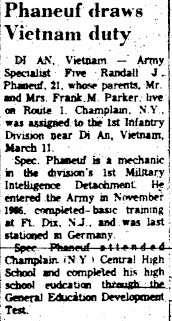
The newspaper article announcing Randy’s tour of duty in Vietnam

Source: Press-Republican, April 18, 1969

The expectation of an imminent return home was abruptly shattered in March 1969, when Randy received orders deploying him to Vietnam. He arrived in-country on March 11, 1969, and was assigned as a mechanic in the 1st Military Intelligence Detachment of the 1st Infantry Division.26 By the time of his arrival, the division had already spent years engaged in sustained combat operations northwest of Saigon, including in the Iron Triangle and along Highway 13, areas synonymous with ambush warfare and heavy casualties. Randy entered Vietnam at a moment when American forces were simultaneously fighting an intensifying war and preparing for eventual withdrawal under the policy of Vietnamization—a contradiction that shaped the conditions of his service from the outset.
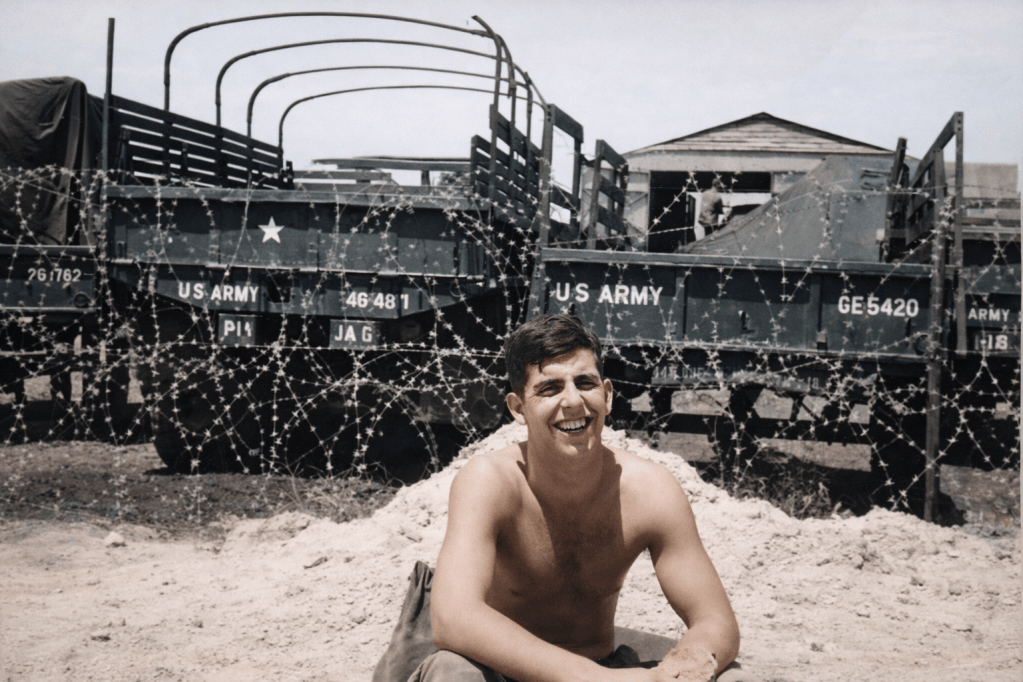
Randy early in his tour of duty in Vietnam

Source: author’s personal collection

Randy’s earliest letters from Vietnam emphasize the physical shock of arrival. Writing just four days after landing, he focused on heat and filth as the most immediate markers of dislocation. “It shore is hot over here,” he told his uncle Kurt—“about 120° during the day about 90° at night.” His barracks, he added with bitter irony, had “about an inch of dirt on the floor,” a condition he described as “real first class livin.” Work offered no reprieve: “We work seven days a week around here,” with only “a few hours off once in a while.”27 These details—heat, dirt, exhaustion—mirror patterns widely documented in Vietnam-era correspondence, where environmental extremes became the first language soldiers used to convey the disorientation of a combat zone’s most destabilizing early weeks.28 Randy’s humor, thinly veiled in sarcasm, functioned as a coping strategy, allowing him to articulate dissatisfaction without open complaint. 

Within weeks, however, physical discomfort gave way to explicit fear. In a letter dated March 30, Randy acknowledged a growing anxiety: “Just a little nervous that’s all. It sure is hell over here there’s no question about that.” He had already been sent deep into contested terrain—“20 miles into enemy territory yesterday”—an experience he described with unfiltered terror: “Boy I was scared like a Mother F____.”29 He also complained bitterly that his commanding officer expected him to “go all over the place” despite having “never been there before,” capturing the disorientation of a war fought without clear front lines or familiar terrain. Vietnam placed Randy in an environment where danger could appear without warning and where he often had little sense of the terrain around him.30 His frustration was compounded by the feeling that those sending him into unfamiliar territory did not understand—or did not care about—the risks he faced.
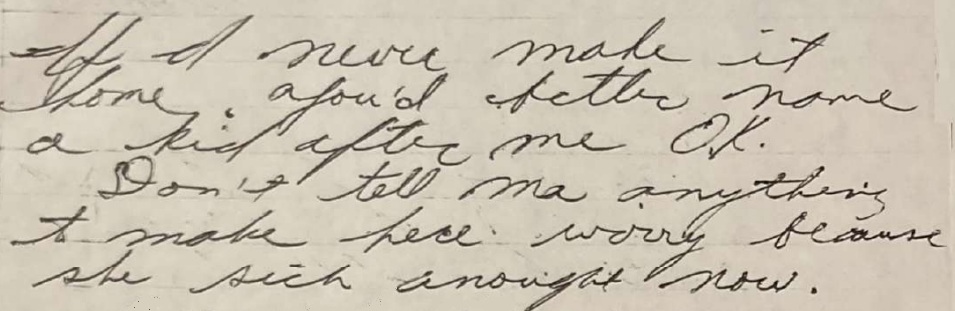
A portion of Randy’s March 30, 1969 letter to his uncle

Source: author’s personal collection

Even as fear sharpened, Randy worked to contain its impact on those at home. “Don’t tell ma anything to make her worry,” he urged Kurt, explaining that his mother was “sick anough now.”31 This request reveals a widening emotional distance between Randy’s lived experience and what he felt able—or willing—to share with his immediate family. His uncle became a buffer, a trusted intermediary through whom fear could be expressed without burdening his mother. Yet even within this guarded space, Randy confronted mortality directly. “If I never make it home,” he wrote, “you’d better name a kid after me.”32 Such statements mark a psychological threshold commonly identified in combat correspondence: the first written acknowledgment of the possibility of death.33 By imagining how he might be remembered if he did not survive, Randy confronted a possibility that had previously remained largely unspoken. 

As his deployment continued, anxiety deepened into exhaustion and foreboding. Letters from April through September describe these changes. “You have to sleep with one eye open around here.”34 “When that siren go off,” he wrote, “it’s time to run for one of the bunkers because Charlie coming.”35 Night brought no relief. Guard duty, monsoon rains, and relentless explosions eroded any sense of safety. “The days are shore long now for me. They seem like a week and Boy that’s bad.”36 Time, once carefully counted as a means of endurance, now stretched painfully.

Still, Randy clung to the familiar anchors established in earlier letters. Music remained a crucial connection to home and identity. He wrote repeatedly about Glen Campbell, Merle Haggard, and other country artists, noting that certain songs played regularly on Armed Forces radio.37 These musical references were not incidental. As with his requests for Smiley Willette’s recordings in Germany, music functioned as a portable version of home—something stable in a landscape defined by chaos. Cultural historians have emphasized the role of music in sustaining emotional continuity among Vietnam-era soldiers, particularly those from rural backgrounds for whom country music reinforced a sense of place and belonging.38
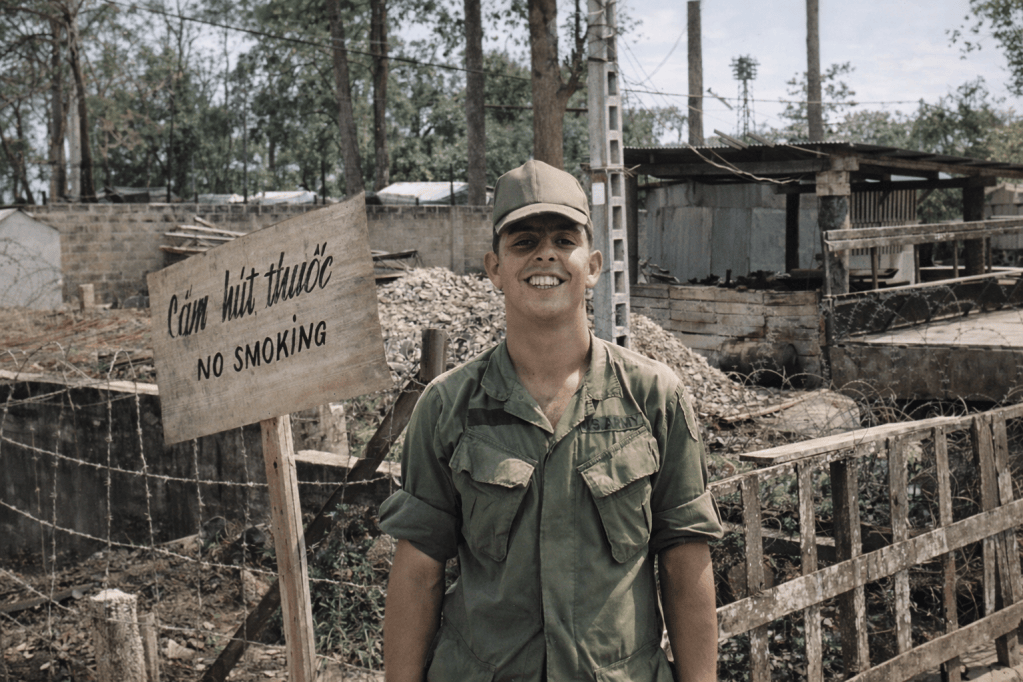
Randy later during his tour of duty in Vietnam

Source: author’s personal collection

Yet alongside these coping mechanisms, Randy’s disenchantment with the Army hardened into open rage. By September, his language toward authority had turned violent and unrestrained, particularly when describing his commanding officer.39 Such expressions marked a striking change from the nervous uncertainty of his earliest letters.40 By this point, fear had become intertwined with anger toward the Army and the officers he believed were responsible for placing him at risk. The Army, once a structure to be endured, became an object of hatred. His final letter from Vietnam ended with a blunt postscript—“P.S. F.T.A.”—a phrase widely used among disillusioned soldiers to signal total rejection of the institution that had claimed their youth and safety.41

Randy’s letters also reveal a growing preoccupation with survival as an individual responsibility. “They don’t care what happen to you,” he wrote after a three-day patrol. “You have to take care of your own self if you want to survive.”42 This belief—that survival depended less on leadership or strategy than on personal vigilance—was common among Vietnam veterans and has been identified as a key contributor to long-term psychological injury. As a mechanic, Randy’s own work put him in direct contact with what that vigilance was guarding against: he was the one who repaired the vehicles that came back from ambushes, and at times he was sent into the field to repair them. In June, he reported that two soldiers had been killed in an ambush and that a close friend narrowly survived a rocket attack.43

Throughout this period, Randy continued to count days. “208 days left to go.” “194 days left to go.” “143 days more.” “53 days.” “About a month left.”44 Time remained his primary means of endurance, even as the days themselves grew heavier. The ritual of counting transformed suffering into something finite, survivable. “That’s what keeps me going,” he wrote simply.45
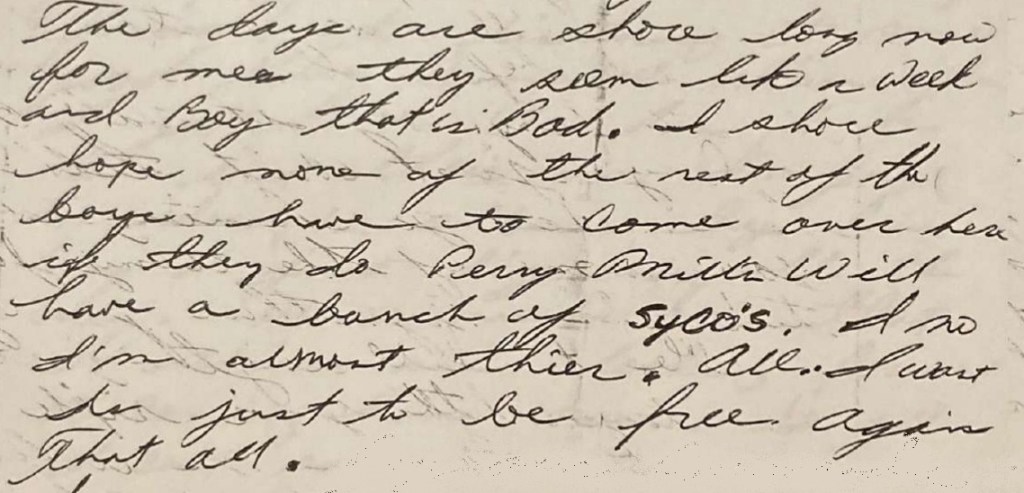
A portion of Randy’s September 14, 1969 letter to his uncle

Source: author’s personal collection

By the time Randy prepared to leave Vietnam, he no longer framed home merely as a destination, but as salvation. “All I want is just to be free again,” he wrote.46 Freedom, not victory or service, had become the governing aspiration. In that sense, his letters trace a transformation shared by many Vietnam veterans: from endurance, to fear, to anger, and finally to a single consuming hope—that survival would be enough.

Randy completed his tour and was honorably discharged from the U.S. Army on November 9, 1969. His military record noted steady advancement rather than distinction in battle: the National Defense Service Medal, the Vietnam Service Medal, the Vietnam Campaign Medal, the Army Commendation Medal, and the rank of Specialist 5 (E-5) — a rank he had tracked toward in his letters home. On paper, his service ended cleanly, the record of a soldier who did what was asked and came back.47

Upon Randy’s return home in late 1969, the term “post-traumatic stress disorder” did not yet exist as the diagnosis it would become. The symptoms that would later be associated with PTSD—including insomnia, irritability, anger, and withdrawal—were not yet understood within the diagnostic framework that would emerge in the following decade. Randy returned to a world that had no language for what he was carrying. He struggled to manage the interpersonal demands of relationships and steady employment. He gradually withdrew. He eventually returned to Perry’s Mills to live with his mother, stepfather, and brothers—physically returning to the place that had anchored his youth, but unable to fully reclaim the life he had envisioned in his letters. Home remained familiar, even if it could not restore the life he had left behind. 

The arc of Randy’s correspondence—from the energy and complaints of basic training, to exploration and longing in Germany, to the anxious, compressed letters from Vietnam—documents a profound change in the young man who wrote them. Historical reconstruction has its limits. Some veterans returned visibly wounded; others, like Randy, came home outwardly intact, while difficulties emerged gradually and persisted across the decades. The war did not end for him in November 1969. Its effects followed him home, into work, family life, and the long years that followed. 

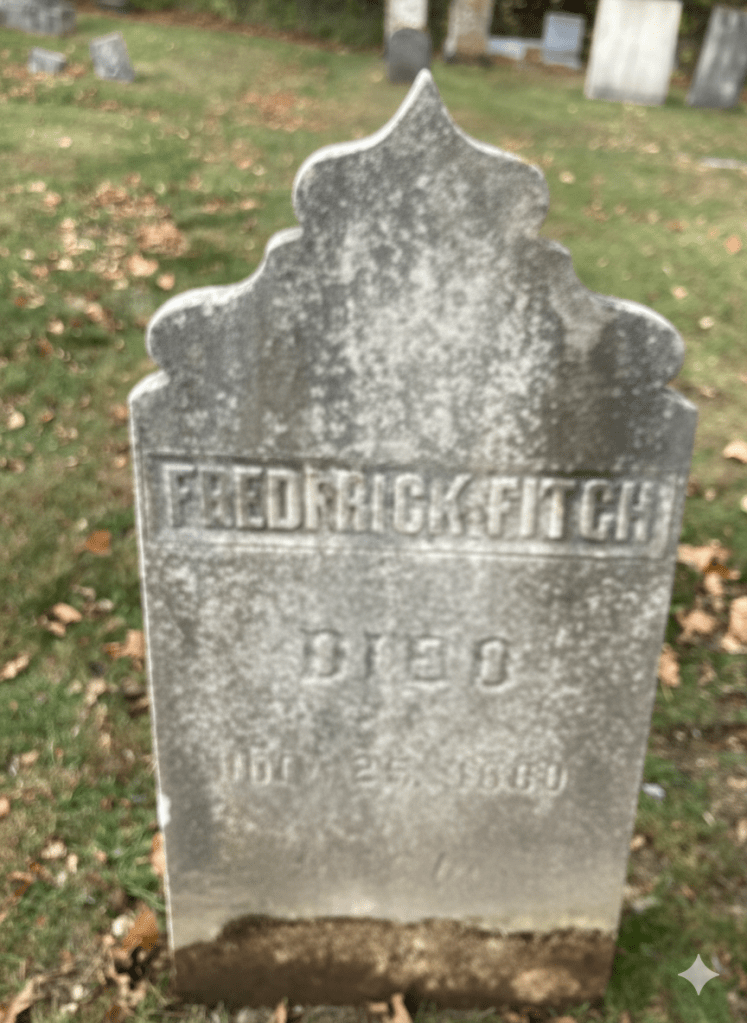
Randy’s grave, like so many others, is unassuming. It records a name, two dates, and a record of military service, but nothing of the years he spent navigating memory, loss, and the consequences of war. Standing there, the distance between the young man who once wrote eagerly of home and the man who eventually returned to Perry’s Mills is stark. His letters allow us to see what the stone cannot: the young man who left, the soldier who feared he might not return, and the veteran who carried the war home with him. The costs of conflict are measured not only in battles fought, but in lives quietly reshaped long after conflicts end.

End notes

  1. Darren Phaneuf, Grave Marker of Randall J. Phaneuf, digital photograph, taken September 12, 2025, St. Ann’s Cemetery, Mooers Forks, NY, personal collection.
  2. 1950 US census, Clinton County, New York, population schedule, Champlain Township, George Phenuf household, house 20 dwelling 169, digital image, Ancestry (http://www.ancestry.com:accessed 2025); citing National Archives Microfilm Publication, NAID 43290879, Sheet: 22.
  3. Kenneth Phaneuf obituary, M.B. Clark Inc. Funeral Home, Champlain, NY, accessed September 24, 2026, https://mbclarkfuneralhome.com/tribute/details/371.
  4. 1950 US census, Clinton County, New York, population schedule, Champlain Township, George Phenuf household, house 20 dwelling 169, digital image, Ancestry (http://www.ancestry.com:accessed 2025); citing National Archives Microfilm Publication, NAID 43290879, Sheet: 22.
  5. 1954 Yearbook, Champlain Central High School (Champlain, NY), 1954, “The Perry’s Mills School” section, indexed in U.S., School Yearbooks, 1880–2012, digital image, Ancestry (http://www.ancestry.com: accessed September 23, 2026).
  6. “Frank M. Parker Sr.,” Obituary, Legacy Remembers, June 6, 2009, https://www.legacy.com/us/obituaries/legacyremembers/frank-parker-obituary?id=28690953.
  7. Randall Phaneuf to Kurt Phaneuf, undated letter, Fort Dix, New Jersey, Randall Phaneuf Letters, personal collection of the author.
  8. Randall Phaneuf to Kurt Phaneuf, undated, Fort Dix, New Jersey, Randall Phaneuf Letters, personal collection of the author. Spelling, punctuation, and capitalization in excerpts from Randall Phaneuf’s letters have been preserved exactly as written in the original manuscripts to maintain the authenticity of his voice. Standard editorial bracketed corrections ([sic]) have been omitted except where necessary to avoid ambiguity.
  9. Ibid.
  10. Randall Phaneuf to Kurt Phaneuf, January 19, 1967, Fort Dix, New Jersey, Randall Phaneuf Letters, personal collection of the author.
  11. Randall Phaneuf to Kurt Phaneuf, undated, Fort Dix, New Jersey, Randall Phaneuf Letters, personal collection of the author.
  12. “Mrs. Edith Phaneuf,” Press-Republican, November 18, 1967, 6, col. 4-5. “MRS. EDITH PHANEUF,” The North Countryman, November 23, 1967, 4, col. 3-4.
  13. Randall Phaneuf to Kurt Phaneuf, January 13, 1968, Aschaffenburg, Germany, Randall Phaneuf Letters, personal collection of the author.
  14. Randall Phaneuf to Kurt Phaneuf, February 6, 1968, Aschaffenburg, Germany, Randall Phaneuf Letters, personal collection of the author.
  15. Randall Phaneuf to Kurt Phaneuf, December 1968, Aschaffenburg, Germany, Randall Phaneuf Letters, personal collection of the author.
  16. For more information on the experience of US soldiers in Germany during this time, see Thomas W. Maulucci Jr. and Detlef Junker, eds., GIs in Germany: The First Thirty Years, 1945–1970 (New York: Cambridge University Press, 2010).
  17. Randall Phaneuf to Kurt Phaneuf, February 6, 1968, Aschaffenburg, Germany, Randall Phaneuf Letters, personal collection of the author.
  18. Randall Phaneuf to Kurt Phaneuf, January 13, 1968, Aschaffenburg, Germany, Randall Phaneuf Letters, personal collection of the author.
  19. Randall Phaneuf to Kurt Phaneuf, February 6, 1968, Aschaffenburg, Germany, Randall Phaneuf Letters, personal collection of the author.
  20. Randall Phaneuf to Kurt Phaneuf, December 1968, Aschaffenburg, Germany, Randall Phaneuf Letters, personal collection of the author.
  21. For more information on how soldier correspondence functions as a psychological mechanism to preserve civilian identity and navigate temporal separation, see Andrew Carroll, ed., Behind the Lines: Powerful and Revealing Letters Home from the American Military in World War I, World War II, Korea, and Vietnam (New York: Scribner, 2005), 15–28.
  22. Randall Phaneuf to Kurt Phaneuf, January 13, 1968, Aschaffenburg, Germany, Randall Phaneuf Letters, personal collection of the author.
  23. Randall Phaneuf to Kurt Phaneuf, undated letter, Germany, discussing music and radio broadcasts, personal correspondence.
  24. Randall Phaneuf to Kurt Phaneuf, January 13, 1968, Aschaffenburg, Germany, Randall Phaneuf Letters, personal collection of the author.
  25. Willette, Alfreda R. Obituary. M. B. Clark, Inc. Funeral Home, July 2011. https://mbclarkfuneralhome.com/tribute/details/134.
  26. “Phaneuf draws Vietnam duty,” Press-Republican (Plattsburgh, NY), April 18, 1969, p. 5, col. 2.
  27. Randall Phaneuf to Kurt Phaneuf, March 15, 1969, Dĩ An Base Camp, South Vietnam, Randall Phaneuf Letters, personal collection of the author.
  28. For more information on environmental shock, sensory disorientation, and the psychological impact of arrival during the first weeks of deployment in Vietnam, see Christian G. Appy, Working-Class War: American Combat Soldiers and Vietnam (Chapel Hill: University of North Carolina Press, 1993), chapter 4 (“Ominous Beginnings”).
  29. Randall Phaneuf to Kurt Phaneuf, March 30, 1969, Dĩ An Base Camp, South Vietnam, Randall Phaneuf Letters, personal collection of the author.
  30. For comprehensive discussions of soldier disorientation, the absence of fixed front lines, and widespread disillusionment with military leadership in Vietnam, see Christian G. Appy, Working-Class War: American Combat Soldiers and Vietnam (Chapel Hill: University of North Carolina Press, 1993), chapter 5 (“The Terms of Battle”).
  31. Randall Phaneuf to Kurt Phaneuf, March 30, 1969, Dĩ An Base Camp, South Vietnam, Randall Phaneuf Letters, personal collection of the author.
  32. Randall Phaneuf to Kurt Phaneuf, March 30, 1969, Dĩ An Base Camp, South Vietnam, Randall Phaneuf Letters, personal collection of the author.
  33. For more information on the psychological realization of mortality in combat, see Christian G. Appy, Working-Class War: American Combat Soldiers and Vietnam (Chapel Hill: University of North Carolina Press, 1993), chapter 5 (“The Terms of Battle”).
  34. Randall Phaneuf to Kurt Phaneuf, April 16, 1969, Dĩ An Base Camp, South Vietnam, Randall Phaneuf Letters, personal collection of the author.
  35. Randall Phaneuf to Kurt Phaneuf, April 28, 1969, Dĩ An Base Camp, South Vietnam, Randall Phaneuf Letters, personal collection of the author.
  36. Randall Phaneuf to Kurt Phaneuf, September 14, 1969, Dĩ An Base Camp, South Vietnam, Randall Phaneuf Letters, personal collection of the author.
  37. Randall Phaneuf to Kurt Phaneuf, April 28, 1969, Dĩ An Base Camp, South Vietnam, Randall Phaneuf Letters, personal collection of the author. Randall Phaneuf to Kurt Phaneuf, September 14, 1969, Dĩ An Base Camp, South Vietnam, Randall Phaneuf Letters, personal collection of the author.
  38. For more information on the role of music in sustaining emotional continuity among Vietnam-era soldiers, see Michael J. Kramer, The Republic of Rock: Music and Citizenship in the Sixties Counterculture (New York: Oxford University Press, 2013).
  39. Randall Phaneuf to Kurt Phaneuf, September 14, 1969, Dĩ An Base Camp, South Vietnam, Randall Phaneuf Letters, personal collection of the author.
  40. For more information on the moral and psychological transformation of soldiers, see Christian G. Appy, Working-Class War: American Combat Soldiers and Vietnam (Chapel Hill: University of North Carolina Press, 1993), chapter 8 (“What Are We Becoming?”).
  41. Randall Phaneuf to Kurt Phaneuf, October 1969, Dĩ An Base Camp, South Vietnam, Randall Phaneuf Letters, personal collection of the author.
  42. Randall Phaneuf to Kurt Phaneuf, June 16, 1969, Dĩ An Base Camp, South Vietnam, Randall Phaneuf Letters, personal collection of the author.
  43. Ibid.
  44. Randall Phaneuf to Kurt Phaneuf, April 17, 1969, Dĩ An Base Camp, South Vietnam, Randall Phaneuf Letters, personal collection of the author. Randall Phaneuf to Kurt Phaneuf, April 28, 1969, Dĩ An Base Camp, South Vietnam, Randall Phaneuf Letters, personal collection of the author. Randall Phaneuf to Kurt Phaneuf, June 16, 1969, Dĩ An Base Camp, South Vietnam, Randall Phaneuf Letters, personal collection of the author. Randall Phaneuf to Kurt Phaneuf, September 14, 1969, Dĩ An Base Camp, South Vietnam, Randall Phaneuf Letters, personal collection of the author. The June 1969 letter is noteworthy as Randy mentions 143 days left to go twice.
  45. Randall Phaneuf to Kurt Phaneuf, June 16, 1969, Dĩ An Base Camp, South Vietnam, Randall Phaneuf Letters, personal collection of the author.
  46. Randall Phaneuf to Kurt Phaneuf, September 14, 1969, Dĩ An Base Camp, South Vietnam, Randall Phaneuf Letters, personal collection of the author.
  47. U.S. Armed Forces Report of Transfer or Discharge (DD Form 214), Randall J. Phaneuf, November 9, 1969.
Mary Lacroix’s Tale

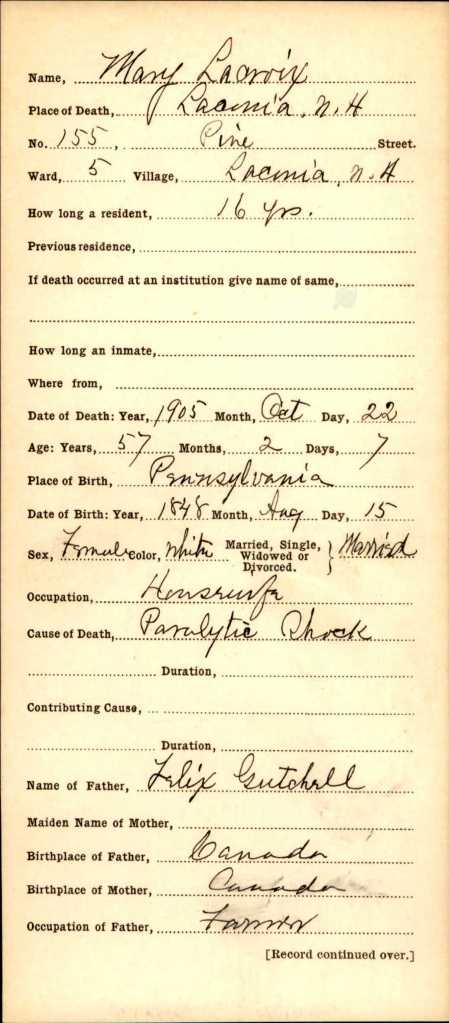
Mary Lacroix’s death certificate

Source: New Hampshire Division of Archives & Records Management

Somewhere in Saint Lambert’s Cemetery in Laconia, New Hampshire, lies the grave of Mary Lacroix. The record of her passing on October 22, 1905, is sparse: death by paralytic shock, an address on Pine Street, and a marital status of married.1 It tells us little about the life that preceded her death, and nothing about the accumulated weight of grief, displacement, and endurance that shaped its course. The turning point in Mary’s life came suddenly, in a crowded saloon in the bustling industrial village of Keeseville, far from Laconia, where immigrant communities and economic change often collided. Her tale opens a window into immigration, ethnic conflict, justice, and widowhood in the nineteenth century—and illuminates the life of someone whose grave has no marker.

Mary’s story begins far from Laconia, in the world of mid-nineteenth-century French-Canadian migration. She was born on August 15, 1848, in Pennsylvania, the daughter of Félix Gutchell and Marie Louise Biron.2 Her parents were natives of Canada, part of the great migration of French Canadians into the industrial towns of the United States during the nineteenth century, as economic pressures in Quebec encouraged many families to seek opportunities south of the border.3 Her father’s family history illustrates how complicated the paths of immigration could be: Félix was born in Canada to parents who were both born in Germany.4 Félix and Marie Louise left Quebec for Pennsylvania sometime between the birth of their eldest child, Félix, around 1837, and their daughter Esther in 1840. By the time Mary was born in 1848, the couple had been joined by Rosa, born around 1842, Sarah, around 1843, and Rebecca, around 1846. Mary’s younger sister Olive was the last child born in Pennsylvania, joining the family in 1851.5

The family left Pennsylvania for Chesterfield, New York, when Mary was a small child, eventually settling in the industrial village of Keeseville.6 Straddling the border between Clinton and Essex Counties along the Ausable River, Keeseville had grown by the 1850s into a bustling industrial center anchored by enterprises such as the Ausable Horse Nail Company, a large horseshoe nail manufacturer that had ten machines producing about 100 tons of horse nails by 1863. The Ausable Horse Nail Company alone employed up to 240 men at its peak, most of them young Irish or French-Canadian immigrants who worked dangerous jobs feeding hot iron into machines, sorting nails, and packing boxes, earning wages that typically ranged between eight and fifteen dollars per week. This was the world in which the Gutchell family would make its home.

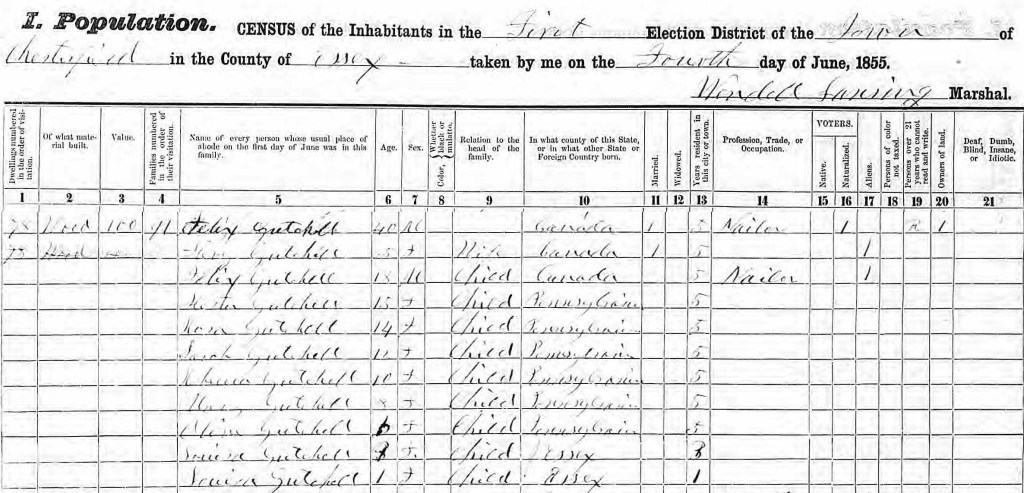
Mary’s first appearance in New York state living in Chesterfield with her parents and eight siblings

Source: 1855 New York state census, Essex County, New York, population schedule, Chesterfield Township.

The 1855 New York State census finds Mary living in a large household headed by her forty-year-old father and thirty-five-year-old mother. The household included eight of Mary’s siblings, from her eighteen-year-old brother Felix, the family’s only son, to her infant sister Louisa.7 The size of the household also reflected the economic reality of working-class immigrant families, where the wages of multiple family members could be essential to making ends meet. The record does not tell us precisely why the Gutchells came to Keeseville, but the availability of industrial work was likely an important factor; both Mary’s father and brother found employment in the area’s horse-nail companies. 

By 1860, the federal census found eleven-year-old Mary attending school and living with her parents and several siblings on the Chesterfield side of Keeseville. The family now included two younger brothers, Henry, born in 1856, and Joseph, listed as just one month old. Older sisters Esther and Rosalie remained in the household, as did younger sisters Olive and Louisa.8 But the absences speak as loudly as the additions. Her brother Felix had already established his own household in Keeseville with his young wife, Eliza, and their infant son Henry, and continued to work as a nailer.9 Sarah was no longer in the household, while Mary’s sister Rebecca had crossed the river and was working as a servant in the household of Alvira Sawyer.10 Mary’s father, like her brother Felix, continued to earn his living as a nailer, tying the family directly to the industry that had transformed Keeseville into one of the region’s leading manufacturing centers. 

The stability that families like the Gutchells struggled to build proved fragile. Like thousands of young men from northern New York, Mary’s older brother Felix enlisted in the Union Army, joining Company D of the 153rd New York Infantry. On September 19, 1864, he was mortally wounded in the third battle of Winchester and died of those wounds eleven days later.11 He was twenty-four years old and left behind a young wife and five-year-old son. For Mary, who was only fifteen, Felix’s death marked an early loss within her immediate family. 

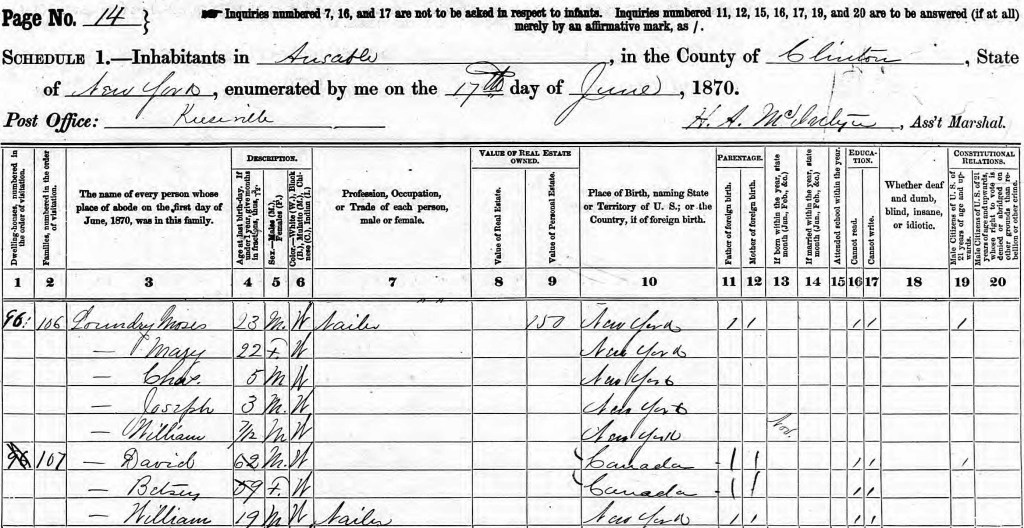
Only three weeks after her brother succumbed to his wounds, Mary married Moses Laundry on October 22, 1864, at the age of sixteen.12 She was young even by the standards of the era, but early marriage was common among working-class immigrant women for whom domestic life and economic partnership were deeply intertwined. Moses was himself a young French-Canadian immigrant, the son of David and Gertrude Laundry, who had arrived in the United States before 1850.13 The 1870 census records Moses as twenty-three years old, working as a nailer and unable to read or write. In 1870, Moses and Mary reported a personal estate of $150 and shared a rented home with Moses’s parents and a brother in Keeseville.14 More than twenty years after the Laundry family arrived in the United States, they still lived in a rented home rather than owning property of their own. 

Mary, her husband Moses, and their children sharing a home with Moses’s parents and brother

Source: 1870 US census, Clinton County, New York, population schedule, Ausable Township.

Mary and Moses began building their family almost immediately after their marriage. Their son Charles was born in 1865, followed by Joseph in 1867 and William in 1869.15 But even as the family grew, loss arrived early: on September 4, 1870, their youngest son, William, died.16 When William died, Mary was already pregnant with another child. By the spring of 1871, she was eight months along.17 

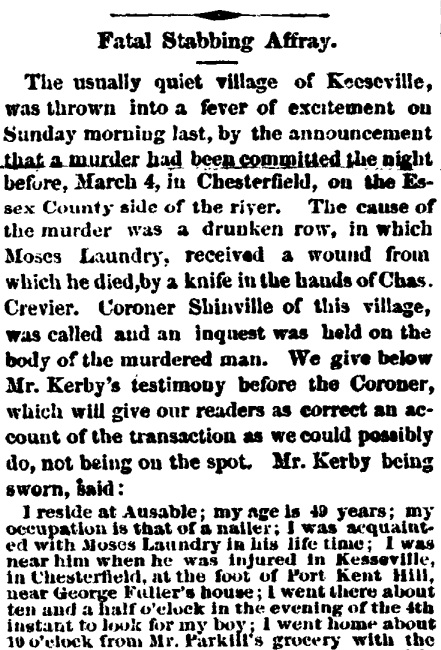
On the evening of Saturday, March 4, 1871, Mary’s life changed when Moses did not return home from work. The end of the six-day work week was a regular occasion for the men of Keeseville’s factories to gather in the village’s many saloons and drinking houses. At least sixteen drinking establishments operated in Keeseville in 1870 alone.18 That night, Moses and his friend Seraphin Crevier, a twenty-year-old French-Canadian immigrant, stopped at the Ausable House on Main Street. Shortly afterward, Moses and Crevier left the saloon and became involved in a street altercation with James Corcoran, a twenty-four-year-old Irish laborer known as a “fighting man.” Corcoran was also associated with the Port Kent Hill Gang, which had harassed Crevier on multiple occasions, including once chasing him to the door of his boarding house. When Moses stepped in to break up the fight, Crevier slashed him across the neck with his knife. Moses was taken home by wagon, where pregnant Mary and their children were waiting. Despite attempts to stop the bleeding, Moses died around nine o’clock the following morning. He was twenty-five years old.19

The newspaper article providing details about the death of Mary’s husband, Moses Laundry

Source: Plattsburgh Republican., March 11, 1871, Page 3

Moses Laundry’s death quickly became a subject of public discussion in Keeseville. One local newspaper almost immediately framed the tragedy through the lens of temperance, blaming alcohol for the killing and using Laundry’s death to strengthen its argument against the village’s saloon culture. The newspaper even noted that the Laundry family could potentially sue the saloon owner for damages of up to $2,500.20 But the temperance account captured only part of what was happening in Keeseville. Beneath the immediate role of alcohol lay deeper tensions: intense economic competition between Irish and French-Canadian workers for dangerous, low-paying jobs, and a masculine culture in which physical courage and reputation could become alternative measures of status. For men with few avenues to economic advancement or social standing, the street could become a theater where disputes over honor, reputation, and hierarchy were played out.21

Keeseville’s ethnic divisions were reinforced by geography and community institutions. French-Canadian immigrants clustered on the Clinton County side of the Ausable River in what contemporaries called a “Little Canada,” a francophone neighborhood populated largely by families from Quebec. They developed their own social and religious institutions, including a Catholic congregation separate from the Irish-dominated parish on the Essex County side.22 Mary and Moses lived within this French-Canadian community, even as economic competition between Irish and French-Canadian workers created tensions across the river. 

For Mary, none of these larger historical forces mattered in the immediate aftermath. What mattered was that she was eight months pregnant, had two surviving young children, lived in a rented house, and had just lost her husband. On April 22, 1871—forty-nine days after Moses died—she gave birth to a son. She named him William Moses.23 The name joined the names of both the son and husband she had lost within the previous year—a quiet yet eloquent detail in the surviving record of her life. 

A widow in 1871 with three small children, including a newborn, and no property had few options. Historians of working-class women’s lives in the nineteenth century have documented how difficult it was for women to sustain households on their wages alone. For many working-class widows, remarriage was as much an economic decision as a personal one. On November 30, 1872, less than two years after Moses’s death, Mary married Joseph LaCroix at St. John’s Church in Keeseville, New York.24 Joseph, like Moses before him, was a French-Canadian immigrant laborer who moved through the same francophone networks, neighborhoods, and Catholic institutions that had shaped Mary’s life.25 The marriage took place in the same church whose records, preserved more than a century later, help researchers reconstruct the fragments of the Laundry family’s life. 

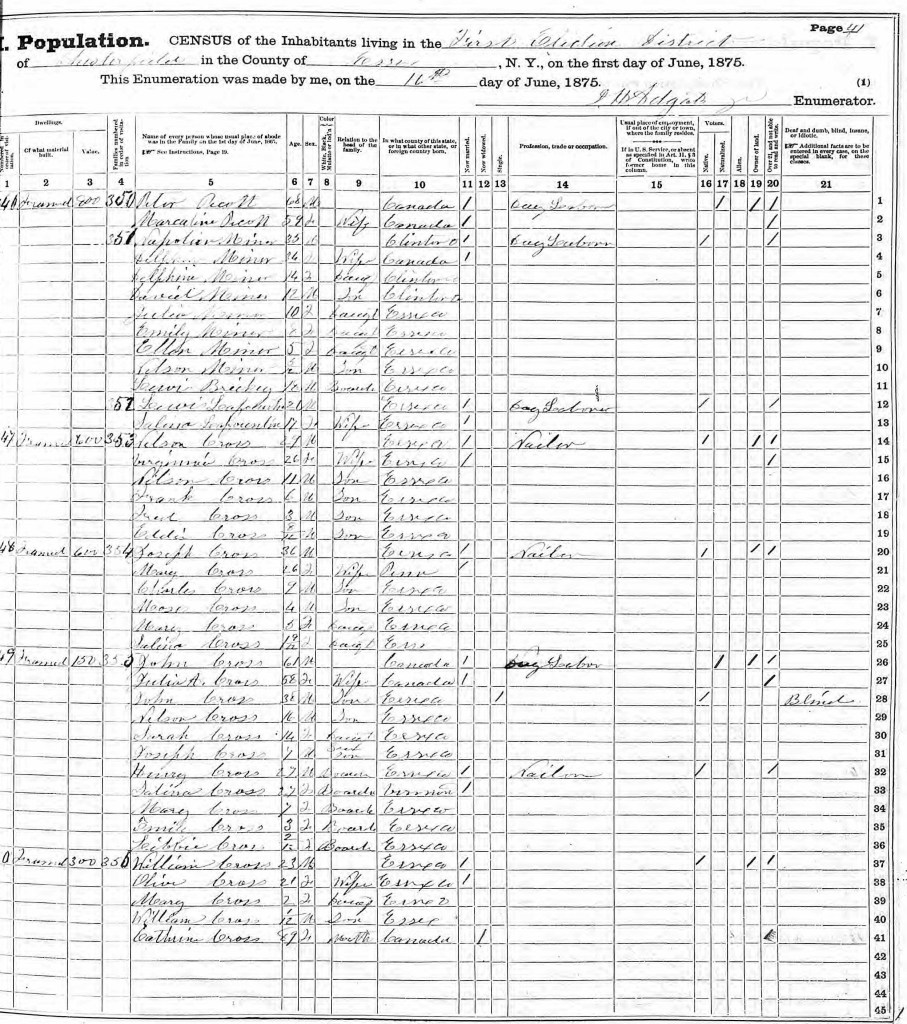
By 1875, Mary and Joseph LaCroix continued to live in Keeseville with their combined family. The New York State census identified Joseph and Mary, along with all of the children—including the three fathered by Moses Laundry—under the surname Cross.26 Cross was an anglicized rendering of LaCroix, the sort of surname adaptation that appears frequently in the records of French-Canadian immigrants navigating English-speaking institutions.27 Mary and her children would move through the records as Laundry, Cross, and LaCroix over the years, creating a shifting paper trail that would complicate any attempt to reconstruct their lives. 

Mary’s children with Moses had adopted the Cross name by 1875 while surrounded by the families Joseph’s parents and brothers

Source: 1875 US census, Essex County, New York, population schedule, Chesterfield Township.

The early years of marriage to Joseph saw Mary experiencing an extraordinary pattern of pregnancy: six children in nine years. Celina was born September 8, 1873, less than a year after the wedding; Felix followed in 1875, Elizabeth in 1877, Julia in 1879, Edward in 1880, and Henry on March 10, 1882.28 In naming her second son Felix, Mary honored both her father and the brother she had lost at Winchester more than a decade earlier. 

The 1880s brought geographic upheaval for Mary and her family. For reasons the historical record does not make explicit — economic opportunity, unemployment, family networks, or some combination of all three — the LaCroix family left their long-established community in the Keeseville area and began moving. By 1885 they were in Cicero, Illinois, a working-class suburb of Chicago, where daughter Dora was born that November.29 By 1888 they were in New Haven, Connecticut, welcoming twins George and Georgina on March 4.30 By 1890 they had settled in Laconia, New Hampshire, where the 1900 census would finally fix them in place at 155 Pine Street.31

This sequence of moves — Keeseville to Cicero to New Haven to Laconia, across a span of roughly five years — tells a story that is familiar to many working-class immigrant families of the period. One study of immigrants in the North Atlantic economy has shown that geographic mobility was not exceptional among immigrant workers but normative; families followed the rhythms of industrial hiring, moving between mill towns and factory cities as employment contracted and expanded.32 Mary and Joseph were part of this mobile proletariat, following labor from place to place, raising children as they went, never appearing to own a home.

What such mobility costs in terms of social roots, community support, and stability is difficult to quantify but easy to contemplate. The French-Canadian immigrant networks that had sustained Mary in Keeseville — the church of St. John’s, the neighbors who shared her language and her faith, the extended family connections that provided informal support — had to be rebuilt from scratch with each move. For French-Canadian immigrant families generally, the parish did more than provide religious community; it offered continuity as families shifted from one industrial town to the next, a continuity Mary’s family had to reconstruct four times over.33

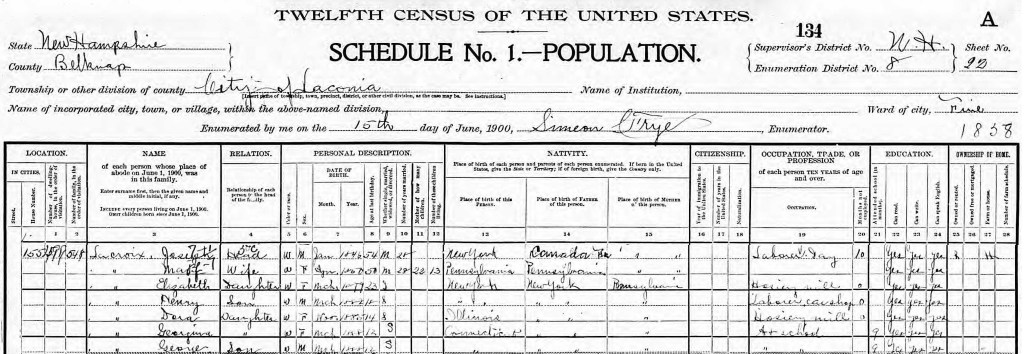
Mary and her family in the 1900 census with five of their children living at 155 Pine Street, Laconia, NH

Source: 1900 US census, Belknap County, New Hampshire, population schedule, Laconia Township.

The 1900 federal census finds Mary, age fifty, and Joseph, age fifty-four, still living with many of their children. Elizabeth, Henry, Dora, and the twins Georgina and George continue to reside with their parents. Joseph was working as a day laborer, but had been unemployed for ten months of the previous year. The family’s economic position rested heavily on its children: twenty-three-year-old Elizabeth and fourteen-year-old Dora both worked at a hosiery mill, while eighteen-year-old Henry worked in a car shop.34 Survival for French-Canadian families required everyone to play a role, even if it meant a young teen stopped going to school to seek employment.

Mary’s response to one census taker’s question about her children is among the most revealing details of her life. She reported that she had given birth to twenty-two children, of whom thirteen were still alive.35 From approximately her sixteenth year until into her forties, Mary’s body was almost continuously engaged in the work of gestation, birth, nursing, and loss. The nine children she lost were not abstractions; they were infants and toddlers she held, nursed, named, and buried. Yet the census enumerator recorded their absence matter-of-factly, in the standard columns provided for the purpose, as if it were ordinary.36 The nine deaths in Mary’s family are largely invisible in the historical record; only two can be identified by name. Her infant son William died in 1870, while her son Joseph survived into adulthood only to die of typhoid fever in Laconia in 1892, at the age of twenty-five.37 Her losses were not confined, then, to the fragile first years of childhood; they could come after years of watching a child grow into adulthood. And the children who survived were themselves shaped by that same economic pressure, their childhoods converted, like those of countless children of French-Canadian immigrants, into an economic asset.

The late 1890s and early 1900s required Mary to draw on the resilience formed by years of losing her children. Her mother Marie died before 1900, likely in 1896; her father Félix followed on October 17, 1903, at the age of eighty-six.38 Since at least 1892, Félix and Marie had made their home in Plattsburgh with the family of their daughter Sarah and her husband, Joseph Forkey — a household that had, by 1900, achieved something Mary’s own family never had: a home of their own, at 50 Cornelia Street.39 That stability was the product of collective labor. Five of Sarah and Joseph’s children, ranging from twenty-nine-year-old Sarah to twenty-two-year-old Josephine, still lived at home, and four of the five were employed — two as dressmakers, two as clerks. Combined with Joseph’s work as a barber, the household had five adults working full-time, with no stretch of unemployment in the year before the census.40 It was this large, fully employed family that gave Mary’s aging parents the security her own household, scattered across four states, could not have provided.

The deaths of her parents were part of a pattern of loss that had followed Mary throughout her life. She had been confronting death since at least her brother Felix’s mortal wounding at Winchester in 1864. In the decade before her own death, she lost her sister Rebecca and Rebecca’s husband, and then her sister Sarah Forkey and her husband, Joseph — the same Sarah who had cared for Mary’s parents in their final years.41 Then, in 1905, Mary’s nephew William Forkey was killed at a Plattsburgh paper mill when his clothing caught in a rapidly revolving shaft.42 His death was a stark reminder of the dangers that industrial work continued to pose to immigrant families like Mary’s.

Mary herself died on October 22, 1905, in Laconia, New Hampshire, at the age of fifty-seven. The cause of death was recorded as paralytic shock.43 The date was quietly significant: forty-one years earlier to the day, a sixteen-year-old girl had married Moses Laundry at St. John’s Church in Keeseville. 

Mary’s life gives shape to a history that scholars have been assembling for decades: a story of downward mobility, ethnic tension, dangerous industrial labor, crowded and unsanitary housing, endemic infant mortality, and the near-total absence of social safety nets for families when disaster struck. Mary’s world was shaped by forces she did not choose and could not control: the agricultural collapse in Quebec that sent her parents south, the rise and decline of the industrial economy in Keeseville that employed her family, the street-level ethnic violence that killed her husband in March 1871 over competition for modest wages, and the labor market fluctuations that sent her family ricocheting between Illinois, Connecticut, and New Hampshire in the 1880s.

Yet Mary’s life resists reduction to a catalog of misfortune. She survived the death of her first husband, raised a large family, learned to read and write, remarried, moved repeatedly in search of economic stability, and navigated a world that offered women of her class and origin few resources for doing so. The name she gave her final son from her first marriage, William Moses, is perhaps the most telling single act in the documentary record of her life. It was the act of a woman who refused to let loss be the only story. She had buried a son named William in September 1870 and husband Moses in March 1871. Seven weeks after her husband’s death, Mary gave birth to a son and named him William Moses, joining the names of the son and husband she had lost within the previous year. We cannot know what the name meant to Mary, but it stands as the clearest surviving act of remembrance in the documentary record of her life.

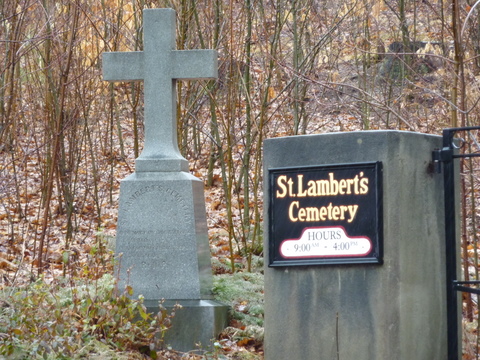
The gates of Saint Lambert’s Cemetery in Laconia

Source: FindAGrave.com

Somewhere in Saint Lambert’s Cemetery, there is ground that holds Mary, but no stone marks her grave. For a woman whose name shifted repeatedly in the records—Gutchell, Laundry, LaCroix, Cross—even the place where she was buried carries no marker to fix her name in stone. But Mary did not wait for the world to mark what mattered to her. In April 1871, with no stone cut for the child and husband she had recently buried, she made her own act of memory: she named a living child after the dead. This telling of her life is offered in that same spirit — not a stone, but a name, set down so that hers would not go unmarked twice.

End notes

  1.  Find A Grave, “Mary Gutchell Lacroix (1848–1905),” Memorial 246106860, Saint Lamberts Cemetery Laconia, Belknap County, New Hampshire, accessed August 15, 2026, https://www.findagrave.com/memorial/246106860/mary-lacroix. New Hampshire Division of Archives & Records Management, New Hampshire Death Records, 1650–1969, Mary Lacroix, death certificate, October 22, 1905, Ancestry (http://www.ancestry.com: accessed August 13, 2026).
  2. 1855 New York state census, Essex County, New York, population schedule, Chesterfield Township, Felix Gutchell household, dwelling 78 family 91, digital image, Ancestry (http://www.ancestry.com: accessed August 8, 2026); page 11.
  3. Historian Yves Frenette has documented how bleak agricultural prospects in Quebec pushed farmers to sell their land and join a growing landless working class, while debt, unemployment, and the hope for better wages encouraged hundreds of thousands of French Canadians to seek opportunities south of the border. See Yves Frenette, “La genèse d’une communauté canadienne-française en Nouvelle-Angleterre: Lewiston, Maine, 1800–1880,” Historical Papers / Communications historiques 24, no. 1 (1989): 75–99.
  4. 1900 US census, Clinton County, New York, population schedule, Plattsburgh Township, Joseph Addison household, dwelling 130 family 145, digital image, Ancestry (http://www.ancestry.com: accessed July 15, 2026); citing National Archives Microfilm Publication roll 1018, page 8A.
  5.  1855 New York state census, Essex County, New York, population schedule, Chesterfield Township, Felix Gutchell household, dwelling 78 family 91, digital image, Ancestry (http://www.ancestry.com: accessed August 8, 2026); page 11.
  6. Ibid.
  7. Ibid.
  8. 1860 US census, Essex County, New York, population schedule, Chesterfield Township, Felix Gutchell household, dwelling 205 family 189, digital image, Ancestry (http://www.ancestry.com: accessed August 8, 2026); citing National Archives Microfilm Publication, page 26.
  9. 1860 US census, Clinton County, New York, population schedule, Ausable Township, Ocule Brunel  household, dwelling 2965 family 2942, digital image, Ancestry (http://www.ancestry.com: accessed August 15, 2026); citing National Archives Microfilm Publication, page 420.
  10. 1860 US census, Clinton County, New York, population schedule, Ausable Township, Alvira Sawyer household, dwelling 3033 family 3005, digital image, Ancestry (http://www.ancestry.com: accessed August 15, 2026); citing National Archives Microfilm Publication, page 430.
  11. New York State Archives, “Civil War Muster Roll Abstracts of New York State Volunteers, United States Sharpshooters, and United States Colored Troops [ca. 1861–1900],” entry for Felix Gutchell, box 257, accessed via New York, U.S., Civil War Muster Roll Abstracts, 1861–1900, Ancestry (http://www.ancestry.com: accessed August 15, 2026).
  12. Birth, Marriage, and Death records for St. John’s Church, Keeseville, NY.
  13. 1850 US census, Essex County, New York, population schedule, Willsboro Township, David Landree household, dwelling 1585 family 1641, digital image, Ancestry (http://www.ancestry.com: accessed August 8, 2026); citing National Archives Microfilm Publication, page 26.
  14. 1870 US census, Clinton County, New York, population schedule, Ausable Township, Moses Loundry  household, dwelling 96 family 106, digital image, Ancestry (http://www.ancestry.com: accessed August 15, 2026); citing National Archives Microfilm Publication, page 14. 1870 US census, Clinton County, New York, population schedule, Ausable Township, David Loundry  household, dwelling 96 family 107, digital image, Ancestry (http://www.ancestry.com: accessed August 15, 2026); citing National Archives Microfilm Publication, page 14.
  15. 1870 US census, Clinton County, New York, population schedule, Ausable Township, Moses Loundry  household, dwelling 96 family 106, digital image, Ancestry (http://www.ancestry.com: accessed August 15, 2026); citing National Archives Microfilm Publication, page 14. 
  16. Birth, Marriage, and Death records for St. John’s Church, Keeseville, NY.
  17. Ibid.
  18. “A Correction,” Essex County Republican, February 23, 1871, 3, col. 2. 
  19. “Fatal Stabbing Affray,” Plattsburgh Republican, March 11, 1871, 3, col. 4.
  20. “Temperance,” Essex County Republican, April 13, 1871, 3, с. 3-4.
  21. Darren Phaneuf, “‘Fighting Men’ or ‘Breathing Holes of Hell’: Labor, Class, and Ethnic Tensions in Keeseville, New York, During the 1870s” (Senior History Honors Project, 1995), 15-16.
  22. Ibid., 8-9.
  23. Find A Grave, “William Moses Landry (1871–1948),” Memorial 246101483, Highland Cemetery, Ipswich, Essex County, Massachusetts, accessed August 15, 2026, https://www.findagrave.com/memorial/246101483/william-moses-landry.
  24. Birth, Marriage, and Death records for St. John’s Church, Keeseville, NY.
  25. 1860 US census, Essex County, New York, population schedule, Chesterfield Township, Joseph Cross household, dwelling 318 family 303, digital image, Ancestry (http://www.ancestry.com: accessed August 8, 2026); citing National Archives Microfilm Publication M653_753, page 40.
  26. 1875 New York state census, Essex County, New York, population schedule, Chesterfield Township, Joseph Cross household, dwelling 348 family 354, digital image, Ancestry (http://www.ancestry.com: accessed August 15, 2026); page 41.
  27. For more information on the anglicization of French-Canadian names, see Gerard J. Brault, The French-Canadian Heritage in New England (Hanover and London: University Press of New England, 1986).
  28. US census, Essex County, New York, population schedule, Chesterfield Township, Joseph Cross household, dwelling 209 family 227, digital image, Ancestry (http://www.ancestry.com: accessed August 15, 2026); citing National Archives Microfilm Publication Roll 832, page 12C. “U.S., World War I Draft Registration Cards, 1917–1918,” digital image, Ancestry.com (https://www.ancestry.com : accessed August 15, 2026), entry for Edward Lacroix, Belknap County, New Hampshire; citing National Archives and Records Administration, Washington, D.C. “U.S., World War II Draft Registration Cards, 1942,” digital image, Ancestry.com (https://www.ancestry.com : accessed August 15, 2026), entry for Henry Lacroix, New Haven County, Connecticut; citing National Archives and Records Administration, Washington, D.C., Record Group Number 147; Series Number M1962.
  29. Find A Grave, “Dora K. LaCroix Cross Collette (1885–1909),” Memorial 227395362, Saint Lamberts Cemetery, Laconia, Belknap County, New Hampshire, accessed August 15, 2026, https://www.findagrave.com/memorial/227395362/dora-k.-collette.
  30. Find A Grave, “George Lacroix (1888–1962),” Memorial 228064257, Sacred Heart Cemetery, Laconia, Belknap County, New Hampshire, accessed August 15, 2026, https://www.findagrave.com/memorial/228064257/george-lacroix. Find A Grave, “Georgeanna LaCrosse Bezio (1888–1956),” Memorial 237870884, Sacred Heart Cemetery, Laconia, Belknap County, New Hampshire, accessed August 15, 2026, https://www.findagrave.com/memorial/237870884/georgeanna-bezio.
  31. 1900 US census, Belknap County, New Hampshire, population schedule, Laconia Township, Joseph Lacroix household, dwelling 499 family 541, digital image, Ancestry (http://www.ancestry.com: accessed August 15, 2026); citing National Archives Microfilm Publication Roll 944, page 22A.
  32. For more information on the migration patterns of immigrants, see Bruno Ramirez, On the Move: French-Canadian and Italian Migrants in the North Atlantic Economy, 1860–1914 (Toronto: McClelland & Stewart, 1991).
  33. For more information on the role of the parish in the lives of French Canadian immigrants, see Mason Wade, “The French Parish and ‘Survivance’ in Nineteenth-Century New England,” in A Franco-American Overview, Vol. 2, New England (Part 2), ed. Madeleine Giguere (Cambridge, Mass.: National Materials Development Center, 1981).
  34. 1900 US census, Belknap County, New Hampshire, population schedule, Laconia Township, Joseph Lacroix household, dwelling 499 family 541, digital image, Ancestry (http://www.ancestry.com: accessed August 15, 2026); citing National Archives Microfilm Publication Roll 944, page 22A.
  35. Ibid.
  36. For more information on “Little Canada” and the high infant mortality among French-Canadian families, see Frances H. Early’s French-Canadian Immigrants in the Mill City: A Study of the French-Canadian Community of Lowell, Massachusetts, 1865–1900 (Ph.D. Dissertation / Concordia University).
  37. New Hampshire, U.S., Death and Burial Records Index, 1654-1949,” digital image, Ancestry.com (https://www.ancestry.com : accessed August 15, 2026), entry for J.H. Cross, Belknap County, New Hampshire.
  38. No death record, obituary, or cemetery record for Marie Gutchell has been located. Her death is confirmed to have occurred before the 1900 census, in which she does not appear in Félix’s household, and before Félix’s December 1903 obituary, which does not list her among his survivors. The year 1896 comes from an undocumented Ancestry family tree maintained by a descendant; it has not been independently verified and is offered here as the best available estimate rather than a confirmed date. New York State Department of Health, “Felix Gutchell death entry, 1903,” New York State Death Index, 1880–1956, Ancestry.com (https://www.ancestry.com : accessed August 15, 2026), citing Certificate Number 40097.
  39. “Obituary – Felix Gutchell,” The Plattsburgh Sentinel and Clinton County Farmer, December 18, 1903, 5, col. 6. Felix’s obituary notes that he had lived with the Forkey family for 24 years, but the earliest corroborating evidence is the 1892 Plattsburgh city directory that places Félix at 50 Cornelia Street along with a listing for Sarah and Joseph’s daughter Olive at the same address.
  40. 1900 US census, Clinton County, New York, population schedule, Plattsburgh Township, Joseph Addison household, dwelling 130 family 145, digital image, Ancestry (http://www.ancestry.com: accessed July 15, 2026); citing National Archives Microfilm Publication roll 1018, page 8A.
  41. Find A Grave, “Rebecca Gutchell Case (1846–1894),” Memorial 17313184, Old Mount Calvary Cemetery, Burlington, Chittenden County, Vermont, accessed August 15, 2026, https://www.findagrave.com/memorial/17313184/rebecca-case. Find A Grave, “Useb Case (1837–1903),” Memorial 17313177, Old Mount Calvary Cemetery, Burlington, Chittenden County, Vermont, accessed August 15, 2026, https://www.findagrave.com/memorial/17313177/useb-case. Find A Grave, “Sarah Gutchell Forkey (1843–1905),” Memorial 154875136, Riverside Cemetery Plattsburgh, Clinton County, New York, accessed August 15, 2026, https://www.findagrave.com/memorial/154875136/sarah-forkey. Find A Grave, “Joseph A. Forkey (1831–1904),” Memorial 154874733, Riverside Cemetery Plattsburgh, Clinton County, New York, accessed August 15, 2026, https://www.findagrave.com/memorial/154874733/joseph_a-forkey.
  42. “William Forkey Killed,” Plattsburgh Republican, February 11, 1905, 1, col. 3. 
  43.  New Hampshire Division of Archives & Records Management, New Hampshire Death Records, 1650–1969, Mary Lacroix, death certificate, October 22, 1905, Ancestry (http://www.ancestry.com: accessed August 13, 2026).

Edith’s Tale

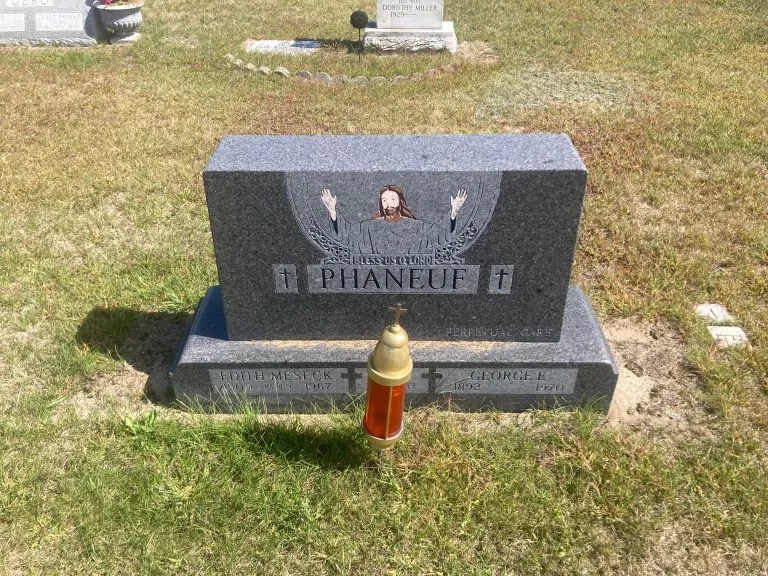
George and Edith Phaneuf’s grave in Saint Ann’s Cemetery, Mooers Forks, NY

Source: author’s personal collection

Visitors entering St. Ann’s Cemetery in Mooers Forks are often drawn first to the rustic, tiered fieldstone structure overlooking the cemetery’s rear grounds or the sharp, clear chittering of songbirds darting between the surrounding thickets. Along the northern border of the cemetery stands a row of modest granite monuments marking more than three generations of one family. Among them rests Edith Meseck Phaneuf. Like so many gravestones, hers offers only the barest hints of a life lived: a name, two dates, and the quiet certainty that someone once mattered deeply to those left behind.1 It says nothing of the rhythms that measured Edith’s days—the lowing of dairy cattle before dawn, the roar of water rushing through the mill race, the laughter of children gathered around a kitchen table, or the familiar hymns that drifted through the house after supper.

While women such as Edith often only survive in the historical record through census schedules, church registers, and death certificates, communities across northern New York were sustained as much by women like her as by the farmers who tilled its fields or the lumbermen who harvested its forests. Their labor was measured not in acres cleared or board feet cut, but in meals prepared, children raised, gardens tended, illnesses endured, and families held together through decades of change.

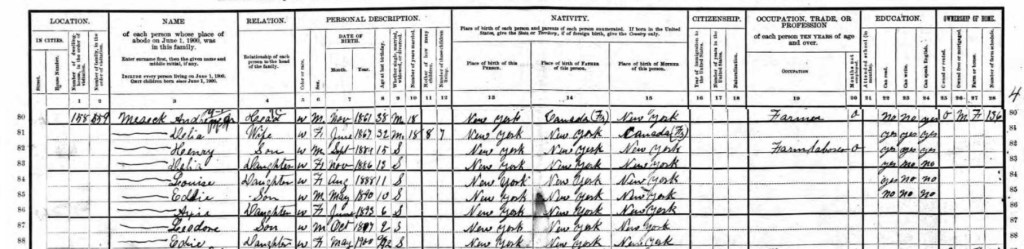
Edith’s first appearance in the federal census as a newborn in the house of Andrew and Delia Meseck

Source: 1900 US census, Clinton County, New York, population schedule, Mooers Township.

Edith’s story began on May 14, 1900, along Bush Road in Mooers Forks, where she was born into one of the many French-Canadian families who had crossed the nearby border in search of opportunity. When the federal census taker visited the Meseck farm a little more than a month later, he found a household already bustling with six older children. Henry, Delia, Mary Louise, Eddie, Achsah, and little Theodore crowded the farmhouse with their parents, Andrew and Delia. Just one farm away lived her grandparents, Andrew Sr. and Sophie, along with several uncles and cousins.2 For Edith, family was not an occasional gathering but the landscape of everyday life where childhood was shared, work was constant, and family was never far away.

The rhythms of Edith’s labor reflected the rhythms of the wider French-Canadian community. Edith likely moved effortlessly between French and English, speaking one language around the kitchen table and another whenever the outside world demanded it. The parish church anchored village life. Extended families lived within walking distance of one another, sharing harvests, baptisms, weddings, and eventually funerals. Church bells marked more than the hour—they measured the spiritual rhythm of the community itself. 

As Edith grew, she would have learned to understand the world through its sounds. Before she turned seven, four younger siblings had joined the household, so silence was almost unknown. There was always another baby crying, a pot boiling, a door opening, or another chore calling someone away.3 Children like Edith would start to recognize each sound instinctively. Before she could read a clock, she could likely tell whether her mother needed help simply by the tone of a baby’s cry as every member of the household contributed according to age and ability. Edith grew up understanding that caring for others was neither exceptional nor optional: it was simply what families did.

Her childhood gradually gave way to responsibility. The infants she once watched became younger siblings she helped dress, feed, and shepherd away from the woodstove or the busy barnyard. The farmhouse vibrated with the rhythms of work: the steady churn of butter, the hiss of hot irons, the scrape of chairs across worn floorboards, and the murmur of French and English voices woven together through the day.

By age nine, Edith’s days often would have begun in the dark of the dairy barn. She learned the heavy rhythm of farm labor through the sound of shifting hooves, the low grunts of cattle, and the sharp metallic ping-ping-ping of warm milk striking the bottom of an empty tin pail. As the bucket filled, the ringing softened into a dense, frothy hush while her fingers repeated the same motion again and again.

From the barn she moved directly into the farmhouse kitchen, where another kind of labor awaited: bread dough thudding onto the table, potatoes peeled for a growing family, laundry scrubbed on a washboard, and younger children needing attention the moment her hands were wiped dry.

Yet even as the farmhouse walls seemed to strain under the weight of so many children, the Meseck world continued to grow in new ways. By the time Edith appeared in the 1910 federal census, the household itself had become smaller, even as the family around it expanded.4 Three of her older siblings had married and established homes of their own: Henry, who married Rosina by 1905; Mary Louise, who married Archie Longtin the following year; and Delia, who wed John Belrose during the winter of 1907.5 Henry settled on the neighboring farm, where he and Rosina had already welcomed Edith’s first niece.6 Then, only months after the census taker visited Bush Road, Eddie married Hattie Phaneuf, quietly linking another French-Canadian family to the Mesecks through marriage.7 The babies Edith had once helped care for were now joined by nieces and nephews, transforming holiday gatherings into a joyful tumult of cousins, overlapping conversations, and the sounds of yet another generation beginning its own story. 

Although Edith’s formal schooling ended after the fifth grade, her education continued in the fields, barns, and kitchen of the Meseck farm. By the time she entered her teens—and became the oldest child still living at home by 1915—the work demanded of her had grown steadily heavier.8 Haying season filled the fields with the hiss of scythes and the clatter of horse-drawn machinery, while autumn brought the thud of potatoes dropping into burlap sacks and the ache of cold hands working through the first frosts. Inside the house, winter preparations seemed endless: clothes mended on a sewing machine, laundry boiled and wrung out by hand, and meals prepared for a household that never stayed quiet for long. By then, Edith was no longer merely helping with chores. She had become essential to the work that kept a large French-Canadian farm family functioning. 

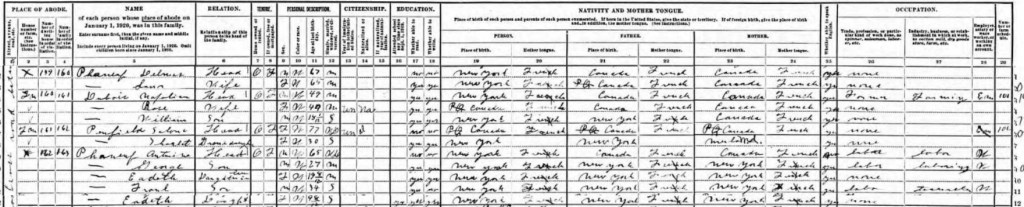
Edith and George living with George’s father in 1920 with George’s uncle Dames living nearby as well

Source: 1920 US census, Clinton County, New York, population schedule, Champlain Township.

On November 25, 1919, nineteen-year-old Edith married George Phaneuf at St. Ann’s Church in Mooers Folks.9 No surviving record describes their courtship, but Eddie’s marriage to George’s sister, Hattie, in 1911 had already brought the Phaneuf and Meseck families into one another’s orbit. Like so many young couples of their generation, they entered marriage carrying little wealth but abundant determination. George earned his living wherever wages could be found, labor which increasingly drew him to Perry’s Mills and its thriving lumber industry. In 1920, the young couple lived with George’s father Antone and George’s brother Frank, and the census taker noted every member of the household had a native tongue of French, hinting once more at the duality of French-Canadian families’ existence on the border.10

During their first five years of marriage, the sounds inside the Phaneuf home changed dramatically. Floyd arrived in October 1920, Lorena in December 1922, and Kenneth in February 1925.11 Once again, Edith found herself living in a household shaped by infancy, where the soft scuffle of little feet, the competing pitches of toddlers, and the scrape of wooden toys across pine floorboards became the soundtrack of daily life. 

Across the narrow lane from Edith and George’s home stood the Perry’s Mills sawmill. For the next half century, it would shape the lives of the Phaneuf family as surely as the Meseck farm had shaped Edith’s childhood. It provided George’s livelihood, later employed several of their sons, and imposed its own relentless rhythm upon the village. Long before a clock announced the hour, the mill told Perry’s Mills when to wake, when to work, and when another day had begun. 

Every morning the mill announced itself before anyone could see it. The sudden rush of water in the trace through the opened headgate echoed across the Great Chazy River, followed moments later by the slow, deliberate turning of the waterwheel. Then came the saw—a high, metallic whine that deepened into a guttural growl as its teeth bit into fresh pine. The scrape of logs, the clatter of gears, and the shouted voices of men merged into a familiar chorus which drifted across the lane to the Phaneuf home. Like the rooster on Bush Road during Edith’s childhood, the mill machinery now dictated the rhythm of another stage of her life. 

By 1930, Edith had given birth to two more children: Leo Ross in 1927 and Pauline Georgianna in 1929.12 When the census taker arrived in spring, he found Edith expecting her sixth child, a daughter she and George would name Geraldine after her birth in November.13 The Phaneuf household was growing rapidly, but so too was the network of family surrounding it. Edith’s uncle Frank Meseck had also settled in Perry’s Mills, joining George at the sawmill.14 Once again, the familiar pattern of French-Canadian life repeated itself: work, family, and kinship remained closely intertwined.

Among Edith’s descendants, one memory has endured without documentary confirmation — that she lost one, perhaps two, children in infancy, one of them possibly named Gerald. Whether the records have simply been lost or the story has changed in the telling can no longer be known. The tradition itself, however, speaks to the way grief can persist within families even after the documents have disappeared. 

While the sawmill supplied George’s wages, Edith’s garden transformed those wages into security. The garden answered the mill in its own currency: not board feet, but meals that carried the family through another North Country winter. Each spring, she planted potatoes, beans, carrots, onions, cabbage, squash, and other vegetables to feed the household through the coming months. The work was familiar. Edith had learned these rhythms as a girl on Bush Road, watching her mother preserve summer’s abundance against the certainty of a North Country winter. Now the sounds belonged to her own garden.

Summer brought constant weeding, watering, and harvesting, accompanied by the steady scrape of hoes through the soil and the chatter of children learning that gardens, like families, required everyone’s labor. When autumn arrived, the rhythm shifted indoors. The kitchen filled with the hiss of boiling water, the clink of glass jars lining the table, and the careful movements of hands working quickly before the first hard frost. Every basket from the garden represented groceries not otherwise purchased. Every jar sealed with a sharp, satisfying ping meant another meal safely stored against February’s cold. The children carried the finished jars to the pantry shelves, listening for familiar sounds promising security through another winter. Long before economists spoke of household budgets or unpaid labor, Edith understood a family’s survival depended not simply on what George earned at the mill, but on what she could coax from the soil and preserve for the months ahead.

The decade which followed brought no slowdown to the rhythms of the Phaneuf household. Dale arrived in 1932, Aurel in 1936, Joyce in 1938, Lorna Jean in 1940, and finally Elden Kurt in May 1942.15 By then Edith had spent more than two decades in a nearly unbroken cycle of pregnancy, birth, and infancy where the sounds of her household had barely changed shape. In 1942, the cycle doubled upon itself: as Edith carried her eleventh and final child, her eldest son Floyd and his wife awaited the birth of their first.16 Grandmother and daughter-in-law, mother and mother-to-be, moved through the same months of the same year toward the same reward. For a family which had always measured its wealth in kinship rather than currency, there could hardly have been a clearer sign that the work of one generation was passing intact into the hands of the next.

Edith’s parents Andrew and Delia circa 1935

Source: copy in author’s personal collection

The same period carried loss as well as renewal. In October 1941, Edith’s father, Andrew, died at seventy-nine, after a fall from a wagon: the same physical labor that had shaped the rhythm of his entire working life had finally ended it.17 The man whose farm on Bush Road had once organized Edith’s earliest understanding of the world—the rooster’s crow, the shifting hooves in the dairy barn, the ping of milk striking a tin pail—was gone. Sixty-five years of that soundscape now belonged only to memory. 

The war reshaped the household’s rhythm again, more abruptly. Floyd and Kenneth both served—Floyd in the Pacific theater, and again, years later, in Korea.18 For the first time since her own childhood on Bush Road, Edith’s household fell quiet with an absence she could not fill by any of the labors she knew. There was no garden to plant that could bring a son home sooner, no jar to seal that could keep him safer. The mill across the lane never missed a beat. The saw kept biting into pine. The whistles still marked the hours. But two of the voices once part of that daily rhythm were somewhere else, beyond the reach of any sound she could make. It would not be the last time Edith would learn to live inside silence—the not-knowing of when, or whether, a child who left home would come back to it.

Her mother, Delia, died in January 1948, at eighty.19 With her death, Edith lost the last of the two people who had built the world she was born into. The Meseck farmhouse on Bush Road now existed only in the memories of the children who had once filled it.

Edith and grandson Randall circa 1950

Source: copy in author’s possession from Don Phaneuf’s original with creases and blemishes improved by AI

By 1950, the sound of a new generation had already returned to the Phaneuf house on Mill Street. The census taker found a two-year-old grandson, Randall, living under Edith and George’s roof alongside his mother, Geraldine, and Edith’s youngest children.20 It was a household still doing what it had always done—absorbing whoever needed a bed, a meal, a place at the table—and Randy, too young to remember any of it later, spent his earliest years within the sounds of his grandmother’s kitchen.

1956 brought a loss that no parent expects to survive. Her daughter Lorena, thirty-three years old, died of a brain aneurysm.21 It was a foreshadowing of things to come.

Six years later, in September 1962, fire claimed the house itself.22 An oil stove exploded inside the Mill Street home where Edith and George had lived since the earliest years of their marriage—the home that had watched eleven children grow, filled on happier nights with music and dancing, and absorbed the sounds of family life: the churn of butter, the hiss of irons, the ping of canning jars, a newborn’s cry answered by an older sibling’s footsteps in the dark. That night the house found a different voice—the crack and groan of old timbers giving way, the hiss of water thrown against flames too late to save anything, and finally, beneath the shouts of neighbors and volunteer firemen, the particular silence that settles after a fire when nothing remains to save. Furniture and possessions gathered over four decades vanished in a single night. George and Edith responded as they always had in the face of hardship: they turned to family, moving in with Geraldine and her household until they could begin again. There was no drama in their response, only recognition—the same instinct, honed over a lifetime, that had once turned a garden’s harvest into a family’s security now turned grief into the ordinary work of enduring it. The house that had witnessed so many beginnings now survived only in memory.

As Edith entered her sixties, another chapter of loss began unfolding. The brothers and sisters who had once crowded the Meseck farmhouse on Bush Road—children who had shared chores, laughter, arguments, church services, and the countless ordinary moments that make a family—began disappearing one by one.

Mary Louise died in January 1963. Only weeks later, Edward followed. Sister Delia died in 1965, followed the same year by Henry. Theodore passed away the following year.23

Five siblings.

Barely three years.

For anyone, such losses would have been difficult.

For Edith, they marked the gradual disappearance of witnesses from her childhood. There were fewer people to recall the voices around their parents’ table, the games played as children, the work expected of every member of the family, or the stories told in French during long winter evenings. With each funeral another shared memory was buried, another link to the world of her youth quietly severed.

As Edith mourned the loss of siblings and in-laws, she found herself confronting her own physical decline. Years of labor that had carried her from Bush Road to Mill Street became increasingly difficult as health problems accumulated. Surgery to remove a goiter marked one turning point, but more troubling were the heart ailments that gradually limited the movement of a woman who had spent her life in motion. The world that had once stretched from fields and gardens to church and mill slowly contracted to the rooms of her own home, where she spent more time listening than doing. 

By the final weeks of her life, the sprawling, sunlit garden of Edith’s youth had shrunk to the quiet confines of a kitchen, and the loud chatter of the Meseck house full of six children at Edith’s birth had given way to the distant updates of a radio broadcast. Yet, the instinct to sustain her family never faltered. The woman who had spent decades measuring her family’s security in jars of canned vegetables was now measuring it in samples of laundry soap, the safety of a grandson, and a chicken meant for her daughter’s supper.

When a sudden car accident shook the family, it was Edith—despite her own failing health—who orchestrated the response, sending George to check on the injured while she sat by the radio, absorbing the fragile nature of life. In her final letters to her daughter Geraldine, written in a shaky but determined hand, the full weight of Edith’s lifelong role as the family anchor comes into sharp, heartbreaking focus:

Dear Gerry,

how is Frank now: does he feel as sore as he did earlier. I was shock when Donnie came & told me this forenoon. Those darn Canadian did you listen to the news this noon. Four other Canadian car got in wreck and in one car both of them got kill and I think there is two other that got kill a man and a 21 year old women in one of the car that was kill. now you no when you leave home but you dont no if you will ever come back again. I hope papoose is not to bad either. Ross came over this noon and he said papoose is not to bad but I guess. when were young we dont notice that so much. I send your father to see Frank so I’ll no how he is to.

Love mom24

Even as her own body began to close in on her, Edith’s mind remained fixed on the practical, everyday needs of those she loved.

The final letter Edith sends to her daughter Geraldine

Source: copy in author’s possession from Don Phaneuf’s original

Her final written words to Geraldine read less like a goodbye and more like a continuation of the quiet, daily labor which had defined her entire life:

Dear Gerry,

Could you wash my sweater. just so I have it for Sunday. I forgot to give it to you this morning. do you need Ivory Snow. I am sending you that sample old Maple had. send me and here is that chicken maybe if you cook it for supper it’s still good (I hope so) any way as your Father dont eat that and for all I eat. I feel to sick right now to bother with it. I cant hardly walk. Donnie been working like a good all after noon.

Love mom25

There is a profound, quiet irony in Edith’s anxiety over these highway accidents. Neither she nor George had ever learned to drive; they had never owned an automobile. They had spent their lives navigating the world at a human pace—on foot, by the rhythms of the seasons, and within the tight geographic radius of the sawmill, the barn, and the garden. To Edith, the roaring modern world of highway speeds was a volatile, unpredictable place where life could be snuffed out in an instant. Her warning to Geraldine—“now you no when you leave home but you dont no if you will ever come back again”—was the honest prose of a matriarch who viewed the sudden acceleration of the mid-twentieth century with deep, protective caution.

But having looked out at a world moving terrifyingly fast, Edith’s perspective immediately shrank back to the confines of her own kitchen, where her own world was slowing to a final, permanent stop.

The woman who had spent decades on her feet—planting, weeding, hauling heavy baskets of wet laundry, and keeping a massive household afloat—was forced to make an admission that must have been harder to write than any warning about speeding cars: “I feel to sick right now to bother with it. I cant hardly walk.” For a lifetime, “bothering with it”—the chicken, the soap, the laundry, the welfare of her children—had been her entire purpose. In acknowledging she could no longer manage these quiet, daily acts of caretaking, she was signaling that the fierce, stubborn motion that had sustained her family for generations was finally spent. The boundary of her life had closed in.

Edith died just days later on Tuesday, November 14, 1967, at the age of sixty-seven. Three days later, her family gathered beneath the high, echoing rafters of St. Mary’s Church in Champlain for a solemn High Mass of Requiem. The air in the sanctuary was thick with the heavy, formal cadences of Latin prayers chanted by three reverends, while six local men—neighbors and friends—bore the weight of her casket out into the grey November afternoon.26 Absent was grandson Randy, the toddler who had once lived under Edith and George’s roof on Mill Street and grown up within the sound of his grandmother’s kitchen. Army basic training prevented his attendance — the larger outside world impacting Edith’s world one final time.

Edith’s funeral announcement from the local newspaper

Source: The North Countryman, November 23, 1967

The Mass was said within earshot of the new highway, its traffic moving at a pace and volume Edith had spent her final months regarding with open suspicion. Interstate 87 had been built to move people quickly between larger destinations — and in doing so, had passed Mooers Forks by. When the funeral procession turned west off the main road, it crossed back into the older, slower geography the highway had never touched: the same roads that had carried Edith from Bush Road to Perry’s Mills and back again for sixty-seven years. 

Her final destination was St. Ann’s Cemetery, the quiet plot of earth resting just a few miles from the old Meseck family farm on the Bush Road.27 There, at St. Ann’s, the sound of the Northway could no longer be heard at all. Mooers Forks had been passed over by the modern world in the same year it received her—spared, whether by neglect or fortune, from the acceleration that had so unsettled her in her final letters. In its place emerged the older acoustics of the North Country landscape that had first welcomed her as a girl: the long, low sigh of a November breeze through the pines along Woods Falls Road—carrying with it the quiet, enduring peace of her childhood home. Those were the sounds that welcomed Edith home.

End notes

  1. Find A Grave, “Edith Meseck Phaneuf (1900–1967),” Memorial 32873762, Saint Ann’s Cemetery, Mooers Forks, Clinton County, New York, accessed July 15, 2026, https://www.findagrave.com/memorial/32873762/edith-phaneuf. There are many different spellings for both the Meseck and Phaneuf family names; I’ve adopted the ones that the family members chose to use on their gravestones. Additionally, this tale heavily benefitted from the memories and documents preserved by my cousin Don.
  2. 1900 US census, Clinton County, New York, population schedule, Mooers Township, Andrew Mesack household, dwelling 158 family 159, digital image, Ancestry (http://www.ancestry.com: accessed July 15, 2026); citing National Archives Microfilm Publication roll T623_31077_4114492, page 8B.
  3. 1910 US census, Clinton County, New York, population schedule, Mooers Township, Andrew Mesack household, dwelling 28 family 28, digital image, Ancestry (http://www.ancestry.com: accessed July 15, 2026); citing National Archives Microfilm Publication roll T624_932, page 3A.
  4. Ibid.
  5. 1905 New York state census, Clinton County, New York, population schedule, Mooers Township, Henry Mesick household, page 14, digital image, Ancestry (http://www.ancestry.com: accessed July 15, 2026). 1930 US census, Clinton County, New York, population schedule, Mooers Township, Archie Longtin household, dwelling 144 family 145, digital image, Ancestry (http://www.ancestry.com: accessed July 15, 2026); citing National Archives Microfilm Publication microfilm 2341151, page 7A. “New York State Marriage Index,” digital image, Ancestry (accessed July 15, 2026), entry for John Belrose and Delia Meseck, marriage January 20, 1907, Mooers Forks, New York; citing New York State Department of Health, Albany.
  6. 1910 US census, Clinton County, New York, population schedule, Mooers Township, Henry Mesack household, dwelling 29 family 29, digital image, Ancestry (http://www.ancestry.com: accessed July 15, 2026); citing National Archives Microfilm Publication roll T624_932, page 3A.
  7. “New York, County Marriages, 1847-1849; 1907-1936,” digital image, Ancestry (accessed July 15, 2026), entry for Edward Mesick and Hattie Phoenuff, marriage April 24, 1911, Champlain, New York, film number 000863409.
  8. 1940 US census, Clinton County, New York, population schedule, Champlain Township, George Pheneuf household, household 31, digital image, Ancestry (http://www.ancestry.com: accessed July 15, 2026); citing National Archives Microfilm Publication roll T627_2516, page 10B. 1915 New York state census, Clinton County, New York, population schedule, Mooers Township, Andrew Mesack household, page 4, digital image, Ancestry (http://www.ancestry.com: accessed July 15, 2026).
  9. “New York, County Marriages, 1847-1849; 1907-1936,” digital image, Ancestry (accessed July 15, 2026), entry for George Pheneuf and Edith Mesick, marriage September 1, 1919, Mooers Forks, New York, film number 000863409.
  10. 1920 US census, Clinton County, New York, population schedule, Champlain Township, Antoine Phaneuf household, dwelling 162 family 163, digital image, Ancestry (http://www.ancestry.com:accessed 2025); citing National Archives Microfilm Publication, Roll T625_1094, Page: 8A.
  11. 1925 New York state census, Clinton County, New York, population schedule, Champlain Township, George Pheneuf household, page 35, digital image, Ancestry (http://www.ancestry.com: accessed July 15, 2026).
  12. 1930 US census, Clinton County, New York, population schedule, Champlain Township, George Pheneuf household, dwelling 92 family 93, digital image, Ancestry (http://www.ancestry.com: accessed July 15, 2026); citing National Archives Microfilm Publication, Roll 1416, Page: 5A.
  13. 1940 US census, Clinton County, New York, population schedule, Champlain Township, George Pheneuf household, household 31, digital image, Ancestry (http://www.ancestry.com: accessed July 15, 2026); citing National Archives Microfilm Publication roll T627_2516, page 10B.
  14. 1930 US census, Clinton County, New York, population schedule, Champlain Township, Frank Mesick household, dwelling 96 family 97, digital image, Ancestry (http://www.ancestry.com: accessed July 15, 2026); citing National Archives Microfilm Publication, Roll 1416, Page: 5B.
  15. 1940 US census, Clinton County, New York, population schedule, Champlain Township, George Pheneuf household, household 31, digital image, Ancestry (http://www.ancestry.com: accessed July 15, 2026); citing National Archives Microfilm Publication roll T627_2516, page 10B. 1950 US census, Clinton County, New York, population schedule, Champlain Township, George Phenuf household, house 22 dwelling 169, Ancestry (http://www.ancestry.com: accessed July 15, 2026); citing National Archives Microfilm Publication, NAID 43290879, Sheet: 22.
  16. 1950 US census, El Paso County, Colorado, population schedule, Camp Carson, Floyd Phaneuf household, house 2954 dwelling 455, digital image, Ancestry (http://www.ancestry.com: accessed July 15, 2026); citing National Archives Microfilm Publication, NAID 43290879, Sheet: 50.
  17. “Andrew Messick, 87, Mooers Forks, Dies,” Plattsburgh Daily Press, October 22, 1941, 3, col. 5. While the article notes age 87, I have adopted the age in other historical records and from Andrew Mesick’s grave.
  18. U.S., World War II Army Enlistment Records, 1938–1946, database, Ancestry (accessed July 15, 2026), entry for Floyd G. Phaneuf, service no. 42121414, enlisted February 8, 1944, Albany, New York.
  19. Find A Grave, “Delia Baker Meseck (1867-1948),” Memorial 168875012, Saint Ann’s Cemetery, Mooers Forks, Clinton County, New York, accessed July 15, 2026, https://www.findagrave.com/memorial/168875012/delia-meseck.
  20. 1950 US census, Clinton County, New York, population schedule, Champlain Township, George Phenuf household, house 22 dwelling 169, digital image, Ancestry (http://www.ancestry.com: accessed July 15, 2026); citing National Archives Microfilm Publication, NAID 43290879, Sheet: 22.
  21. Find A Grave, “Lorena Guerin (1922–1956),” Memorial 32873721, Saint Joseph’s Cemetery, Coopersville, Clinton County, New York, accessed July 15, 2026, https://www.findagrave.com/memorial/32873721/lorena-guerin. “Reports of Deaths of American Citizens Abroad, 1835–1974,” digital image, Ancestry (accessed July 15, 2026), Lorena Phaneuf Guerin death report, February 24, 1956; National Archives and Records Administration, Record Group 59 (General Records of the Department of State), Entry 205, Box 971.
  22. “Fire Routs Family of 3,” Plattsburgh Press-Republican, September 4, 1962.
  23.  Find A Grave, “Mary Louise Mesick Longtin (1888-1963),” Memorial 64282637, Saint Ann’s Cemetery, Mooers Forks, Clinton County, New York, accessed July 15, 2026, https://www.findagrave.com/memorial/64282637/mary-louise-longtin. Find A Grave, “Edward Meseck (1890-1963),” Memorial 63069377, Saint Ann’s Cemetery, Mooers Forks, Clinton County, New York, accessed July 15, 2026, https://www.findagrave.com/memorial/63069377/edward-meseck. Find A Grave, “Delia Meseck Belrose (1887-1965),” Memorial 168922400, Saint Ann’s Cemetery, Mooers Forks, Clinton County, New York, accessed July 15, 2026, https://www.findagrave.com/memorial/168922400/delia-belrose. Find A Grave, “Henry Andrew Meseck (1884-1965),” Memorial 168876564, Saint Ann’s Cemetery, Mooers Forks, Clinton County, New York, accessed July 15, 2026, https://www.findagrave.com/memorial/168876564/henry_andrew-meseck. “Leodore Messeck Dies; Leaves 90 Descendants,” The Springfield Union, May 31, 1966, 26, col. 4.
  24. Edith Phaneuf to Geraldine Parker, letter, November 1967, copy in the possession of the author.
  25. Ibid.
  26. “Mrs. Edith Phaneuf,” Press-Republican, November 18, 1967, 6, col. 4-5. “MRS. EDITH PHANEUF,” The North Countryman, November 23, 1967, 4, col. 3-4.

Frederick’s Tale

Frederick Fitch’s grave in Maple Hill Cemetery, Champlain, NY

Source: author’s personal collection

Frederick Fitch’s grave lies tucked away in Maple Hill Cemetery on a small rise bordered by the steady hum of traffic along a state highway in Champlain, New York. There he rests beside his wife, their unadorned markers recording only their names and years, the brief inscriptions fading beneath lichen and age. Nothing in those simple inscriptions suggests the long journey that brought them to Champlain from New England or the changing rural world through which they passed. Yet Frederick’s life traces the broader story of many men born in the closing years of the eighteenth century—men who cleared new farms, raised families on uncertain land, and labored through the slow transformation of nineteenth-century America.

Frederick Fitch was born when the young American republic was still defining its ideals. He came into the world in Coventry, Connecticut, on February 27, 1785, the son of John and Anna Fitch—four years before the adoption of the Constitution by the United States. His father, a veteran of the Revolutionary War, was the youngest son in a world where younger sons faced challenges. Primogeniture, though legally weakened after the Revolution, remained powerful in custom, still steering land toward eldest sons and forcing younger ones to find their own path. Historian Paul E. Johnson has described the moral and social pressure this created among New England farmers: “New England men…grew up confronting two uncomfortable facts. The first was the immense value their culture placed on land ownership… the second was that in the late eighteenth century increasing numbers of men owned no land.”1 As Johnson’s observation suggests, opportunity was scarce in older towns. In Coventry’s population of 2,130 in 1790, younger men like John Fitch had little chance of securing a homestead. By 1800, he had moved his family, including 15-year-old Frederick, to Chittenden County, Vermont, where he was documented as farming his own land by 1820.2 John also served as a constable and justice of the peace—a man who had fought for the nation’s creation and then returned home to uphold its laws.3 For men like John Fitch, landownership was both the reward and the proof of independence. In the agrarian imagination of early America, land was not merely property; it was the moral foundation of citizenship.

By the time Frederick reached adulthood, he faced the same challenge his father had known: farmland in Vermont was dwindling, and his older brother, John, would eventually inherit the family farm. In the early nineteenth century, the quest for land drew New England’s sons westward and northward in search of independence and opportunity. The frontier, once bounded by the Hudson River, had shifted into the Adirondack borderlands and the northern reaches of New York, Vermont, and Maine—regions whose forests and meadows offered the independence that New England’s settled towns could no longer provide.4 

Frederick’s own journey followed that course. On February 10, 1813, at age twenty-seven, he married Nancy Bunker in Huntington, Vermont, one of the mountain towns that had flourished during the state’s post-Revolutionary settlement boom.5 Their early years were likely marked by hardship and hope in equal measure. By the time their first children—Adaline, Theodore, and Henry—were born before 1816, the couple was looking toward the Champlain Valley. By 1820, Frederick and Nancy followed his older brother Solomon across the lake to settle in Champlain, a swiftly expanding agricultural settlement at Clinton County’s northern extremity on the Canadian border.6

Champlain was a frontier town in transition when Frederick arrived. Between 1810 and 1820, its population exploded from 1,210 residents to 1,618—a 34% increase in a single decade.7 Roads were poor, and winters severe, but the land was cheap and fertile, and for men like Frederick, that was enough. In the 1820 census, he appears as a farmer, head of a household of five, with two members “engaged in agriculture.”8 It was the modest beginning of a dream that had defined generations: the transformation of wilderness into home.

To the modern reader, the phrase “independent farmer” may evoke pastoral simplicity, but in the 1820s it carried a dense web of moral, religious, and political meaning as well. The value of a freehold farm extended well beyond its acres; it sustained a moral order that defined a man’s autonomy, his role within the family, and his place in the republican nation. For men like Frederick, these ideals were not abstractions but the framework of daily life. Independence meant steady labor. His children grew alongside the farm, contributing their hands to the cycles of planting and harvest. By 1830, nine people lived in the household—parents, sons, and daughters—forming the core of the agricultural workforce centered in the household. By 1840, that number had grown to eleven. Their daily lives would have followed the rhythm of the northern seasons: clearing fields in spring, haying and harvesting through summer and fall, and enduring long winters of mending tools, carding wool, and cutting firewood.9

The Fitch household in 1850 that included Frederick, Nancy, and their children and daughter-in-law Sarah

The Fitch household in 1850 that included Frederick, Nancy, and their children and daughter-in-law Sarah

Source: 1850 US census, Clinton County, New York, population schedule, Champlain Township.

By the 1850s, the family’s long years of labor had matured into a measure of stability—even as the rural world around them was beginning to shift.10 The 1850 federal census records a nine-person household ranging in age from 14 to 65: Frederick (65) and his wife Nancy (58); their son Henry (34) and his wife Sarah (27); sons Charles (27), Frederick Jr. (20), and John (16); and daughters Abigail (24) and Louisa (14). Four men in the household—Frederick, Henry, Charles, and Frederick Jr.—were listed as farmers, a concentration of adult male labor that helps explain the family’s relative prosperity. The farm itself was valued at $4,000, a substantial figure for Clinton County and one notably above the Champlain township average of $2,763.11 

The 1850 agricultural census reveals a farm organized with care and conscious balance. Fitch’s one hundred acre operation—eighty acres improved and twenty in woodlot or pasture—placed him in roughly the upper 40% of Champlain farms by size. His ratio of improved to unimproved land was notably more intensive than the township average (seventy-five improved to fifty-six unimproved), indicating a farm more fully cleared and actively cultivated than most of his neighbors’. This level of improvement likely reflects the presence of four adult men in the household, whose labor made such sustained clearing and cultivation possible. Fitch’s livestock holdings further point to a diversified and comparatively prosperous enterprise. With three horses, seven milk cows, seven other cattle, and thirty sheep, the Fitch herd exceeded local averages in every category except horses, marking the family as part of the township’s substantial middle tier of agricultural producers.12

The presence of sheep offers another window into the household economy of the Fitch farm. Of the 220 farmers in Champlain in 1850, 166 (roughly 75%) kept sheep. Frederick’s flock of thirty placed his household in the top 15% of owners with wool production even higher. Maintaining such a sizable flock was a deliberate choice enabled by the household economy fueled by the women who traditionally bore responsibility for wool processing and textile preparation. Wool production would have provided the Fitch family with yet another commodity for exchange, one that could be bartered for skilled services such as blacksmithing or coopering. In this way, the flock reflects not only household capability but also the family’s strategic engagement with the local economy.13

The farm’s cropping pattern likewise reflects a household transitioning from self-sufficient yeomanry to active participants in a changing market economy. Of the 220 farms in Champlain, all but sixteen harvested wheat in 1850; even in this near-universal crop, the Fitch family’s yield of 170 bushels placed them within the top 15% of local producers. Their 250 bushels of oats similarly exceeded the town average, ranking them in roughly the top 20%. In butter and cheese production, however, the Fitch household reached its highest standing: their butter output placed them among the top 10% of producers in Champlain, while their cheese production ranked in the top 16%—almost certainly the result once more of a household economy driven by the Fitch women.14 In practical terms, the family not only sustained itself comfortably but also produced surpluses for sale, revealing their growing engagement with the market economy.

1856 map of Champlain showing the location of the Fitch farm nearby to the railroad and Canadian border

1856 map of Champlain showing the location of the Fitch farm nearby to the railroad and Canadian border

Source: Ligowsky, A. Map of Clinton Co., New York. Philadelphia: O.J. Lamb, 1856. Map. https://www.loc.gov/item/2009583837/.

As Frederick achieved independence, the world around him was changing. By the 1850s, upstate New York was no longer the frontier. The Ogdensburg and Lake Champlain Railroad, with its eastern terminus ending in Champlain within sight of the Fitch farm, connected the farmlands of northern New York to rapidly growing cities in the northeast and southern Canada.15 Market integration was transforming the region, binding farmers to distant prices and urban demand. The ideal of the self-sufficient yeoman was giving way to the reality of a competitive market economy as the expanding Midwest and improved rail transport flooded eastern markets with cheaper grain, forcing smallholders to specialize or scale back.16

The broader regional trends became more visible in the 1860 census, where the value of Fitch’s farm had declined modestly to $3,500 from $4,000 a decade earlier. More significant than the decrease in land value, however, was the contraction of the household itself. By 1860, only four people remained at home: Frederick and Nancy, along with two of their sons, Charles and Frederick Jr. As sons and daughters married or moved away to establish their own households, the loss of labor—particularly the women who had supported dairying and textile production—caused the farm’s outputs to align more closely with township averages in both livestock and crop yields. The number of horses fell from three to two, and milk cows from seven to four. The sheep flock, which had numbered thirty in 1850, had fallen to five, a clear sign that the labor-intensive wool work could no longer be sustained.17 This change also reflected broader economic shifts: as textile production became increasingly industrialized in New England, the Fitch family would no longer rely on household wool as a viable commodity for trade.

In nearly every respect, Fitch’s production now fell slightly below Champlain’s township averages. His crop yields tell the same story: thirty-six bushels of wheat (compared to a town average of forty-six), forty of corn (below the average of sixty-nine), and 500 of oats (somewhat above the typical 436). The continued emphasis on oats may indicate a pragmatic shift toward fodder crops to support a reduced herd rather than a focus on commercial grain sales. His potato harvest (100 bushels, against a local mean of 182) and his butter production (400 pounds, compared to a township average of 380)—further reflect a scaled-back operation aimed at subsistence with limited surplus. Together, these figures depict a farm adjusting to diminishing household labor and the aging of its patriarch, rather than one actively expanding or seeking profit in an increasingly competitive agricultural economy.18

Such contraction was not unusual. Across the North, aging farmers often found themselves unable to keep pace with the accelerating modernization of agriculture. Mechanization, improved plows, reapers, and threshers, and new market-oriented breeds favored younger men with capital and ambition. The decline in Fitch’s equipment value (from $100 in 1850 to $75 in 1860) illustrates this generational divide.19 Frederick was nearing the end of his working life, still maintaining the land that had sustained his family for more than four decades, but now doing so on a reduced scale. His two sons almost certainly managed the physically demanding work their father could no longer perform.20

Seen through the 1860 census, the Fitch farm captures a pivotal moment in the transformation of northern agriculture: a household that had begun in the spirit of yeoman self-sufficiency now operated within an increasingly integrated market economy. No longer was the household economy a primary driver in decision making. The adjustments visible in Frederick’s final decade—the contraction of livestock, shifts in cropping patterns, a move toward selective specialization, and a smaller household—suggest not simple decline but a farmer responding pragmatically to changing prices, labor shortages, and regional competition while his family aged and began to seek out their own opportunities. Even late in life, Frederick was not merely enduring agricultural change but negotiating it, adapting his practices to the new economic currents reshaping rural New York.

The 1860 census showed Frederick’s household shortly before he passed away in July 1860

Source: 1860 US census, Clinton County, New York, population schedule, Champlain Township.

By the time Frederick died in Champlain on July 27, 1860, at the age of 75, the society he had helped build was giving way to a new one. The Civil War loomed, ushering in an age of industrialization, urban growth, and restless movement that favored younger men better positioned to adopt the increasingly capital-intensive practices reshaping American agriculture. Some pressed farther west, pursuing the same agrarian dream that had once brought Frederick to the Champlain frontier—a chance to own land, raise a family, and live by their labor. Viewed through census data and agricultural returns, Fitch’s life may appear ordinary, yet within those numbers lies the story of a man whose choices reflected the broader economic transformation of the American countryside. To read Frederick’s story is to glimpse a central thread in the American experience: the enduring search for rootedness in a world of movement. That legacy endures in Champlain today, where the Fitch farm remains in the hands of his descendants—a rare continuity in a region where most family farms have long since vanished.

Endnotes

  1. Paul E. Johnson, “The Modernization of Mayo Greenleaf Patch: Land, Family, and Marginality in New England, 1766–1818,” The New England Quarterly 55, no. 4 (December 1982): 489–490.
  2. 1800 US census, Chittenden County, Vermont, population schedule, Huntington Township, page 1, John Fitch household, digital image, Ancestry (http://www.ancestry.com: accessed 2025); citing National Archives Microfilm Publication M32, Roll 51. 1820 US census, Chittenden County, Vermont, population schedule, Huntington Township, page 1, John Fitch household, digital image, Ancestry (http://www.ancestry.com: accessed 2025); citing National Archives Microfilm Publication M33, Roll 127.
  3. “Chittenden County,” The Vergennes Gazette and Vermont and New-York Advertiser (Vergennes, Vermont, USA), November 1, 1798, 3, https://www.newspapers.com/.
  4. See Alan Taylor, Liberty Men and Great Proprietors: The Revolutionary Settlement on the Maine Frontier, 1760–1820 (Chapel Hill: University of North Carolina Press, 1990) for an overview of frontier settlement in the early republic. Taylor focuses on Maine but highlights the moral as well as economic motives for migration.
  5. “Nancy Bunker,” entry in “Geneanet Community Trees Index” 2022, Ancestry (http://www.ancestry.com: accessed 2025), record 7821956846.
  6. 1820 US census, Clinton County, New York, population schedule, Champlain Township, Frederick Fitch household, page 3, digital image, Ancestry (http://www.ancestry.com: accessed 2025); citing National Archives Microfilm Publication M33, Roll 66.
  7. Clinton County NYGenWeb, “The 1810 Census for Clinton County, New York,” accessed November 16, 2025, https://clinton.nygenweb.net/1810.htm. U.S. Census Office, Census for 1820 (Washington, DC: U.S. Census Office, 1821), 22, table of aggregates for New York State, Town of Champlain; https://www.census.gov/library/publications/1821/dec/1820a.html.
  8. 1820 US census, Clinton County, New York, population schedule, Champlain Township, Frederick Fitch household, page 3, digital image, Ancestry (http://www.ancestry.com: accessed 2025); citing National Archives Microfilm Publication M33, Roll 66.
  9. 1830 US census, Clinton County, New York, population schedule, Champlain Township, Frederick Fitch household, page 5, digital image, Ancestry (http://www.ancestry.com: accessed 2025); citing National Archives Microfilm Publication M19, Roll 85. 1840 US census, Clinton County, New York, population schedule, Champlain Township, Frederick Fitch household, page 15, digital image, Ancestry (http://www.ancestry.com: accessed 2025); citing National Archives Microfilm Publication Roll 276.
  10. See Christopher Clark, The Roots of Rural Capitalism: Western Massachusetts, 1780–1860 (Ithaca: Cornell University Press, 1990) for an overview of the broader social, economical, and ideological changes seen in a rural community from 1790-1860.
  11. 1850 US census, Clinton County, New York, population schedule, Champlain Township, Frederick Fitch household, dwelling 2879 family 3105, digital image, Ancestry (http://www.ancestry.com: accessed 2025); citing National Archives Microfilm Publication, Roll 490, Page: 454a.
  12. 1850 U.S. Census, Agricultural Schedule, Town of Champlain, Clinton County, New York, Frederick Fitch farm, page 2, line 35, digital image, Ancestry (http://www.ancestry.com: accessed 2025).
  13. Ibid.
  14. Ibid.
  15. Doherty, Lawrence. “General History of the O. & L. C. Railroad.” The Railway and Locomotive Historical Society Bulletin, no. 58A (1942): 91–98. http://www.jstor.org/stable/43504337.
  16. For more information on how Midwestern grain and the introduction of railroads forced changes to eastern agriculture, see William Cronon, Nature’s Metropolis: Chicago and the Great West (New York: W. W. Norton & Company, 1991).
  17. 1860 U.S. Census, Agricultural Schedule, Town of Champlain, Clinton County, New York, Frederick Fitch farm, page 6, line 2, digital image, Ancestry (http://www.ancestry.com: accessed 2025).
  18. Ibid.
  19. Ibid.
  20.  1860 US census, Clinton County, New York, population schedule, Champlain Township, Frederick Fitch household, dwelling 630 family 653, digital image, Ancestry (http://www.ancestry.com: accessed 2025); citing National Archives Microfilm Publication, Roll 653_736, Page: 657.