
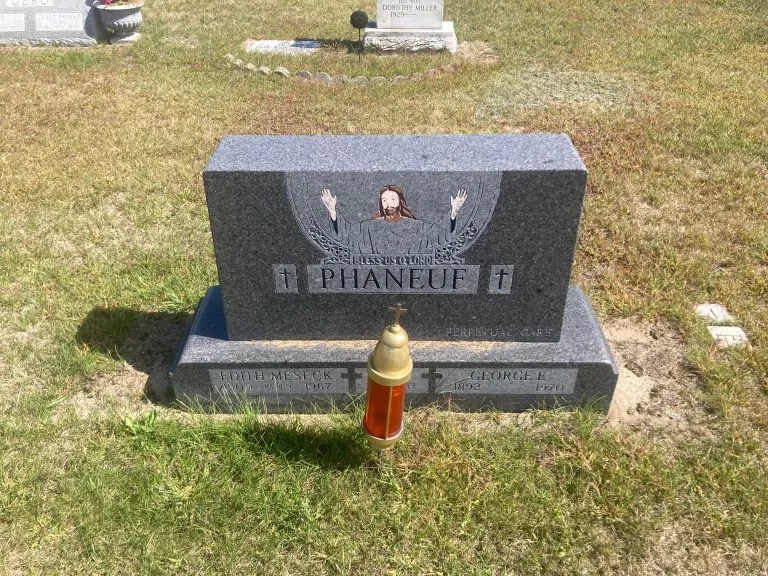
George and Edith Phaneuf’s grave in Saint Ann’s Cemetery, Mooers Forks, NY
Source: author’s personal collection
Visitors entering St. Ann’s Cemetery in Mooers Forks are often drawn first to the rustic, tiered fieldstone structure overlooking the cemetery’s rear grounds or the sharp, clear chittering of songbirds darting between the surrounding thickets. Along the northern border of the cemetery stands a row of modest granite monuments marking more than three generations of one family. Among them rests Edith Meseck Phaneuf. Like so many gravestones, hers offers only the barest hints of a life lived: a name, two dates, and the quiet certainty that someone once mattered deeply to those left behind.1 It says nothing of the rhythms that measured Edith’s days—the lowing of dairy cattle before dawn, the roar of water rushing through the mill race, the laughter of children gathered around a kitchen table, or the familiar hymns that drifted through the house after supper.
While women such as Edith often only survive in the historical record through census schedules, church registers, and death certificates, communities across northern New York were sustained as much by women like her as by the farmers who tilled its fields or the lumbermen who harvested its forests. Their labor was measured not in acres cleared or board feet cut, but in meals prepared, children raised, gardens tended, illnesses endured, and families held together through decades of change.
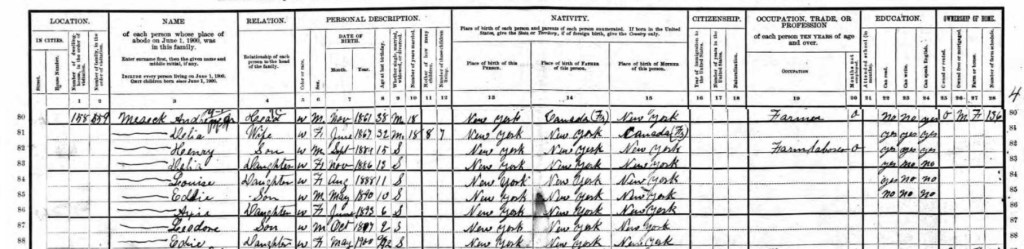
Edith’s first appearance in the federal census as a newborn in the house of Andrew and Delia Meseck
Source: 1900 US census, Clinton County, New York, population schedule, Mooers Township.
Edith’s story began on May 14, 1900, along Bush Road in Mooers Forks, where she was born into one of the many French-Canadian families who had crossed the nearby border in search of opportunity. When the federal census taker visited the Meseck farm a little more than a month later, he found a household already bustling with six older children. Henry, Delia, Mary Louise, Eddie, Achsah, and little Theodore crowded the farmhouse with their parents, Andrew and Delia. Just one farm away lived her grandparents, Andrew Sr. and Sophie, along with several uncles and cousins.2 For Edith, family was not an occasional gathering but the landscape of everyday life where childhood was shared, work was constant, and family was never far away.
The rhythms of Edith’s labor reflected the rhythms of the wider French-Canadian community. Edith likely moved effortlessly between French and English, speaking one language around the kitchen table and another whenever the outside world demanded it. The parish church anchored village life. Extended families lived within walking distance of one another, sharing harvests, baptisms, weddings, and eventually funerals. Church bells marked more than the hour—they measured the spiritual rhythm of the community itself.
As Edith grew, she would have learned to understand the world through its sounds. Before she turned seven, four younger siblings had joined the household, so silence was almost unknown. There was always another baby crying, a pot boiling, a door opening, or another chore calling someone away.3 Children like Edith would start to recognize each sound instinctively. Before she could read a clock, she could likely tell whether her mother needed help simply by the tone of a baby’s cry as every member of the household contributed according to age and ability. Edith grew up understanding that caring for others was neither exceptional nor optional: it was simply what families did.
Her childhood gradually gave way to responsibility. The infants she once watched became younger siblings she helped dress, feed, and shepherd away from the woodstove or the busy barnyard. The farmhouse vibrated with the rhythms of work: the steady churn of butter, the hiss of hot irons, the scrape of chairs across worn floorboards, and the murmur of French and English voices woven together through the day.
By age nine, Edith’s days often would have begun in the dark of the dairy barn. She learned the heavy rhythm of farm labor through the sound of shifting hooves, the low grunts of cattle, and the sharp metallic ping-ping-ping of warm milk striking the bottom of an empty tin pail. As the bucket filled, the ringing softened into a dense, frothy hush while her fingers repeated the same motion again and again.
From the barn she moved directly into the farmhouse kitchen, where another kind of labor awaited: bread dough thudding onto the table, potatoes peeled for a growing family, laundry scrubbed on a washboard, and younger children needing attention the moment her hands were wiped dry.
Yet even as the farmhouse walls seemed to strain under the weight of so many children, the Meseck world continued to grow in new ways. By the time Edith appeared in the 1910 federal census, the household itself had become smaller, even as the family around it expanded.4 Three of her older siblings had married and established homes of their own: Henry, who married Rosina by 1905; Mary Louise, who married Archie Longtin the following year; and Delia, who wed John Belrose during the winter of 1907.5 Henry settled on the neighboring farm, where he and Rosina had already welcomed Edith’s first niece.6 Then, only months after the census taker visited Bush Road, Eddie married Hattie Phaneuf, quietly linking another French-Canadian family to the Mesecks through marriage.7 The babies Edith had once helped care for were now joined by nieces and nephews, transforming holiday gatherings into a joyful tumult of cousins, overlapping conversations, and the sounds of yet another generation beginning its own story.
Although Edith’s formal schooling ended after the fifth grade, her education continued in the fields, barns, and kitchen of the Meseck farm. By the time she entered her teens—and became the oldest child still living at home by 1915—the work demanded of her had grown steadily heavier.8 Haying season filled the fields with the hiss of scythes and the clatter of horse-drawn machinery, while autumn brought the thud of potatoes dropping into burlap sacks and the ache of cold hands working through the first frosts. Inside the house, winter preparations seemed endless: clothes mended on a sewing machine, laundry boiled and wrung out by hand, and meals prepared for a household that never stayed quiet for long. By then, Edith was no longer merely helping with chores. She had become essential to the work that kept a large French-Canadian farm family functioning.
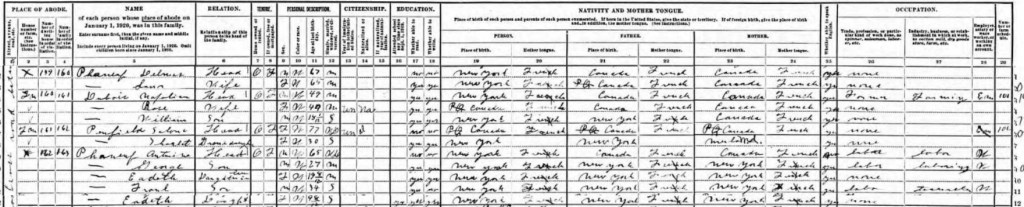
Edith and George living with George’s father in 1920 with George’s uncle Dames living nearby as well
Source: 1920 US census, Clinton County, New York, population schedule, Champlain Township.
On November 25, 1919, nineteen-year-old Edith married George Phaneuf at St. Ann’s Church in Mooers Folks.9 No surviving record describes their courtship, but Eddie’s marriage to George’s sister, Hattie, in 1911 had already brought the Phaneuf and Meseck families into one another’s orbit. Like so many young couples of their generation, they entered marriage carrying little wealth but abundant determination. George earned his living wherever wages could be found, labor which increasingly drew him to Perry’s Mills and its thriving lumber industry. In 1920, the young couple lived with George’s father Antone and George’s brother Frank, and the census taker noted every member of the household had a native tongue of French, hinting once more at the duality of French-Canadian families’ existence on the border.10
During their first five years of marriage, the sounds inside the Phaneuf home changed dramatically. Floyd arrived in October 1920, Lorena in December 1922, and Kenneth in February 1925.11 Once again, Edith found herself living in a household shaped by infancy, where the soft scuffle of little feet, the competing pitches of toddlers, and the scrape of wooden toys across pine floorboards became the soundtrack of daily life.
Across the narrow lane from Edith and George’s home stood the Perry’s Mills sawmill. For the next half century, it would shape the lives of the Phaneuf family as surely as the Meseck farm had shaped Edith’s childhood. It provided George’s livelihood, later employed several of their sons, and imposed its own relentless rhythm upon the village. Long before a clock announced the hour, the mill told Perry’s Mills when to wake, when to work, and when another day had begun.
Every morning the mill announced itself before anyone could see it. The sudden rush of water in the trace through the opened headgate echoed across the Great Chazy River, followed moments later by the slow, deliberate turning of the waterwheel. Then came the saw—a high, metallic whine that deepened into a guttural growl as its teeth bit into fresh pine. The scrape of logs, the clatter of gears, and the shouted voices of men merged into a familiar chorus which drifted across the lane to the Phaneuf home. Like the rooster on Bush Road during Edith’s childhood, the mill machinery now dictated the rhythm of another stage of her life.
By 1930, Edith had given birth to two more children: Leo Ross in 1927 and Pauline Georgianna in 1929.12 When the census taker arrived in spring, he found Edith expecting her sixth child, a daughter she and George would name Geraldine after her birth in November.13 The Phaneuf household was growing rapidly, but so too was the network of family surrounding it. Edith’s uncle Frank Meseck had also settled in Perry’s Mills, joining George at the sawmill.14 Once again, the familiar pattern of French-Canadian life repeated itself: work, family, and kinship remained closely intertwined.
Among Edith’s descendants, one memory has endured without documentary confirmation — that she lost one, perhaps two, children in infancy, one of them possibly named Gerald. Whether the records have simply been lost or the story has changed in the telling can no longer be known. The tradition itself, however, speaks to the way grief can persist within families even after the documents have disappeared.
While the sawmill supplied George’s wages, Edith’s garden transformed those wages into security. The garden answered the mill in its own currency: not board feet, but meals that carried the family through another North Country winter. Each spring, she planted potatoes, beans, carrots, onions, cabbage, squash, and other vegetables to feed the household through the coming months. The work was familiar. Edith had learned these rhythms as a girl on Bush Road, watching her mother preserve summer’s abundance against the certainty of a North Country winter. Now the sounds belonged to her own garden.
Summer brought constant weeding, watering, and harvesting, accompanied by the steady scrape of hoes through the soil and the chatter of children learning that gardens, like families, required everyone’s labor. When autumn arrived, the rhythm shifted indoors. The kitchen filled with the hiss of boiling water, the clink of glass jars lining the table, and the careful movements of hands working quickly before the first hard frost. Every basket from the garden represented groceries not otherwise purchased. Every jar sealed with a sharp, satisfying ping meant another meal safely stored against February’s cold. The children carried the finished jars to the pantry shelves, listening for familiar sounds promising security through another winter. Long before economists spoke of household budgets or unpaid labor, Edith understood a family’s survival depended not simply on what George earned at the mill, but on what she could coax from the soil and preserve for the months ahead.
The decade which followed brought no slowdown to the rhythms of the Phaneuf household. Dale arrived in 1932, Aurel in 1936, Joyce in 1938, Lorna Jean in 1940, and finally Elden Kurt in May 1942.15 By then Edith had spent more than two decades in a nearly unbroken cycle of pregnancy, birth, and infancy where the sounds of her household had barely changed shape. In 1942, the cycle doubled upon itself: as Edith carried her eleventh and final child, her eldest son Floyd and his wife awaited the birth of their first.16 Grandmother and daughter-in-law, mother and mother-to-be, moved through the same months of the same year toward the same reward. For a family which had always measured its wealth in kinship rather than currency, there could hardly have been a clearer sign that the work of one generation was passing intact into the hands of the next.
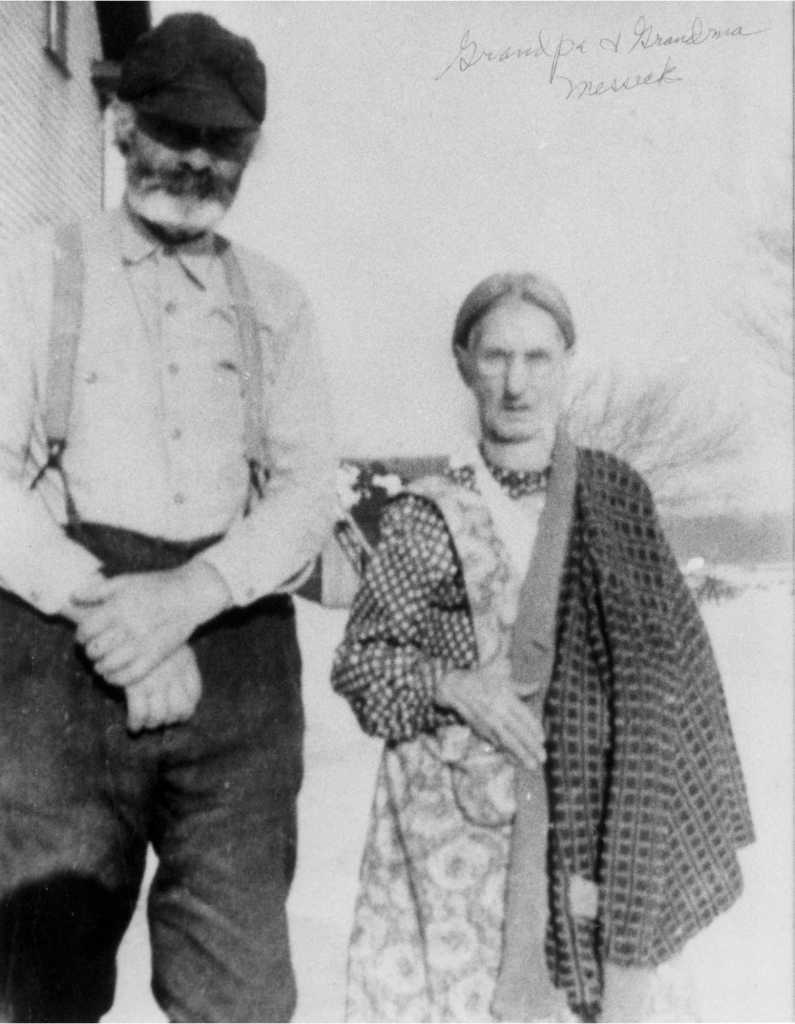
Edith’s parents Andrew and Delia circa 1935
Source: copy in author’s personal collection
The same period carried loss as well as renewal. In October 1941, Edith’s father, Andrew, died at seventy-nine, after a fall from a wagon: the same physical labor that had shaped the rhythm of his entire working life had finally ended it.17 The man whose farm on Bush Road had once organized Edith’s earliest understanding of the world—the rooster’s crow, the shifting hooves in the dairy barn, the ping of milk striking a tin pail—was gone. Sixty-five years of that soundscape now belonged only to memory.
The war reshaped the household’s rhythm again, more abruptly. Floyd and Kenneth both served—Floyd in the Pacific theater, and again, years later, in Korea.18 For the first time since her own childhood on Bush Road, Edith’s household fell quiet with an absence she could not fill by any of the labors she knew. There was no garden to plant that could bring a son home sooner, no jar to seal that could keep him safer. The mill across the lane never missed a beat. The saw kept biting into pine. The whistles still marked the hours. But two of the voices once part of that daily rhythm were somewhere else, beyond the reach of any sound she could make. It would not be the last time Edith would learn to live inside silence—the not-knowing of when, or whether, a child who left home would come back to it.
Her mother, Delia, died in January 1948, at eighty.19 With her death, Edith lost the last of the two people who had built the world she was born into. The Meseck farmhouse on Bush Road now existed only in the memories of the children who had once filled it.
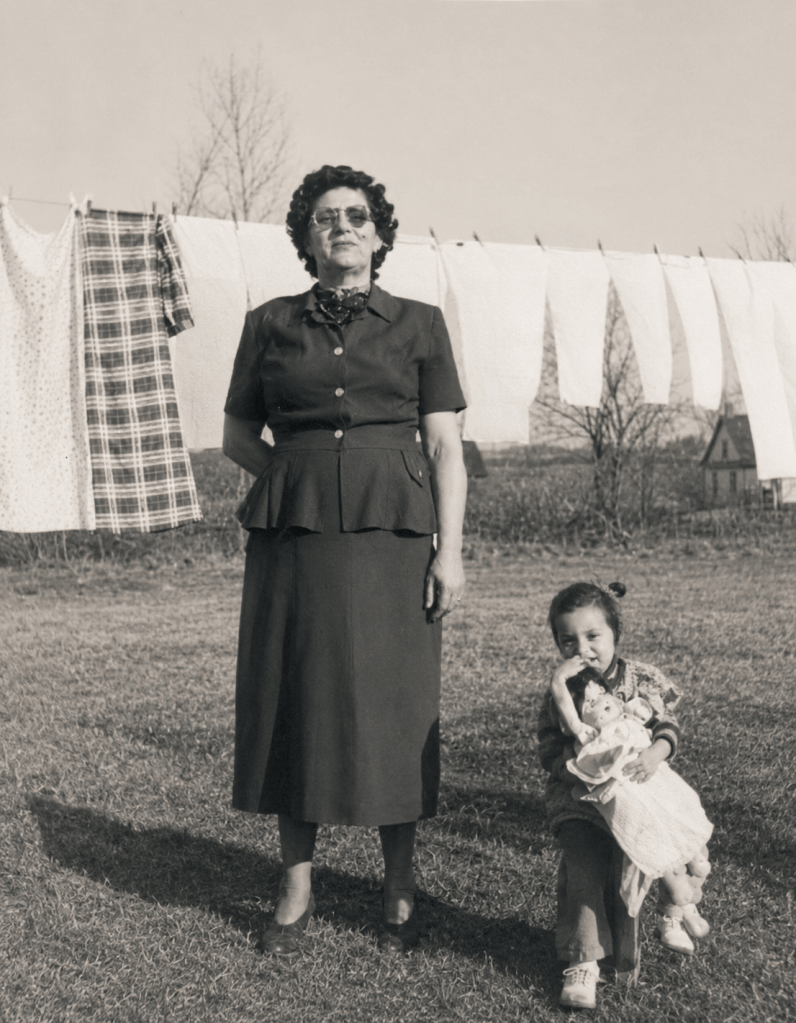
Edith and grandson Randall circa 1950
Source: copy in author’s possession from Don Phaneuf’s original with creases and blemishes improved by AI
By 1950, the sound of a new generation had already returned to the Phaneuf house on Mill Street. The census taker found a two-year-old grandson, Randall, living under Edith and George’s roof alongside his mother, Geraldine, and Edith’s youngest children.20 It was a household still doing what it had always done—absorbing whoever needed a bed, a meal, a place at the table—and Randy, too young to remember any of it later, spent his earliest years within the sounds of his grandmother’s kitchen.
1956 brought a loss that no parent expects to survive. Her daughter Lorena, thirty-three years old, died of a brain aneurysm.21 It was a foreshadowing of things to come.
Six years later, in September 1962, fire claimed the house itself.22 An oil stove exploded inside the Mill Street home where Edith and George had lived since the earliest years of their marriage—the home that had watched eleven children grow, filled on happier nights with music and dancing, and absorbed the sounds of family life: the churn of butter, the hiss of irons, the ping of canning jars, a newborn’s cry answered by an older sibling’s footsteps in the dark. That night the house found a different voice—the crack and groan of old timbers giving way, the hiss of water thrown against flames too late to save anything, and finally, beneath the shouts of neighbors and volunteer firemen, the particular silence that settles after a fire when nothing remains to save. Furniture and possessions gathered over four decades vanished in a single night. George and Edith responded as they always had in the face of hardship: they turned to family, moving in with Geraldine and her household until they could begin again. There was no drama in their response, only recognition—the same instinct, honed over a lifetime, that had once turned a garden’s harvest into a family’s security now turned grief into the ordinary work of enduring it. The house that had witnessed so many beginnings now survived only in memory.
As Edith entered her sixties, another chapter of loss began unfolding. The brothers and sisters who had once crowded the Meseck farmhouse on Bush Road—children who had shared chores, laughter, arguments, church services, and the countless ordinary moments that make a family—began disappearing one by one.
Mary Louise died in January 1963. Only weeks later, Edward followed. Sister Delia died in 1965, followed the same year by Henry. Theodore passed away the following year.23
Five siblings.
Barely three years.
For anyone, such losses would have been difficult.
For Edith, they marked the gradual disappearance of witnesses from her childhood. There were fewer people to recall the voices around their parents’ table, the games played as children, the work expected of every member of the family, or the stories told in French during long winter evenings. With each funeral another shared memory was buried, another link to the world of her youth quietly severed.
As Edith mourned the loss of siblings and in-laws, she found herself confronting her own physical decline. Years of labor that had carried her from Bush Road to Mill Street became increasingly difficult as health problems accumulated. Surgery to remove a goiter marked one turning point, but more troubling were the heart ailments that gradually limited the movement of a woman who had spent her life in motion. The world that had once stretched from fields and gardens to church and mill slowly contracted to the rooms of her own home, where she spent more time listening than doing.
By the final weeks of her life, the sprawling, sunlit garden of Edith’s youth had shrunk to the quiet confines of a kitchen, and the loud chatter of the Meseck house full of six children at Edith’s birth had given way to the distant updates of a radio broadcast. Yet, the instinct to sustain her family never faltered. The woman who had spent decades measuring her family’s security in jars of canned vegetables was now measuring it in samples of laundry soap, the safety of a grandson, and a chicken meant for her daughter’s supper.
When a sudden car accident shook the family, it was Edith—despite her own failing health—who orchestrated the response, sending George to check on the injured while she sat by the radio, absorbing the fragile nature of life. In her final letters to her daughter Geraldine, written in a shaky but determined hand, the full weight of Edith’s lifelong role as the family anchor comes into sharp, heartbreaking focus:
Dear Gerry,
how is Frank now: does he feel as sore as he did earlier. I was shock when Donnie came & told me this forenoon. Those darn Canadian did you listen to the news this noon. Four other Canadian car got in wreck and in one car both of them got kill and I think there is two other that got kill a man and a 21 year old women in one of the car that was kill. now you no when you leave home but you dont no if you will ever come back again. I hope papoose is not to bad either. Ross came over this noon and he said papoose is not to bad but I guess. when were young we dont notice that so much. I send your father to see Frank so I’ll no how he is to.
Love mom24
Even as her own body began to close in on her, Edith’s mind remained fixed on the practical, everyday needs of those she loved.
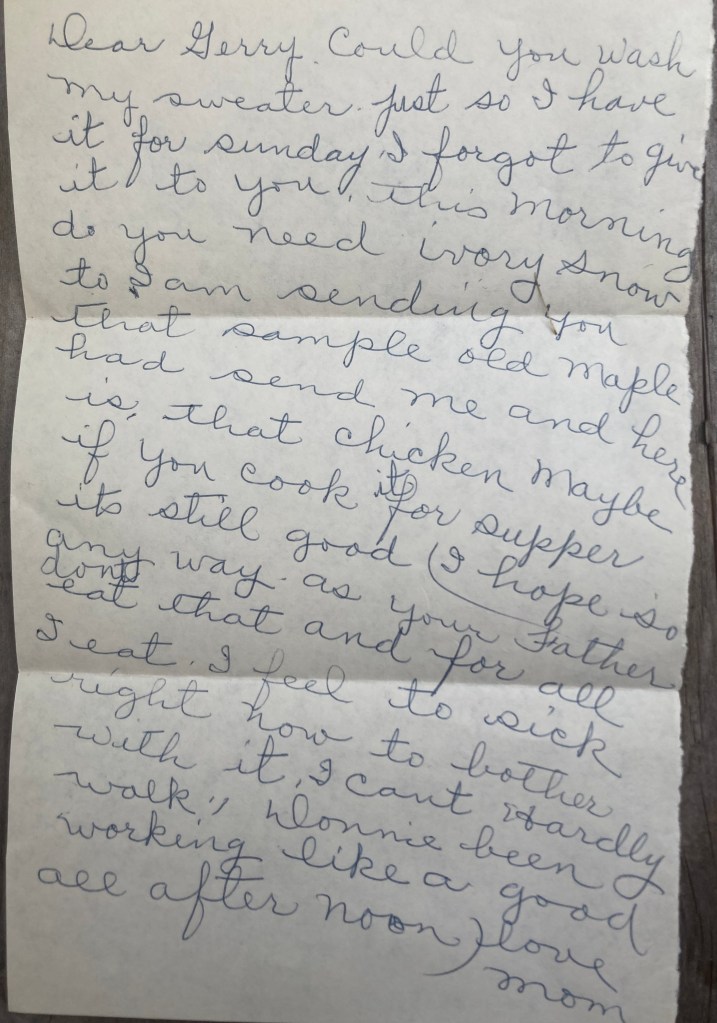
The final letter Edith sends to her daughter Geraldine
Source: copy in author’s possession from Don Phaneuf’s original
Her final written words to Geraldine read less like a goodbye and more like a continuation of the quiet, daily labor which had defined her entire life:
Dear Gerry,
Could you wash my sweater. just so I have it for Sunday. I forgot to give it to you this morning. do you need Ivory Snow. I am sending you that sample old Maple had. send me and here is that chicken maybe if you cook it for supper it’s still good (I hope so) any way as your Father dont eat that and for all I eat. I feel to sick right now to bother with it. I cant hardly walk. Donnie been working like a good all after noon.
Love mom25
There is a profound, quiet irony in Edith’s anxiety over these highway accidents. Neither she nor George had ever learned to drive; they had never owned an automobile. They had spent their lives navigating the world at a human pace—on foot, by the rhythms of the seasons, and within the tight geographic radius of the sawmill, the barn, and the garden. To Edith, the roaring modern world of highway speeds was a volatile, unpredictable place where life could be snuffed out in an instant. Her warning to Geraldine—“now you no when you leave home but you dont no if you will ever come back again”—was the honest prose of a matriarch who viewed the sudden acceleration of the mid-twentieth century with deep, protective caution.
But having looked out at a world moving terrifyingly fast, Edith’s perspective immediately shrank back to the confines of her own kitchen, where her own world was slowing to a final, permanent stop.
The woman who had spent decades on her feet—planting, weeding, hauling heavy baskets of wet laundry, and keeping a massive household afloat—was forced to make an admission that must have been harder to write than any warning about speeding cars: “I feel to sick right now to bother with it. I cant hardly walk.” For a lifetime, “bothering with it”—the chicken, the soap, the laundry, the welfare of her children—had been her entire purpose. In acknowledging she could no longer manage these quiet, daily acts of caretaking, she was signaling that the fierce, stubborn motion that had sustained her family for generations was finally spent. The boundary of her life had closed in.
Edith died just days later on Tuesday, November 14, 1967, at the age of sixty-seven. Three days later, her family gathered beneath the high, echoing rafters of St. Mary’s Church in Champlain for a solemn High Mass of Requiem. The air in the sanctuary was thick with the heavy, formal cadences of Latin prayers chanted by three reverends, while six local men—neighbors and friends—bore the weight of her casket out into the grey November afternoon.26 Absent was grandson Randy, the toddler who had once lived under Edith and George’s roof on Mill Street and grown up within the sound of his grandmother’s kitchen. Army basic training prevented his attendance — the larger outside world impacting Edith’s world one final time.
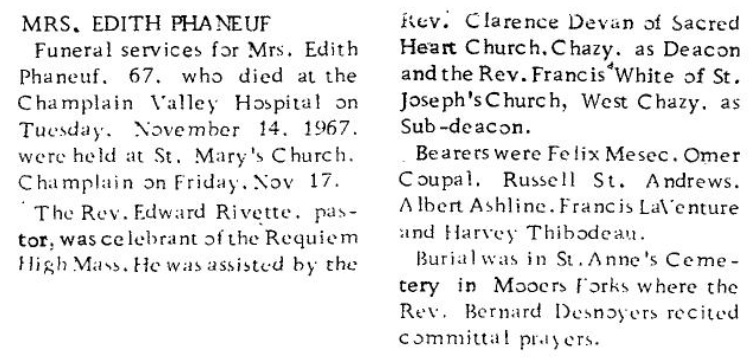
Edith’s funeral announcement from the local newspaper
Source: The North Countryman, November 23, 1967
The Mass was said within earshot of the new highway, its traffic moving at a pace and volume Edith had spent her final months regarding with open suspicion. Interstate 87 had been built to move people quickly between larger destinations — and in doing so, had passed Mooers Forks by. When the funeral procession turned west off the main road, it crossed back into the older, slower geography the highway had never touched: the same roads that had carried Edith from Bush Road to Perry’s Mills and back again for sixty-seven years.
Her final destination was St. Ann’s Cemetery, the quiet plot of earth resting just a few miles from the old Meseck family farm on the Bush Road.27 There, at St. Ann’s, the sound of the Northway could no longer be heard at all. Mooers Forks had been passed over by the modern world in the same year it received her—spared, whether by neglect or fortune, from the acceleration that had so unsettled her in her final letters. In its place emerged the older acoustics of the North Country landscape that had first welcomed her as a girl: the long, low sigh of a November breeze through the pines along Woods Falls Road—carrying with it the quiet, enduring peace of her childhood home. Those were the sounds that welcomed Edith home.
End notes
- Find A Grave, “Edith Meseck Phaneuf (1900–1967),” Memorial 32873762, Saint Ann’s Cemetery, Mooers Forks, Clinton County, New York, accessed July 15, 2026, https://www.findagrave.com/memorial/32873762/edith-phaneuf. There are many different spellings for both the Meseck and Phaneuf family names; I’ve adopted the ones that the family members chose to use on their gravestones. Additionally, this tale heavily benefitted from the memories and documents preserved by my cousin Don.
- 1900 US census, Clinton County, New York, population schedule, Mooers Township, Andrew Mesack household, dwelling 158 family 159, digital image, Ancestry (http://www.ancestry.com: accessed July 15, 2026); citing National Archives Microfilm Publication roll T623_31077_4114492, page 8B.
- 1910 US census, Clinton County, New York, population schedule, Mooers Township, Andrew Mesack household, dwelling 28 family 28, digital image, Ancestry (http://www.ancestry.com: accessed July 15, 2026); citing National Archives Microfilm Publication roll T624_932, page 3A.
- Ibid.
- 1905 New York state census, Clinton County, New York, population schedule, Mooers Township, Henry Mesick household, page 14, digital image, Ancestry (http://www.ancestry.com: accessed July 15, 2026). 1930 US census, Clinton County, New York, population schedule, Mooers Township, Archie Longtin household, dwelling 144 family 145, digital image, Ancestry (http://www.ancestry.com: accessed July 15, 2026); citing National Archives Microfilm Publication microfilm 2341151, page 7A. “New York State Marriage Index,” digital image, Ancestry (accessed July 15, 2026), entry for John Belrose and Delia Meseck, marriage January 20, 1907, Mooers Forks, New York; citing New York State Department of Health, Albany.
- 1910 US census, Clinton County, New York, population schedule, Mooers Township, Henry Mesack household, dwelling 29 family 29, digital image, Ancestry (http://www.ancestry.com: accessed July 15, 2026); citing National Archives Microfilm Publication roll T624_932, page 3A.
- “New York, County Marriages, 1847-1849; 1907-1936,” digital image, Ancestry (accessed July 15, 2026), entry for Edward Mesick and Hattie Phoenuff, marriage April 24, 1911, Champlain, New York, film number 000863409.
- 1940 US census, Clinton County, New York, population schedule, Champlain Township, George Pheneuf household, household 31, digital image, Ancestry (http://www.ancestry.com: accessed July 15, 2026); citing National Archives Microfilm Publication roll T627_2516, page 10B. 1915 New York state census, Clinton County, New York, population schedule, Mooers Township, Andrew Mesack household, page 4, digital image, Ancestry (http://www.ancestry.com: accessed July 15, 2026).
- “New York, County Marriages, 1847-1849; 1907-1936,” digital image, Ancestry (accessed July 15, 2026), entry for George Pheneuf and Edith Mesick, marriage September 1, 1919, Mooers Forks, New York, film number 000863409.
- 1920 US census, Clinton County, New York, population schedule, Champlain Township, Antoine Phaneuf household, dwelling 162 family 163, digital image, Ancestry (http://www.ancestry.com:accessed 2025); citing National Archives Microfilm Publication, Roll T625_1094, Page: 8A.
- 1925 New York state census, Clinton County, New York, population schedule, Champlain Township, George Pheneuf household, page 35, digital image, Ancestry (http://www.ancestry.com: accessed July 15, 2026).
- 1930 US census, Clinton County, New York, population schedule, Champlain Township, George Pheneuf household, dwelling 92 family 93, digital image, Ancestry (http://www.ancestry.com: accessed July 15, 2026); citing National Archives Microfilm Publication, Roll 1416, Page: 5A.
- 1940 US census, Clinton County, New York, population schedule, Champlain Township, George Pheneuf household, household 31, digital image, Ancestry (http://www.ancestry.com: accessed July 15, 2026); citing National Archives Microfilm Publication roll T627_2516, page 10B.
- 1930 US census, Clinton County, New York, population schedule, Champlain Township, Frank Mesick household, dwelling 96 family 97, digital image, Ancestry (http://www.ancestry.com: accessed July 15, 2026); citing National Archives Microfilm Publication, Roll 1416, Page: 5B.
- 1940 US census, Clinton County, New York, population schedule, Champlain Township, George Pheneuf household, household 31, digital image, Ancestry (http://www.ancestry.com: accessed July 15, 2026); citing National Archives Microfilm Publication roll T627_2516, page 10B. 1950 US census, Clinton County, New York, population schedule, Champlain Township, George Phenuf household, house 22 dwelling 169, Ancestry (http://www.ancestry.com: accessed July 15, 2026); citing National Archives Microfilm Publication, NAID 43290879, Sheet: 22.
- 1950 US census, El Paso County, Colorado, population schedule, Camp Carson, Floyd Phaneuf household, house 2954 dwelling 455, digital image, Ancestry (http://www.ancestry.com: accessed July 15, 2026); citing National Archives Microfilm Publication, NAID 43290879, Sheet: 50.
- “Andrew Messick, 87, Mooers Forks, Dies,” Plattsburgh Daily Press, October 22, 1941, 3, col. 5. While the article notes age 87, I have adopted the age in other historical records and from Andrew Mesick’s grave.
- U.S., World War II Army Enlistment Records, 1938–1946, database, Ancestry (accessed July 15, 2026), entry for Floyd G. Phaneuf, service no. 42121414, enlisted February 8, 1944, Albany, New York.
- Find A Grave, “Delia Baker Meseck (1867-1948),” Memorial 168875012, Saint Ann’s Cemetery, Mooers Forks, Clinton County, New York, accessed July 15, 2026, https://www.findagrave.com/memorial/168875012/delia-meseck.
- 1950 US census, Clinton County, New York, population schedule, Champlain Township, George Phenuf household, house 22 dwelling 169, digital image, Ancestry (http://www.ancestry.com: accessed July 15, 2026); citing National Archives Microfilm Publication, NAID 43290879, Sheet: 22.
- Find A Grave, “Lorena Guerin (1922–1956),” Memorial 32873721, Saint Joseph’s Cemetery, Coopersville, Clinton County, New York, accessed July 15, 2026, https://www.findagrave.com/memorial/32873721/lorena-guerin. “Reports of Deaths of American Citizens Abroad, 1835–1974,” digital image, Ancestry (accessed July 15, 2026), Lorena Phaneuf Guerin death report, February 24, 1956; National Archives and Records Administration, Record Group 59 (General Records of the Department of State), Entry 205, Box 971.
- “Fire Routs Family of 3,” Plattsburgh Press-Republican, September 4, 1962.
- Find A Grave, “Mary Louise Mesick Longtin (1888-1963),” Memorial 64282637, Saint Ann’s Cemetery, Mooers Forks, Clinton County, New York, accessed July 15, 2026, https://www.findagrave.com/memorial/64282637/mary-louise-longtin. Find A Grave, “Edward Meseck (1890-1963),” Memorial 63069377, Saint Ann’s Cemetery, Mooers Forks, Clinton County, New York, accessed July 15, 2026, https://www.findagrave.com/memorial/63069377/edward-meseck. Find A Grave, “Delia Meseck Belrose (1887-1965),” Memorial 168922400, Saint Ann’s Cemetery, Mooers Forks, Clinton County, New York, accessed July 15, 2026, https://www.findagrave.com/memorial/168922400/delia-belrose. Find A Grave, “Henry Andrew Meseck (1884-1965),” Memorial 168876564, Saint Ann’s Cemetery, Mooers Forks, Clinton County, New York, accessed July 15, 2026, https://www.findagrave.com/memorial/168876564/henry_andrew-meseck. “Leodore Messeck Dies; Leaves 90 Descendants,” The Springfield Union, May 31, 1966, 26, col. 4.
- Edith Phaneuf to Geraldine Parker, letter, November 1967, copy in the possession of the author.
- Ibid.
- “Mrs. Edith Phaneuf,” Press-Republican, November 18, 1967, 6, col. 4-5. “MRS. EDITH PHANEUF,” The North Countryman, November 23, 1967, 4, col. 3-4.


